
The final exam for investors is whether AI agents can make equity investments without seeing the future.
The ILE benchmark shows AI agents excel at evidence organization but lag in equity forecasting, revealing a research-to-decision gap.
Key Points
- The ILE benchmark evaluates whether AI agents can turn evidence into forward-looking equity forecasts using only information available at the decision moment.
- Current models such as Astra and DeepSeek V4.1 Flash are strong at organizing research and evidence, but significantly weaker at producing disciplined forecast and model judgments.
- ILE builds a versioned financial corpus and buy-side-style tasks with source-anchored rubrics and dependency graphs to make the evidence-to-assumption-to-forecast chain auditable.
- The benchmark addresses a key problem in financial AI evaluation: waiting too long for outcomes makes it hard to separate model skill from changing market conditions.
- The work suggests that reliable investment-stage AI forecasting requires strict information boundaries, reproducible calculations, and uncertainty handling, not just fluent analysis.
Meta description: Astra and DeepSeek V4.1 Flash reveal ILE financial forecasting gaps as models score 78.9 on evidence but only 52.5 on forecast and model work.
Tags: ILE, financial forecasting, LLM4Finance, Astra, DeepSeek V4.1 Flash
Featured image: abstract technology style timeline chart showing forecast evidence and model scores, no real people, no company logos, no text
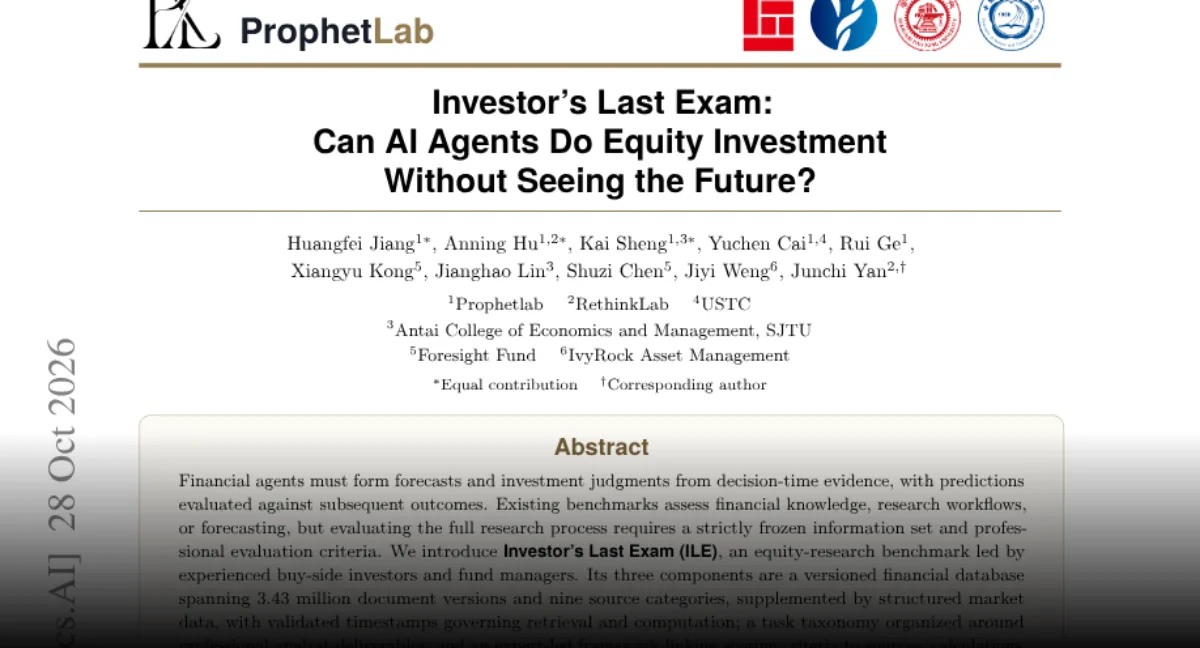
The ILE financial forecasting benchmark puts Astra and DeepSeek V4.1 Flash in a sharper light: state-of-the-art systems can gather and structure evidence well, but still struggle to convert that evidence into disciplined forward-looking judgments. The benchmark asks whether an agent can complete the full chain from evidence to assumptions to forecast using only information visible at the decision moment. Its results show why that question matters for finance-focused large language model systems, where evaluation often waits too long for outcomes to be meaningful.
Background: Forecast Evaluation Struggles With Time
Evaluating forecasting capability usually depends on waiting. Markets, fundamentals, and the information environment change while predictions mature. By the time outcomes arrive, months or even years later, scores may be influenced by conditions that were not present when the system made its call. That makes it difficult to attribute performance cleanly to the model rather than to the changing world.
The source also points to a broader gap in LLM4Finance work. Much of the field has focused on the research stage, where systems collect, organize, and summarize information. The investment stage is the field’s core objective, because that is where research must become a decision. This distinction frames the ILE benchmark: it is not only asking whether a model can explain the past, but whether it can reason forward under a realistic information cutoff.
Development: ILE Builds a Versioned Corpus and Task Set
To create a test that keeps the time boundary intact, the benchmark was built around a versioned corpus containing 3.43M document versions across 1.52TB of material and 9 source classes. The corpus enforces the cutoff across the entire toolchain. When a timestamp is specified, the system receives exactly the versions that were visible at that moment, reducing leakage from later disclosures or revisions.
The benchmark organizes 86 assignments around the deliverables expected of buy-side analysts. These tasks are evaluated with rubrics anchored to sources and reproducible calculations through financial dependency graphs. That structure is designed to make the chain from evidence to assumptions to forecast auditable. Instead of rewarding fluent narrative alone, it asks whether an agent can show where a conclusion comes from and how the calculation follows from the evidence.
Latest Findings: Evidence Organization Is Stronger Than Forecasting
Among current state-of-the-art systems, Astra scores 78.9 on Research & Evidence, a strong mark for assembling relevant information into coherent analysis. Its Forecast & Model score is much lower at 52.5. The gap is the benchmark’s central finding: today’s models are very good at organizing evidence of what has already happened, but not yet good at turning that analysis into judgment about what has not happened.
The realized-outcome comparison reinforces the same pattern. Ordering by realized outcomes places DeepSeek V4.1 Flash ahead at 40.3, compared with 37.7. The numbers are modest, but their meaning is clear: even when systems can retrieve and synthesize information, the step that converts analysis into a forecast remains difficult. The benchmark therefore separates two abilities that are often discussed together but tested poorly when evaluation waits for outcomes.
What It Means: A Shared Environment for Training and Evaluation
The longer-term significance is not only in the scores. Once the time boundary becomes a mechanism rather than an assumption, historical timestamps can function as a re-samplable environment. That allows large-scale domain reinforcement learning to be trained on the same structure used for evaluation. Evaluation and training can share one environment, making it easier to measure whether a model is learning forecast discipline or simply repeating patterns from its training data.
For readers following financial AI, the result suggests that model quality should be judged less by how polished an answer sounds and more by whether the system respects information boundaries, reproduces calculations, and handles uncertainty without hindsight. The ILE benchmark points to a more rigorous evaluation design for LLM4Finance, while Astra and DeepSeek V4.1 Flash show how much work remains before research-grade evidence assembly becomes reliable investment-stage forecasting.
Comments
No comments yet. Be the first to comment.