
GlyphAtlas separates stroke details from layout to synthesize scene text.
GlyphAtlas separates scene text layout from stroke references, improves small-text legibility, and releases code, weights, and 1.5 million images.
Key Takeaways
- GlyphAtlas is an open-source scene text synthesis model built on FLUX.1-Fill-dev, released with code, weights, and a 1.5 million image dataset.
- It addresses a key failure mode in synthetic scene text: when layout and stroke details share one low-resolution glyph image, small, dense, or complex scripts can lose legibility.
- The model separates layout anchoring from stroke rendering, using a scene-aligned glyph image for placement and a resolution-independent glyph atlas for crisp character strokes.
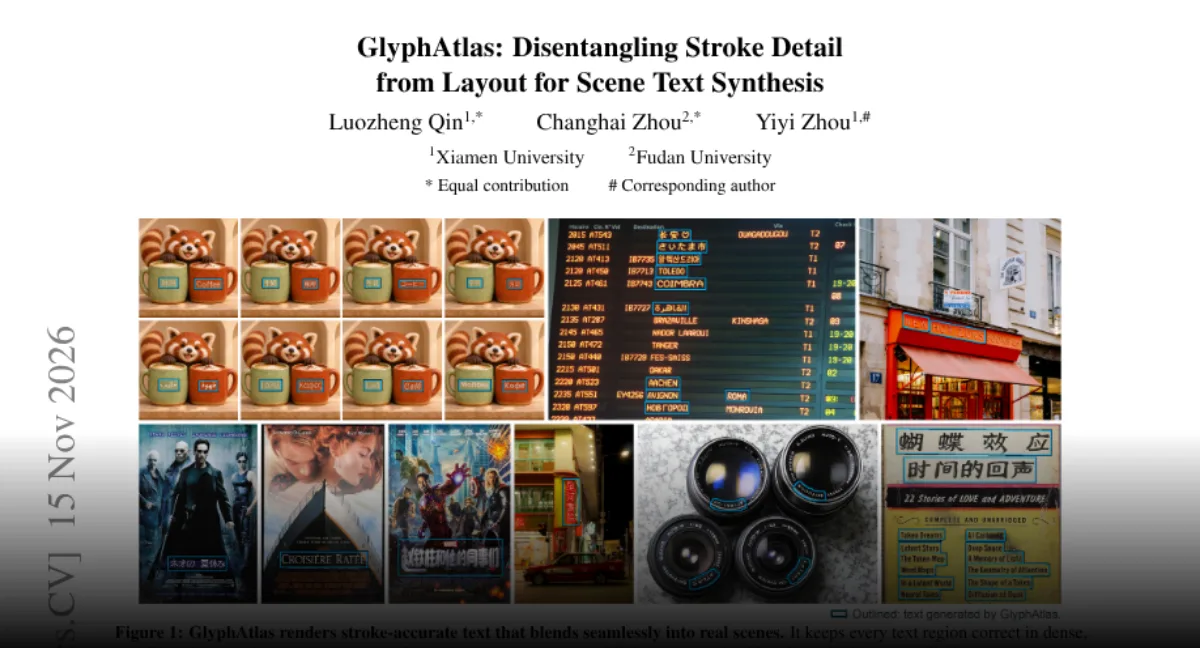
- GlyphAtlas-Bi is trained only on Chinese and English but generalizes zero-shot to Japanese, Korean, and Arabic, including difficult cases like curved storefronts, posters, and dense book covers.
Meta Description: GlyphAtlas, built on FLUX.1-Fill-dev, decouples scene text layout from stroke references and opens code, weights, and a 1.5 million image dataset.
Tags: GlyphAtlas, scene text synthesis, FLUX.1-Fill-dev, open source dataset, glyph atlas
Featured Image: abstract technology-style composition of translucent geometric glyph-like shapes and grid lines, no real people, no company logos, no text.
The GlyphAtlas scene text synthesis model was introduced as an open release built on FLUX.1-Fill-dev. It arrives with code, model weights, and GlyphAtlas-Data-1.5M, a 1.5 million scene text image dataset. The release targets a known failure point in synthetic scene text generation: when a single glyph image must carry both the text region layout and the exact stroke shapes, small or dense text can lose legibility.
Before GlyphAtlas: When Layout and Strokes Share One Resolution
Scene text synthesis has to place words in a scene while preserving the shape of each character. Standard approaches rely on a scene-aligned glyph image to specify both layout and character shape. That makes the glyph resolution tied to region size. When the target region is small, or when the text contains dense multi-line layouts and complex scripts, the stroke information is squeezed into a handful of pixels. The result can include missing strokes, merged strokes, or distorted strokes.
This creates a practical tension. A generator needs to know where text belongs in the scene, but it also needs a clean reference for how each stroke should look. If both are inferred from a low-resolution region, the model may get the position roughly right while damaging the character structure.
The GlyphAtlas Approach: Separate Anchoring From Stroke References
GlyphAtlas decouples where text goes from how strokes are drawn. A scene-aligned glyph image anchors layout, while a resolution-independent glyph atlas supplies crisp stroke references. The atlas is encoded directly via the backbone's native variational autoencoder without extra encoders. Atlas-anchored attention then binds each cell back to its target region. This supports accurate coarse-to-fine synthesis: the model first establishes the region-level placement, then uses stable stroke references to refine the rendered characters.
Zero-Shot Reach and the Open Dataset
Trained solely on Chinese and English, GlyphAtlas-Bi generalizes zero-shot to Japanese, Korean, and Arabic. The released description covers difficult visual settings, including curved storefronts, posters, and dense book covers. This matters for readers because multilingual scene text often combines scripts with different stroke density and layout constraints.
Alongside code and weights, the project releases GlyphAtlas-Data-1.5M, described as 1.5 million scene text images. The dataset and model are available through the listed project page, Hugging Face checkpoint, Hugging Face dataset repository, and GitHub code repository.
Project page: https://fr0zencrane.github.io/project-glyphatlas/
Model checkpoint: https://huggingface.co/Fr0zencr4nE/GlyphAtlas
Dataset: https://huggingface.co/datasets/Fr0zencr4nE/GlyphAtlas-Data-1.5M
Code: https://github.com/Fr0zenCrane/GlyphAtlas
Current Stage: An Open Starting Point for Testing
The current stage is a fully open-sourced release of GlyphAtlas, its code, weights, and the 1.5M dataset. What to watch next is how the released assets are used to evaluate small text, dense multi-line text, and complex scripts across Japanese, Korean, and Arabic in addition to Chinese and English.
Comments
No comments yet. Be the first to comment.