
MIRIX-2.0 is a multi-agent memory system.
MIRIX-2.0 combines factual and procedural memory with AutoDream, a provenance hypergraph, offline merging, and no fine-tuning for agent systems.
Key Takeaways
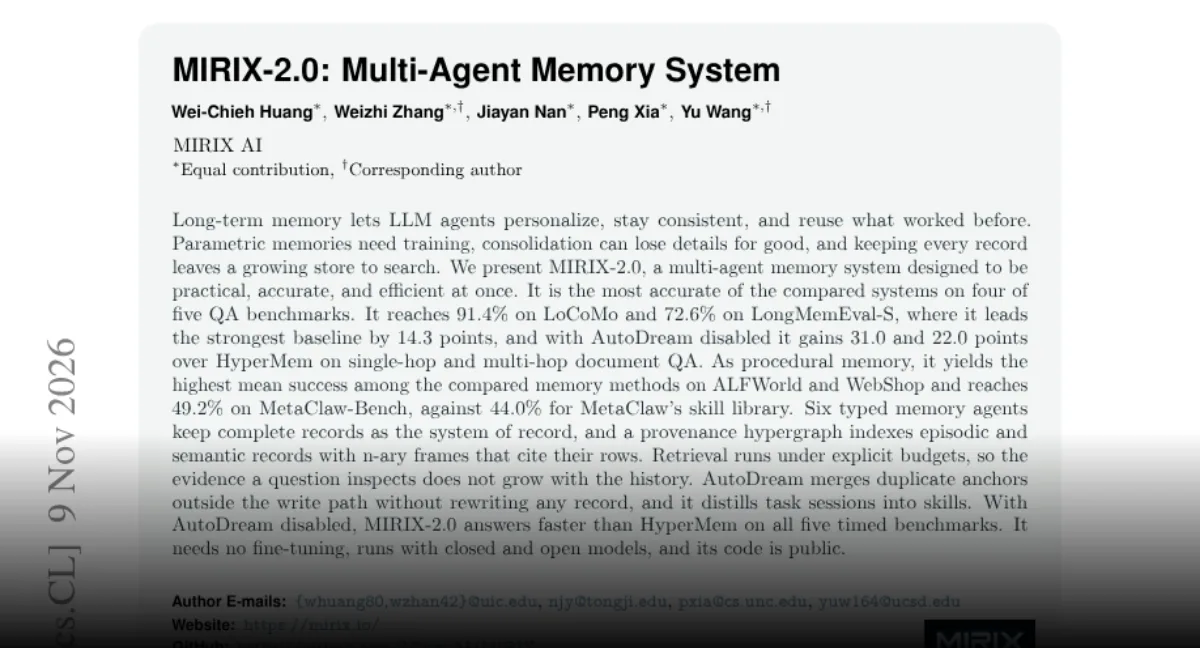
- MIRIX-2.0 introduces a single multi-agent memory layer that handles both user factual memory and agent procedural memory.
- AutoDream improves memory offline by merging duplicates and distilling skills without adding work to the write path or requiring fine-tuning.
- A provenance hypergraph links answers back to raw records, keeping the system of record traceable.
- Reported factual-memory benchmarks include 91.4 on LoCoMo and 72.6 on LongMemEval-S, with a +14.3 gain over the strongest baseline.
- Procedural-memory results show gains such as ALFWorld improving to 76.4% from 69.4%, while WebShop, MetaClaw-Bench, and file-completion scores also improve.
MIRIX-2.0 arrives as a single memory layer for user factual memory and agent procedural memory. The release ties complete records to a system of record, uses a provenance hypergraph to cite answers back to raw rows, and relies on AutoDream to merge duplicates and distill skills offline, outside the write path. It is presented as a no fine-tuning approach.
Background: One system for two memory jobs
The launch frames the memory problem as two related jobs. For users, the system stores factual information as complete records. For agents, it turns experience into procedural memory through distilled skills. The provenance hypergraph is meant to keep answers traceable to raw rows, while AutoDream operates offline instead of adding work to the write path.
Development: AutoDream reshapes the memory pipeline
AutoDream is the central mechanism in the MIRIX-2.0 description. It merges duplicate records and distills skills outside the write path, with no fine-tuning. This places memory improvement in an offline lane: records remain the system of record, and answers can be cited back through the provenance hypergraph.
Latest progress: Reported benchmark numbers
For user factual memory, AutoDream is listed at 91.4 on LoCoMo and 72.6 on LongMemEval-S, with a +14.3 gain over the strongest baseline. AutoDream alone adds +3.0 on LoCoMo without rewriting a single stored record.
For agent procedural memory, AutoDream skills lift ALFWorld to 76.4% from 69.4% without memory. On WebShop, they are best among memory methods with the fewest tokens. On MetaClaw-Bench, the listed score is 49.2% versus 44.0%. File completion reaches 27.7% versus 17.1%.
What to watch next
The current stage is MIRIX-2.0’s release pitch: one memory system, one offline AutoDream process, and one provenance structure linking answers back to raw rows. The practical signal to watch is whether the listed factual and procedural gains hold when complete records, duplicate merging, and skill distillation are used outside the write path.
Meta description: MIRIX-2.0 combines factual and procedural memory with AutoDream, provenance hypergraph, no fine-tuning, and benchmark results across LoCoMo and LongMemEval-S.
Tags: MIRIX-2.0, AutoDream, AI memory, procedural memory, factual memory
Featured image: abstract knowledge graph of linked memory nodes and skill pathways, no real people, no company logos, no text.
Comments
No comments yet. Be the first to comment.