
VidDub introduces replacement-aware distillation for two-step video dubbing.
VidDub distills video dubbing into two steps, using replacement-aware supervision to improve lip sync while preserving identity and quality.
Key Takeaways
- VidDub is a full-context diffusion editor for video dubbing that reduces the editing process to 2 denoising steps while preserving speaker identity, head pose, and background.
- It addresses the supervision conflict created by replacement speech by masking source-mouth reconstruction losses and using audio-visual synchronization to supervise lip movements.
- The model trains a replacement-aware teacher first, then distills it into a two-step student using trajectory matching and distribution matching to recover visual quality.
- VidDub improves cross-audio lip-sync accuracy by 0.833 Sync-C and plans to release VidDub-Bench, evaluation manifests, preprocessing outputs, and unified code for consistent benchmarking.
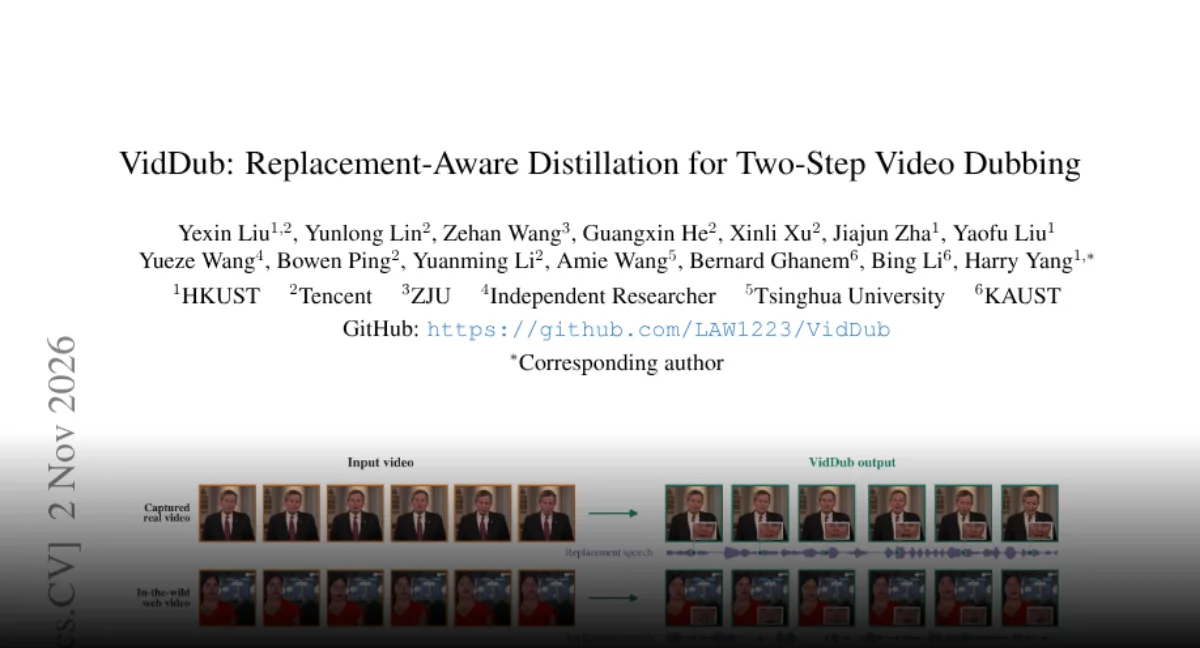
VidDub is a full-context diffusion editor for video dubbing that compresses the editing process into 2 denoising steps while addressing a supervision conflict created by replacement speech. The change matters because dubbing must match target speech to lip movements while preserving speaker identity, head pose, and background. In this setting, the source video provides the visual anchor, and the replacement speech provides the new timing for the mouth. VidDub moves away from a training habit based on original paired audio and toward a method that treats the source mouth as a possible conflicting target.
Background: Self-Reconstruction Can Teach the Wrong Target
Existing video dubbing editors are predominantly trained through self-reconstruction under original paired audio. That approach works when the original mouth movements match the original speech. In dubbing, however, the driving speech may be replaced. When that happens, the source mouth becomes a conflicting target, and a model that keeps reconstructing it may learn visual patterns that no longer correspond to the new audio.
Development: Replacement-Aware Cross-Audio Supervision
The method introduces replacement-aware cross-audio supervision. The supervision is replacement-aware because it changes according to whether the audio is original paired audio or replacement audio. For paired-audio samples, it still uses full-frame reconstruction because the original audio and original mouth remain aligned. For unpaired replacement-audio samples, it masks out source-mouth reconstruction losses and supervises the mouth only through audio-visual synchronization. The unmasked facial regions and background are preserved, so the model does not have to reproduce a mouth shape that belongs to the old speech rather than the replacement speech.
This design also fits offline dubbing, where the complete source video and target speech are available beforehand. Because the model can see the full context, VidDub is presented as a full-context diffusion editor distilled into 2 denoising steps, corresponding to 2 neural function evaluations.
Latest Progress: Teacher, Student, and Distillation
The replacement-aware teacher first learns accurate lip synchronization without regressing toward conflicting source mouth movements. Matched trajectory regression then transfers the teacher's classifier-free guidance trajectories to a two-step student. After the compression, distribution matching distillation recovers visual quality. The teacher's guided trajectory serves as the reference that the compressed student tries to follow, while the distillation step addresses quality loss introduced by using only 2 steps.
The reported supervision effect is specific: across three training seeds, masking out conflicting source-mouth reconstruction improves cross-audio Sync-C by 0.833. The final two-step model combines strong lip synchronization with superior visual quality, identity preservation, and visual speech recognition across four benchmarks.
Current Stage: A Model and Evaluation Release Plan
VidDub is currently presented as a full-context diffusion editor and evaluation release. The planned release includes the curated training dataset, VidDub-Bench, fixed paired- and cross-audio evaluation manifests, preprocessing outputs, and unified evaluation code. The release plan matters because cross-audio evaluation requires fixed manifests: paired and replacement audio must be handled differently, and preprocessing outputs and unified code can reduce ambiguity when comparing Sync-C, visual quality, identity preservation, and visual speech recognition. The next thing to watch is whether the combination of replacement-aware supervision and 2 denoising steps makes video dubbing easier to evaluate consistently across paired audio, cross audio, visual quality, identity preservation, and visual speech recognition.
Comments
No comments yet. Be the first to comment.