
Video face swapping advances from short clips to real-time streams using identity-aware supervision and context-efficient generation.
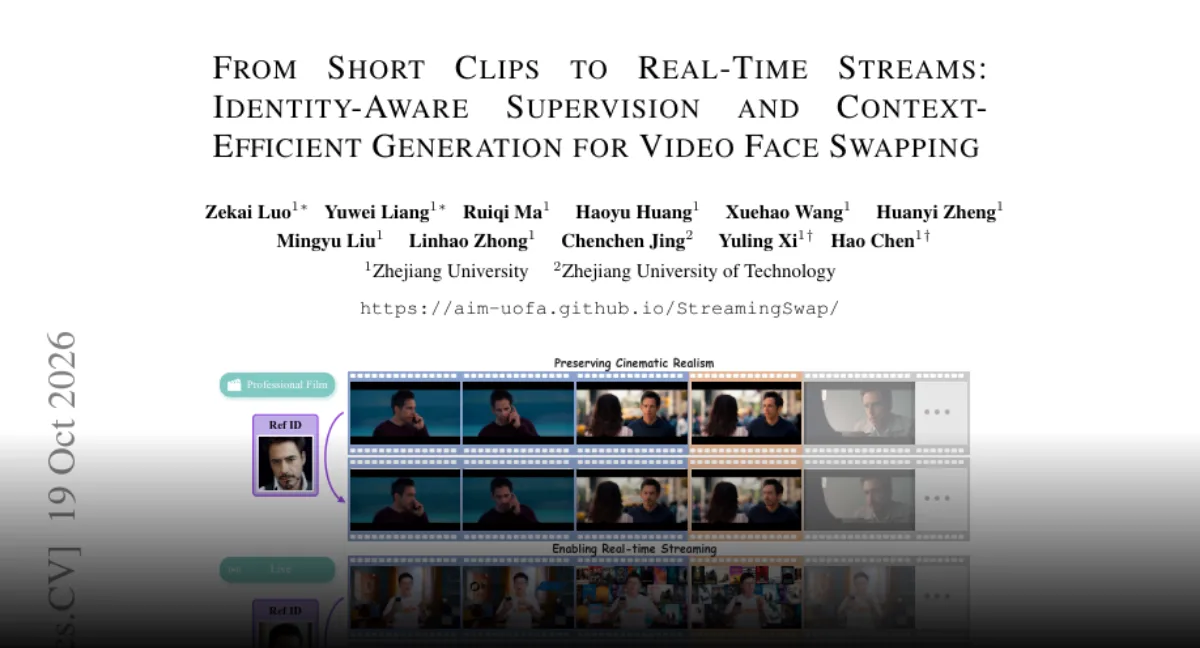
StreamingSwap enables real-time video face swapping via identity supervision and efficient context, preserving target attributes and motion.
Key Takeaways
- StreamingSwap enables real-time video face swapping with stable identity and motion consistency.
- It uses Joint Rec-ID Loss for identity-aware supervision across different noise levels.
- Face-RoI Generation and Short-Context Rollout Training reduce spatial and temporal context requirements.
- The method is trained on HumanFaceVid, a 1,000-hour cinematic dataset, and evaluated on short and long videos.
- The current model achieves 21.174 FPS on an NVIDIA RTX 4090 and supports videos up to 10 minutes long.
StreamingSwap is a reference-guided face swapping method for real-time video streams, with the stated goal of preserving target attributes and motion. The project page and code are published at https://aim-uofa.github.io/StreamingSwap/ and https://github.com/aim-uofa/StreamingSwap.
Background: Streaming Needs Identity and Motion
Face swapping in live video must keep identity stable while following the movement of the target across frames. The release therefore focuses on streaming conditions, where attribute preservation and motion consistency are part of the generation task.
Development: Supervision, Context, and Data
The method uses identity-aware supervision through Joint Rec-ID Loss, which combines identity and reconstruction objectives according to the noise level. It also uses Face-RoI Generation and Short-Context Rollout Training to reduce the spatial and temporal context needed for streaming. For training and evaluation, the release points to HumanFaceVid: 1,000 hours of cinematic training data, with evaluation sets of 200 short and 200 long videos.
Latest: Real-Time Speed and Long Videos
The final streaming model reaches 21.174 FPS (frames per second) on one NVIDIA RTX 4090 and supports videos up to 10 minutes long. The current stage is a public research release with available project materials and reported performance figures.
Comments
No comments yet. Be the first to comment.