
Meta Launches Muse Ember, a New Lightweight Model for Executing Agent Tasks
Meta Muse Ember is a low-cost multimodal AI model for agent tasks at 10 cents per million input tokens, paired with Muse Wonder for workflows.
Key Takeaways
- Meta Superintelligence Lab released Muse Ember, a lightweight, low-cost AI model priced at 10 cents per million input tokens and designed for agent workflows.
- Ember targets repetitive, high-volume tasks such as tool calls, coding subtasks, routing, extraction, and long-document parsing.
- It supports text, images, and audio, allowing agents to process screenshots, charts, scanned documents, voice memos, recordings, and video without separate models.
- Ember is designed to pair with larger models like Muse Wonder, where the larger model plans and sets rules while Ember executes at scale.
- It is the fourth model in Meta’s Muse line, following Spark, Glimmer, and Wonder, expanding Meta’s stack for cost-efficient AI agents.
Meta Releases Muse Ember AI Model at 10 Cents Per Million Tokens
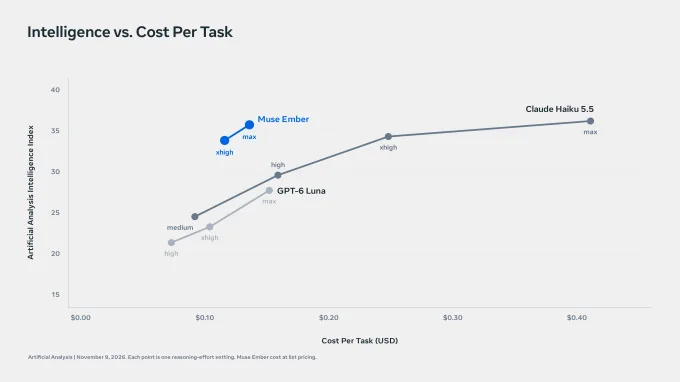
Meta description: Meta releases Muse Ember on Monday, a low-cost AI model at 10 cents per million input tokens, designed for agent tasks and paired with Muse Wonder.
Tags: Muse Ember, Meta Superintelligence Lab, AI agents, cost per token, multimodal model
Featured image: Abstract glowing neural network threads forming a lightweight AI core, no people, no logos, no text
Background: Meta's Muse line moves toward lightweight agent work
Meta Superintelligence Lab released Muse Ember on Monday, presenting it as the lab's lightest and most cost-efficient AI model yet. The model is intended for complex reasoning execution and the repetitive work agents perform all day, including tool calls, coding subtasks, routing, extraction, and long document parsing. That framing places Ember less as a standalone answer engine and more as a component inside agent workflows that run many operations.
Development: pricing, benchmark comparison, and multimodal range
The release emphasized cost per task. Meta used Artificial Analysis's composite benchmark score to compare Ember with competing models, including Anthropic's Haiku and OpenAI's Luna. At 10 cents per million input tokens, Ember is significantly cheaper than those frontier competitors in Meta's comparison. The company also positioned Ember as cost-competitive with open-source alternatives such as DeepSeek V4.1 Flash and GLM 5.3 Flash. The implication for agents is that high-volume operations may not always need the most expensive model available.
Meta also trained Ember to work across text, images, and audio. This makes the model flexible when inputs are not clean text prompts. Agents can handle screenshots, charts, scanned documents, voice memos, meeting recordings, and video without a separate model for each media type.
Latest progress: pairing with Muse Wonder and expanding the Muse line
Ember is designed to pair with a larger model, such as Meta's Muse Wonder, inside an agentic harness. Meta gave the example of a customer-support agent: a heavier model could establish rules for how to handle a particular issue, then a lighter-weight model could apply those rules across tens of thousands of cases. In that arrangement, Wonder carries the planning burden, and Ember carries the volume.
The model is the fourth under Meta's Muse brand. It follows the mid-weight Spark, released in April, and Spark's open-source twin, Glimmer, released in August. The Wonder frontier model arrived in October. Meta also released the flagship consumer AI product, Muse Agent, in September to unexpected success. Spaces and video chat were rolled out earlier this month, giving Ember a place inside an already expanding product line.
What to watch next
The next signal is how Meta deploys Ember alongside Muse Wonder in real agent systems, especially in customer-support and other high-volume workflows. The pricing point and multimodal training suggest the lab is testing whether a smaller, cheaper model can take over repeated steps after a larger model defines the plan.
Comments
No comments yet. Be the first to comment.