
Sketchpad Provides Certified Exact Arithmetic Using a Small Vision-Language Model
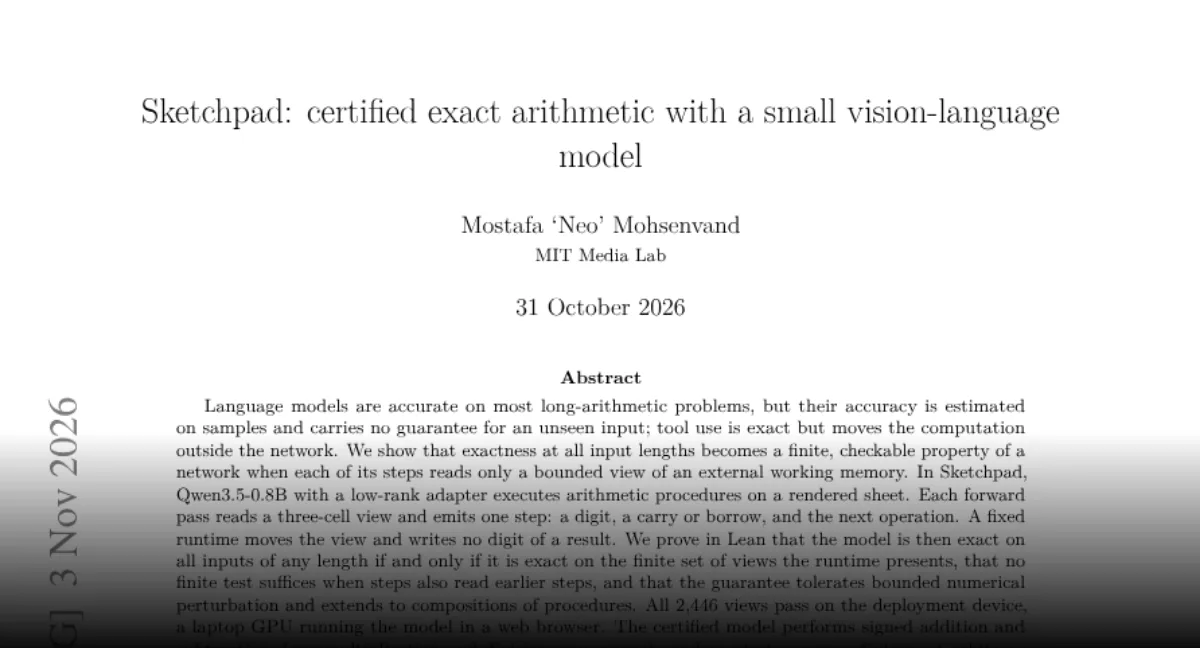
Sketchpad adapter certifies Qwen3.5-0.8B exact arithmetic for all lengths via 2,446 bounded views, beating larger models on arithmetic benchmarks.
Key Takeaways
- Sketchpad adds a small adapter to Qwen3.5-0.8B and is certified by a Lean proof to perform `+ − × ÷ √ gcd` exactly for inputs of any length.
- The certification uses bounded views of external memory, turning an infinite-family exactness problem into finite verification over 2,446 views.
- The framework establishes necessity, robustness to bounded numerical error, and composition, allowing verified arithmetic routines to be combined into larger verified procedures.
- Empirically, Sketchpad scores 220/220 on 220 pre-registered problems and 20/20 on 1,000-digit sums, outperforming compared frontier and open-weight models.
- The main contribution is not just benchmark performance, but making exact arithmetic across all input lengths a checkable formal property for a small language model.
Meta Description: A Sketchpad adapter on Qwen3.5-0.8B passes 2,446 views and is certified for exact arithmetic on inputs of any length, according to a Lean proof.
Tags: formal arithmetic certification, small language models, Lean proof, Qwen3.5, Sketchpad

A formal arithmetic certification claim now gives small models a different kind of test: not only whether they answer many problems correctly, but whether a bounded procedure can be proved exact for every input length. The case centers on Qwen3.5-0.8B with a small adapter, called Sketchpad, which passes all 2,446 views and is reported as certified for + − × ÷ √ gcd at any length.
The Question Behind the Certification
The underlying question is whether a small model can be proven exact at arithmetic on inputs of every length, rather than merely benchmarked on a sample. The theory frames the problem around bounded views of external memory: if each step reads only a bounded view of an external memory, exactness at all lengths reduces to exactness on a finite set of views. This turns an infinite-family question into a finite verification task under a specific model of access.
From Infinite Inputs to a Finite Set of Views
The development adds three conditions. First, necessity: once steps can also read earlier steps, no finite test suffices, so the bounded-view restriction is not cosmetic. Second, robustness: the guarantee survives bounded numerical error. Third, composition: certified procedures stay certified when combined, allowing verified arithmetic routines to be assembled into larger verified procedures.
The Practice: A Laptop GPU, a Browser, and 2,446 Views
In practice, the result is attached to Qwen3.5-0.8B plus a small adapter. The reported system passes all 2,446 views on a laptop GPU, in the browser, and is certified for + − × ÷ √ gcd at any length. The operation set includes addition, subtraction, multiplication, division, square root, and gcd (greatest common divisor). A live demo and code are also referenced.
Benchmark Results Across Small and Frontier Models
On 220 pre-registered problems, Sketchpad (0.8B) scores 220. The frontier comparisons are GPT-6.1 Sol at 217, Claude Opus 5.5 at 216, and Gemini 4 Argon at 207. Five open-weight models score 149–199. Qwen3.5-27B scores 121, while Qwen3.5-0.8B base scores 23.
On 1,000-digit sums, Sketchpad scores 20/20. The frontier models score 19, 17, and 9. Every open-weight model scores ≤ 2.
This stage shows a split between empirical model size and formal coverage. The Qwen3.5-0.8B base model performs poorly at 23 on the 220-problem set, but with the adapter it reaches a perfect score and a finite-view certificate. The larger Qwen3.5-27B still scores 121, while the certified small system scores 220. The contribution is not simply a benchmark win; it is an attempt to make exactness at every length a checkable property by restricting how model steps access memory.
Comments
No comments yet. Be the first to comment.