
Micius-Flash offers lightweight agentic intelligence for engineering.
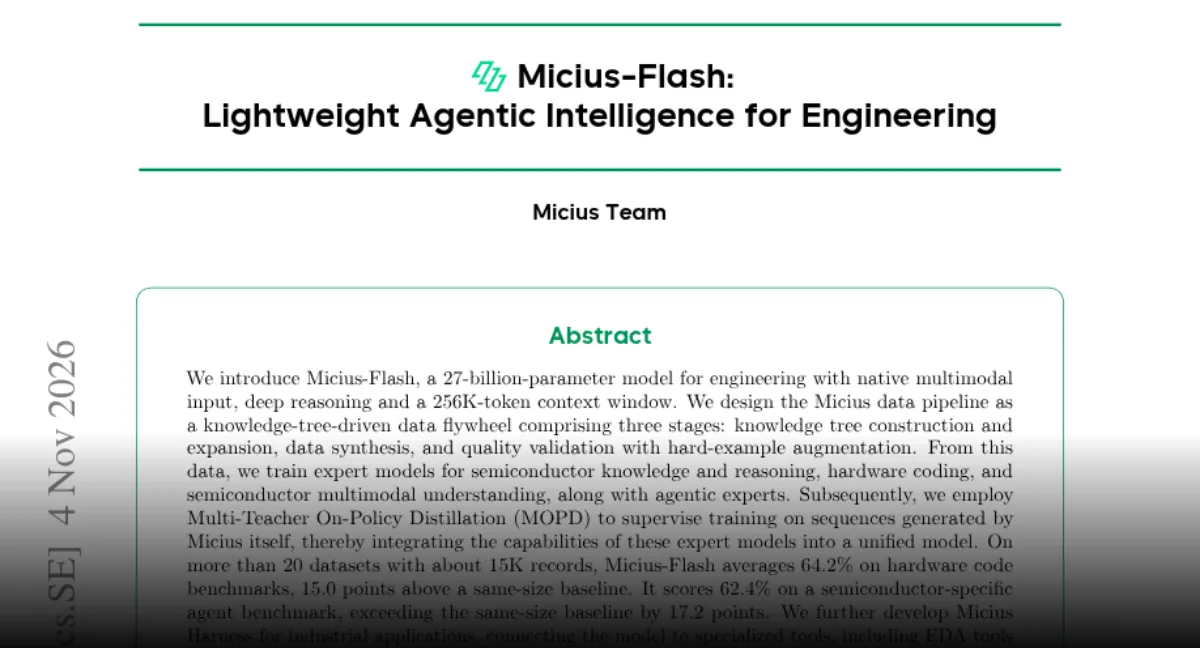
Micius-Flash is an open-source 27B-parameter multimodal AI model for semiconductor engineering and scientific applications. It combines semiconductor knowledge, hardware coding, multimodal understanding, and agentic capabilities. The release includes Micius Harness for tool-augmented workflows with electronic design automation tools, KiCad, and execution environments, supporting PCB design, chip design automation, and software development. Benchmark results report 64.2% average accuracy on hardware coding and 62.4% on a semiconductor-specific agent benchmark, with gains over same-size baselines.
Key Points
- Micius-Flash is an open-source 27-billion-parameter multimodal AI model designed specifically for semiconductor engineering and scientific applications.
- It combines semiconductor knowledge, hardware coding, multimodal understanding, and agentic capabilities using a knowledge-tree data pipeline, expert models, and multi-teacher on-policy distillation.
- The model reports strong benchmark performance, including 64.2% accuracy on hardware coding and 62.4% on a semiconductor-specific agent benchmark, with large gains over same-size baselines.
- The released Micius Harness supports tool-augmented engineering workflows, enabling practical applications in electronic design automation, KiCad, PCB design, chip design automation, and software development.
Micius-Flash is an open-source 27 billion parameter multimodal model designed for semiconductor engineering and scientific applications. It unifies semiconductor knowledge, hardware coding, multimodal understanding, and agentic capabilities, and is released with Micius Harness for tool-augmented engineering workflows.
Background: The Domain Focus Comes First
The project begins with a clear target: semiconductor engineering and scientific applications. Instead of presenting a broad assistant, Micius-Flash is framed around tasks that need technical knowledge, hardware code, and agent-style execution. This focus explains the benchmark areas and the case studies reported in the release.
Development: Data Pipeline, Expert Models, and Distillation
Micius combines a knowledge-tree-driven data pipeline, specialized expert models, and Multi-Teacher On-Policy Distillation. The pipeline organizes technical training material, the expert models support specialized tasks, and the distillation step is described as a way to unify semiconductor knowledge, hardware coding, multimodal understanding, and agentic capabilities.
The result is a single model aimed at more than question answering. It is intended to connect understanding with executable engineering behavior, which is why the release includes a harness and tool workflows.
Evaluation: Reported Accuracy and Gaps Over Baselines
The benchmark results are the main quantitative markers. Micius-Flash reports 64.2% average accuracy on hardware coding benchmarks and 62.4% on a semiconductor-specific agent benchmark. Compared with same-size baselines, the reported advantages are 15.0 percentage points on hardware coding and 17.2 percentage points on the semiconductor-specific agent benchmark.
These numbers place the model’s value in two specific areas: writing and handling hardware-related code, and operating as an agent within semiconductor engineering tasks.
Latest Progress: Harness, Case Studies, and Open Release
Micius Harness is introduced to enable tool-augmented workflows with electronic design automation tools, KiCad, and execution environments. The case studies show practical capabilities in printed circuit board design, chip design automation, and software development.
The release is open-source, and its stated aim is to advance open-source AI agents for science and engineering.
Current Stage: Open Source, Specialized, and Tool-Connected
The current stage is the release of Micius-Flash and Micius Harness, supported by benchmark results and case studies. The model is positioned as a specialized open-source AI system for semiconductor engineering and scientific applications, with tool connectivity as a central part of its design.
Meta description: Micius-Flash is an open-source 27 billion parameter multimodal model for semiconductor engineering, hardware coding, circuit design, and chip design automation.
Tags: Micius-Flash, semiconductor AI, open-source model, hardware coding, electronic design automation
Featured image: abstract technology style circuit board and schematic, no real people, no company logos, no text
Comments
No comments yet. Be the first to comment.