
Nvidia's GR00T 2 model learns to imagine itself as the robot after watching humans in videos
Nvidia GR00T 2 is a world-action model that predicts future video from human footage, reduces teleoperation, and improves robot task success rates.
Key Takeaways
- Nvidia GR00T 2 shifts from a vision-language-action model to a world-action model that predicts future video and robot movements, helping transfer skills across different robot bodies.
- Training uses about 400,000 hours of human head-mounted video plus limited robot-specific demonstrations, reducing the need for heavy teleoperation.
- Lab tests show improved learning efficiency, with small amounts of conventional training raising success rates from 40% to 95% on selected tasks.
- Paired with a higher-level language model such as GPT-6 Astra, the system can plan complex assembly tasks, reaching at least 97% success in one toy-model test.
- Real-world use still faces limits, including missing touch sensing, slow planning delays, and inconsistent success on harder tasks like liquid wiping.
Meta Description: Nvidia GR00T 2 becomes a world-action model that predicts future video, reduces teleoperation, and lifts success rates with GPT-6 Astra support.
Tags: Nvidia GR00T 2, World-Action Model, Robot Learning, GPT-6 Astra, Jetson Thor
Featured Image: Abstract rendering of a robotic hand, predicted video frames, and control signals on a dark grid, no people, no logos, no text.
Background: From Direct Motor Commands To A World-Action Model
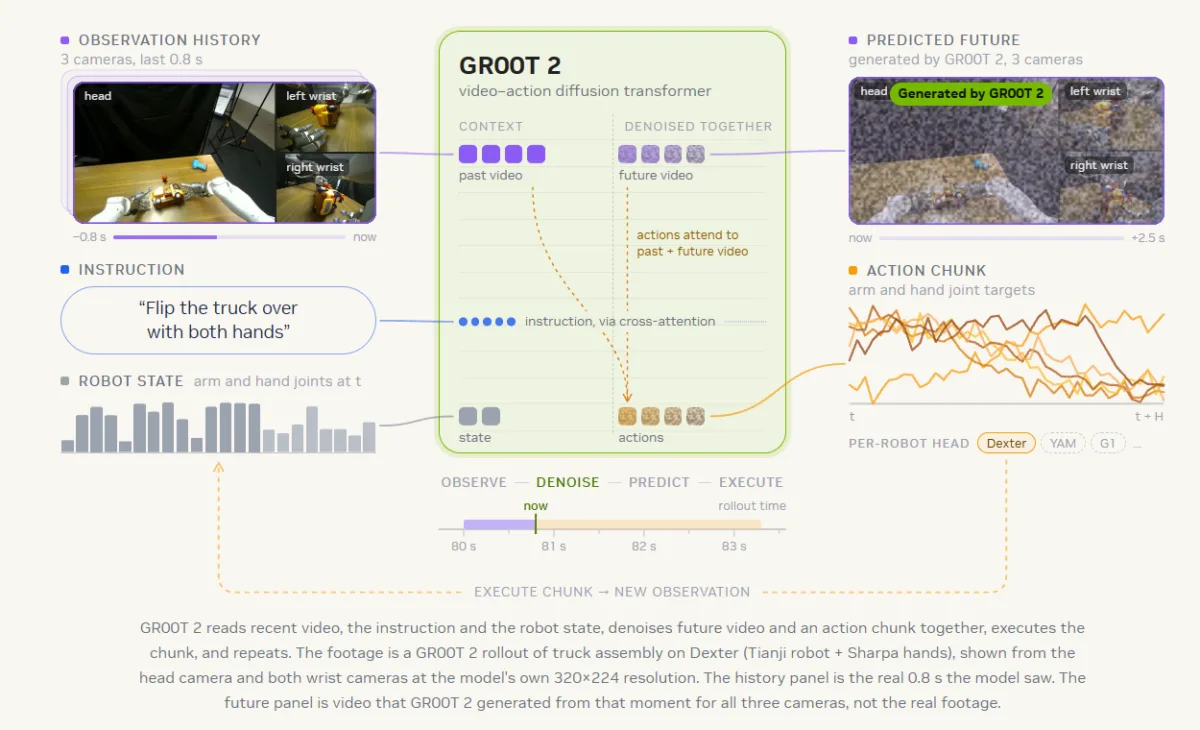
Nvidia GR00T 2 is a world-action model for robot control. Its key change from earlier systems is the output it predicts. Previous approaches, including Nvidia's predecessor GR00T 1, were vision-language-action models that mapped camera images and language commands directly into motor movements. GR00T 2 instead calculates the next movement and a short video of the immediate future. Nvidia says the system can predict how the camera image should change when a robotic arm picks up an object.
Nvidia's supplied image caption describes GR00T 2 as no longer a vision-language-action model but a world-action model that predicts future visual observations via diffusion, a generative prediction method. Nvidia says this video prediction should let the model transfer movement sequences between different robot form factors.
Development: Human Video And Robot Motion Data Replaced Heavy Teleoperation
Training used a cluster with more than 1,000 GB300 chips and about 400,000 hours of video footage showing people performing various tasks while wearing head-mounted cameras. That footage gives broad human motion context, while robot-specific training connects those demonstrations to a target robot.
For a new task, researchers say a person can demonstrate steps using data gloves, specialized hand grippers, or a finger exoskeleton. During training, those recordings are combined with general motion data from the target robot. The model then generates the robotic arm instead of the human arm in its predicted video and derives matching control commands.
Lab tests showed a robot with five-fingered hands could light a match, slice a banana, or toss packages onto a conveyor belt without being teleoperated for those specific tasks. Success rates varied from 10 to 80 percent depending on the task. The system also learned to hammer nails from a single video of a human hand movement, using a computer simulation.
For 50 selected tasks where the model already performed well after only a few examples, less than three minutes of conventional training raised the success rate from 40 to 95 percent. This suggests future-video prediction can reduce robot-specific fine-tuning once the base model has learned broad task structure.
Latest Progress: GPT-6 Astra Adds Planning, Turbo Adds Onboard Simplicity
For longer assembly work, Nvidia pairs GR00T 2 with a higher-level AI language model, such as OpenAI's GPT-6 Astra. GR00T 2 handles gripping movements, while the language model breaks the task into steps, color-codes grip points in the camera image, and launches helper routines when a part falls off.
In one test, researchers placed loose parts for toy models on a table in no particular order. The combined system assembled them in at least 97 percent of trials. Without the corrective language model and additional fine-tuning, toy car assembly succeeded in only 23 out of 100 attempts. The team also trained precision tasks like plugging in network cables or chargers through repeated trial and error on the real device.
For bipedal robots, Nvidia developed GR00T 2 Turbo, a slimmer variant that processes fewer image details and runs directly on the Jetson Thor onboard computer of a humanoid robot. In testing, it could scoop popcorn, clear tables, and wipe up liquids with a towel under its foot. The liquid-wiping task succeeded in just under half of all attempts.
Current Stage: Lab Promise, Real-World Limits
The research team says significant hurdles remain before reliable real-world use. GR00T 2 does not yet process direct sensor data for touch and can miss subtle errors such as half-turned screws. The higher-level language model also slows execution considerably. During trash sorting, the robot stood idle for roughly a third of the total time because it had to wait more than seven seconds on average for the planning model's next computation.
Other labs are also exploring ways to teach robots new tasks with less teleoperation, a trend covered in AI Radar #5 on Neolabs. GR00T 2 now sits between lab demonstration and dependable deployment: future-video prediction and language-model planning improve learning efficiency, while missing touch data and slow planning are the main barriers to watch.
Comments
No comments yet. Be the first to comment.