
Generative Pre-trained Transformer 6.1 Terra halves OpenAI's API prices while still gaining ground on its larger models.
OpenAI's GPT-6.1 Terra halves API prices and improves reasoning, coding, computer control, and safety across ChatGPT Work and Codex.
Key Takeaways
- OpenAI launched GPT-6.1 Terra with API pricing cut to $1 per million input tokens and $5 per million output tokens, half the cost of GPT-5.6 Terra.
- Benchmarks show Terra delivers a better intelligence-per-dollar ratio, with major gains in coding, visual reasoning, and agent tasks compared with GPT-5.6 Terra.
- Terra is especially strong in automated software control, offering high token efficiency and faster task completion while still trailing OpenAI’s top models for the hardest coding work.
- The model falls under OpenAI’s Critical safety threshold and improves prompt injection defense, reaching a 98.8% defense rate versus 96.2% for its predecessor.
Meta description: OpenAI releases GPT-6.1 Terra at $1 input and $5 output, with benchmark gains in reasoning, coding, computer control, and safety across API and ChatGPT Work.
Tags: GPT-6.1 Terra, OpenAI API pricing, AI benchmarks, computer control, prompt injection defense
Featured image: Abstract technology style with no real people, no company logos, and no text.
OpenAI has released GPT-6.1 Terra, a model it says pushes the cost-to-performance boundary further than any of its predecessors. The company says the API prices are half those of GPT-5.6 Terra, with input tokens at $1 per million and output tokens at $5. That makes Terra OpenAI's closest competitor to Anthropic's mid-tier Sonnet series at half the price.
Background: The Pricing Wall Before GPT-6.1 Terra
Before Terra, GPT-5.6 Terra cost $2 per million input tokens and $12 per million output tokens. Claude Sonnet 5.5 cost $2 per million input tokens and $10 per million output tokens. OpenAI lists cached inputs at $0.05 per million tokens, a quarter of the previous rate. The launch places GPT-6.1 Terra against Anthropic's mid-tier Sonnet series at half the price, while targeting everyday work tasks such as drafting proposals, interpreting technical drawings, and filling out forms.
Development: OpenAI Launches Terra Across ChatGPT Work and Codex
According to OpenAI, GPT-6.1 Terra combines fast visual reasoning, precise computer control, and a more natural writing style. It is available now for Plus, Pro, Enterprise, and Edu users in ChatGPT Work and Codex, as well as through the API. OpenAI still recommends GPT-6.1 Sol and GPT-6 Astra for the most demanding coding tasks.
Progress: Benchmarks Show Cheaper Tasks, Faster Agents, and Stronger Coding
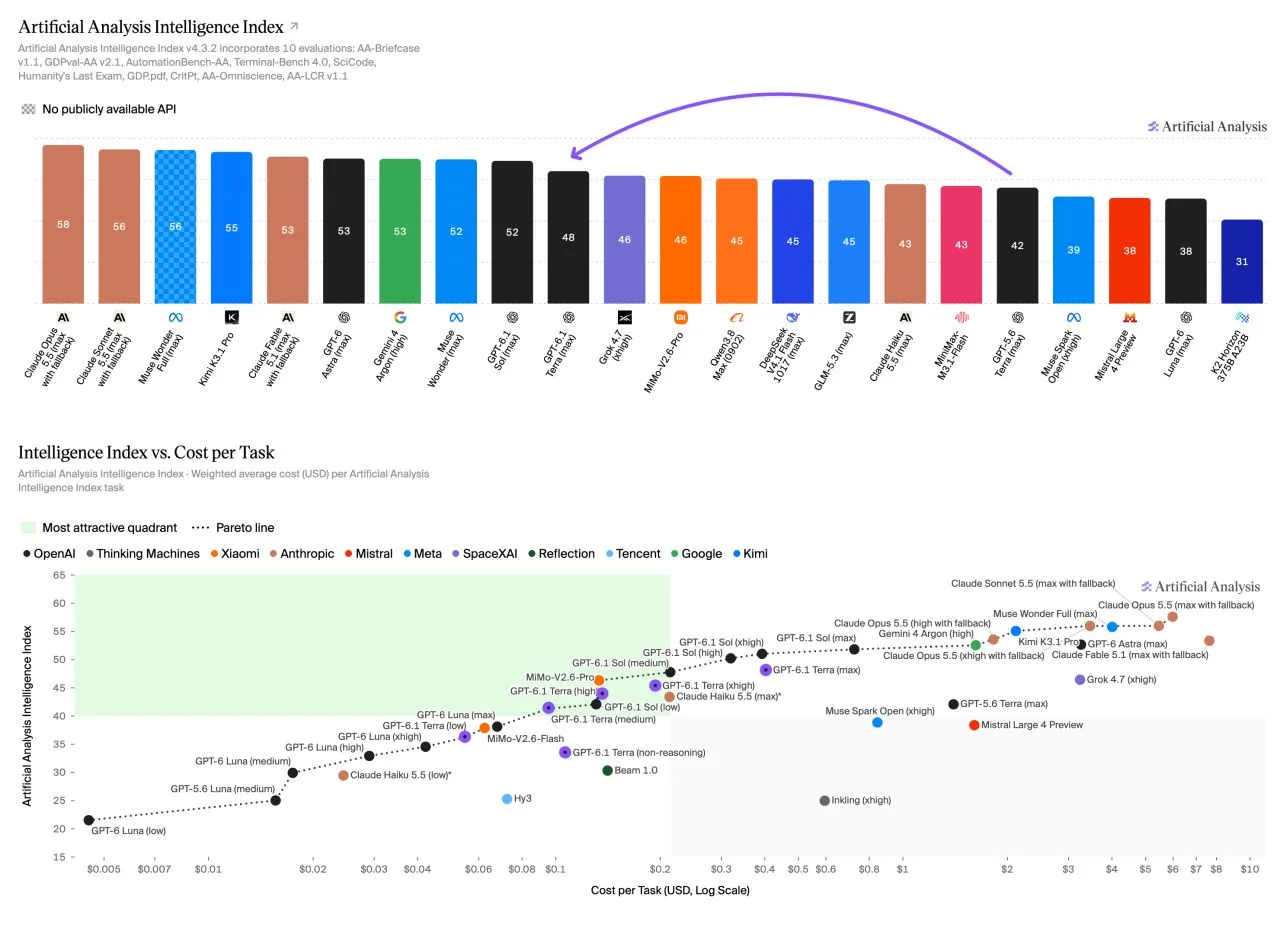
Artificial Analysis calls GPT-6.1 Terra a new benchmark for intelligence per dollar. At maximum reasoning effort, Terra gains 6 Intelligence Index points over GPT-5.6 Terra, reaching 48 against 42 for the older model and 52 for GPT-6.1 Sol. Artificial Analysis also reports a per-task cost of $0.40 versus $1.40 for GPT-5.6 Terra, less than a third. At lower effort levels, the gains widen to 7 to 13 points. In the cost-performance chart, those lower-effort results place Terra on the Pareto frontier, the point where cost and performance can no longer both improve simultaneously, and give it the best current ratio of intelligence to cost per task.
On the new Coding Agent Index v2.0, Terra scores 48, six points below GPT-6.1 Sol's 54 and 17 points above GPT-6 Luna's 31. The hallucination reduction is larger: on the private AA-Omniscience benchmark, the model guesses when it lacks the answer only 38 percent of the time, down from 88 percent for GPT-5.6 Terra, and accuracy rises by two points.
OpenAI positions Terra as particularly strong at automated software control. On Agents' Last Exam, it matches GPT-6 Astra's performance at one-tenth the token price. Compared with Claude Opus 5.5 at maximum effort, Terra is more than three times as token-efficient at a quarter of the token price, which the company says translates to roughly nine times lower cost per task. It also finishes more than three times faster than both GPT-6 Astra and GPT-6.1 Sol.
On MMMU-Pro for visual reasoning, Terra outperforms GPT-5.6 Terra at every reasoning level and nearly matches GPT-6 Astra and GPT-6.1 Sol. On OSWorld 2.1 for desktop agents, it beats GPT-5.6 Terra's best result at medium effort for a fraction of the cost. Terra also shows a sharp improvement in coding. On Terminal-Bench 4.0, Terra solves 50.3 percent of tasks at maximum reasoning effort, up from 21.5 percent for GPT-5.6 Terra. According to Artificial Analysis, that 20-point jump puts Terra in the same tier as GPT-6.1 Sol. On the scientific coding benchmark Terminal-Bench-Science 0.1, Terra outperforms GPT-6.1 Sol at lower cost and comes within five points of Claude Opus 5.5 at less than a fifth of the estimated cost.
Safety: Critical Threshold and Prompt Injection Defense
GPT-6.1 Terra falls under OpenAI's Critical safety threshold, meeting the company's Critical cybersecurity threshold as defined by the Preparedness Framework and inheriting the safeguards of GPT-6 Astra. Compared with its predecessor, Terra is more likely to stay within assigned boundaries and disclose restrictions to users. The system card says Terra holds up about as well as GPT-6 Astra and GPT-6.1 Sol against direct attacks on the instruction hierarchy, with those models reaching 99.99 percent on such tests. For indirect prompt injection attacks, where malicious instructions are buried in third-party content, Terra's defense rate is 98.8 percent, up from 96.2 percent for GPT-5.6 Terra.
Where Terra Now Stands
GPT-6.1 Terra is now OpenAI's lower-cost mid-tier option, while GPT-6.1 Sol and GPT-6 Astra remain the company's recommended models for the most demanding coding tasks. The next thing to watch is whether the benchmark gains show up as lower cost per task in ChatGPT Work, Codex, and API use, especially for agents that need computer control, visual reasoning, and everyday form work.
Comments
No comments yet. Be the first to comment.