
Should autonomous coding agents require consequence-aware approval?
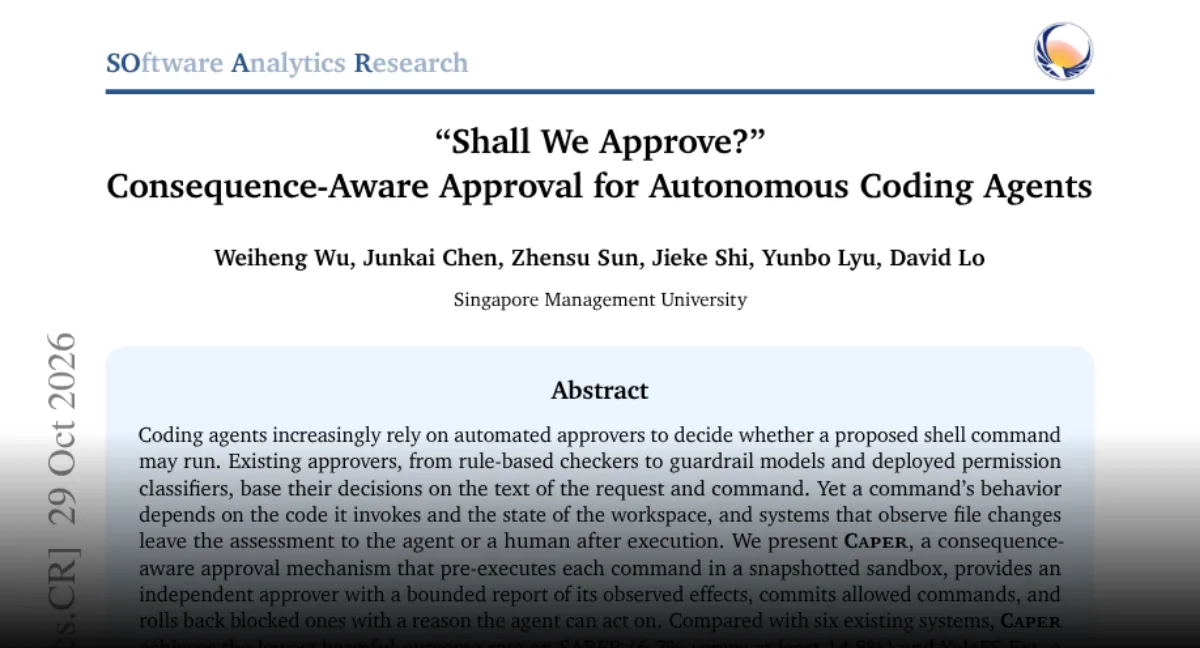
Caper approves coding agent commands after sandboxed execution, reducing harmful outcomes on SABER and YoloFS-Ext while blocking few safe commands.
Key Takeaways
- Manual approval for coding agents does not scale, as users often approve permission prompts routinely and text-based checks can miss context-dependent effects.
- Caper shifts approval from command text to observed effects by running each command in a snapshotted sandbox and reviewing low-level actions such as file changes, network access, and secret reads.
- On benchmarks, Caper reports the lowest harmful-outcome rate: 6.7% on SABER and 7.8% on YoloFS-Ext, while blocking only 1.0% of safe commands.
- The approach suggests safer coding-agent workflows may require consequence-aware approval close to execution, though scalability and added latency remain open questions.
Meta description: Caper tests coding agent commands in a sandbox, then uses an LLM approver to review observed effects and cut harmful outcomes on SABER to 6.7 percent.
Tags: Caper, coding agents, permission prompts, SABER, YoloFS-Ext
Featured image: Abstract technology style showing a sandboxed command execution trace, no real people, no company logos, no text.
Background: Manual Approval Reached Its Limit
A coding agent can run commands, but the safety question is not only whether the command looks acceptable. It is whether the agent really knows what its next command will do. Human approval was the default control, but it does not scale. Claude Code users approve 93% of permission prompts anyway. That figure suggests that permission prompts can become routine rather than careful, especially when an agent needs to run many steps. The problem is therefore not just safety, but the failure of manual review to stay selective at speed.
Development: Text-Based Approvers Became the Default
As coding agents gained more autonomy, developers looked for automated guardrails. Claude Code's Auto Mode, rule-based checkers, and guardrail models are examples. These systems judge the text of the command. That is useful because command text is available before execution, and it can be checked quickly. Yet it has a structural weakness. A command's behavior is decided by the scripts it invokes and the workspace it runs in. The same command can be harmless in one project and destructive in another. The visible text may not show whether the command will modify files, contact network services, or read secrets.
Latest Progress: Caper Inspects Observed Effects
Caper changes the approval point. Instead of approving from command text, it approves after seeing what the command does. Each command is pre-executed in a snapshotted sandbox under system-call tracing. The sandbox is a disposable copy of the workspace, and the tracing records the low-level operations attempted by the command. The LLM approver then reviews a compact report of observed effects: file changes, network attempts, and reads of secrets. If the command is allowed, its effects are committed. If it is blocked, the sandbox is rolled back. The agent gets a reason it can act on, creating a feedback loop rather than a simple yes or no gate.
Benchmark Evidence: Fewer Harmful Outcomes With Low Blocking
The comparison covers six existing systems. On SABER, Caper reports the lowest harmful-outcome rate at 6.7%, compared with at least 14.8% for the other systems. On YoloFS-Ext, a benchmark that hides harm inside the tools agents are asked to run, Caper reaches 7.8%, while the other systems are at least 35.3%. The false-block cost is also low: Caper blocks only 1.0% of the safe twins. That means the method is not simply saying no more often. It is reducing harmful outcomes while preserving more safe commands.
What to Watch Next
The approach suggests that command approval for coding agents may need to move closer to execution evidence. The code and data are available at https://github.com/wudaoz/Caper. The next question is how well observed-effect approval scales when agents run longer chains, use more complex tools, and face benchmarks that hide harm in different ways. Builders will also need to see whether pre-execution review adds enough latency to offset its safety gains.
Comments
No comments yet. Be the first to comment.