
Doc2Harness evaluates LLMs on long-horizon harness engineering for coding agents.
Doc2Harness tests LLMs building coding agent harnesses. GPT-6 Astra leads at 53.05% over 19 models and 328 cases, showing structural gaps.
Key Takeaways
- Doc2Harness is a deterministic benchmark that measures whether LLMs can build complete coding-agent harnesses, not just perform tasks inside fixed harnesses.
- It uses a two-stage test: a model constructs a candidate harness from contracts and documentation, then the frozen harness is evaluated in isolated containers using scripted model calls.
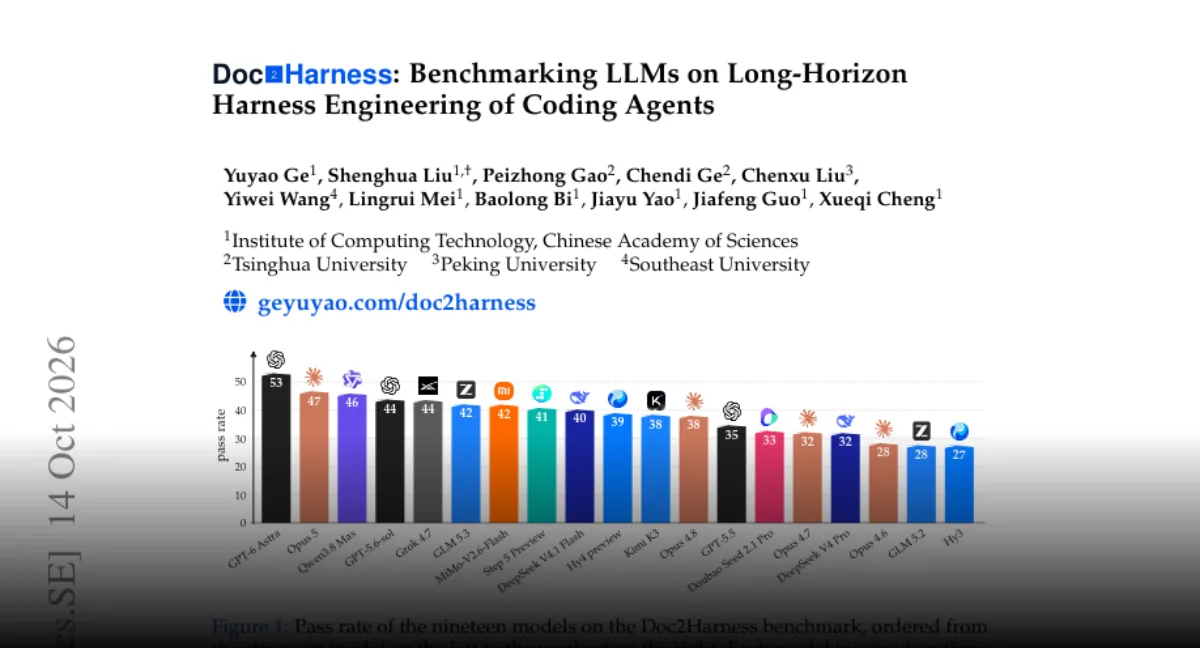
- Across 328 test cases and nineteen frontier models, GPT-6 Astra leads with a 53.05% pass rate, while the weakest model reaches 27.44%.
- Even the best model fails nearly half the cases, mainly due to poor separation between tool handling, state management, request formation, and process control.
- The core finding is that long-horizon harness engineering is now measurable, but frontier LLMs remain far from reliable performance.
Meta description: Doc2Harness tests long-horizon harness engineering; GPT-6 Astra reaches 53.05% pass rate across 328 test cases and nineteen frontier models.
Tags: Doc2Harness, GPT-6 Astra, harness engineering, LLM agents, benchmarks
Featured image: 
Doc2Harness puts harness engineering into a measurable test. Large language model (LLM) agents increasingly handle long-horizon tasks that require tools, files, and real workspaces, and performance depends as much on the harness around the model as on the model itself. Existing benchmarks usually measure downstream task success under a fixed harness. That leaves harness engineering unexplored. Doc2Harness addresses this by evaluating whether a model can build a complete candidate harness, not only operate inside one.
Background: Fixed Harnesses Hide a Missing Skill
A harness is the software scaffold that gives an agent access to tools, files, commands, and state across many steps. When a benchmark fixes that scaffold, a strong score may show good task completion, but it does not show whether the model can design the scaffold. This gap matters because long-horizon work depends on module boundaries, error handling, output capture, and reproducible execution.
Development: A Two-Stage Test for Harness Construction
Stage 1 places a build model inside a fixed builder harness. The model receives an interface-only contract skeleton and a development document that consolidates behavior across twelve frontier harnesses. From those inputs, it must construct a complete candidate harness in an isolated container.
Stage 2 freezes the candidate harness and moves it into containers separate from the construction environment, one per test case. A scripted mock model drives the harness end to end. Scoring uses four observable channels: the requests sent to the model, the files on disk, the process exit code, and the command output. Positive controls rule out vacuous passes.
Latest Results: GPT-6 Astra Leads, but Failure Remains Common
The benchmark evaluates nineteen frontier models, with each model tested through three independent builds on 328 test cases. GPT-6 Astra records the highest pass rate at 53.05%. The weakest model reaches 27.44%, a gap of roughly twenty-six percentage points.
Even the strongest model fails nearly half of the test cases. The failures cluster around how cross-cutting functionality is split across modules. That pattern suggests the difficulty is structural: a working harness needs coherent separation between tool handling, state management, request formation, and process control, not only more generated code.
Current Stage: A Deterministic Benchmark Emerges
Doc2Harness is described as, to the authors' knowledge, the first deterministic benchmark for measuring long-horizon harness engineering. Its contribution is a controlled way to compare harness construction itself: build in isolation, freeze the result, run scripted tests, and score observable outputs. The numbers show both the headroom and the failure modes. For now, the key signal is that harness engineering is measurable, and that even frontier models remain far from reliable pass rates.
Comments
No comments yet. Be the first to comment.