
ReproBridge Brings Reproducibility to ML Research Artifacts
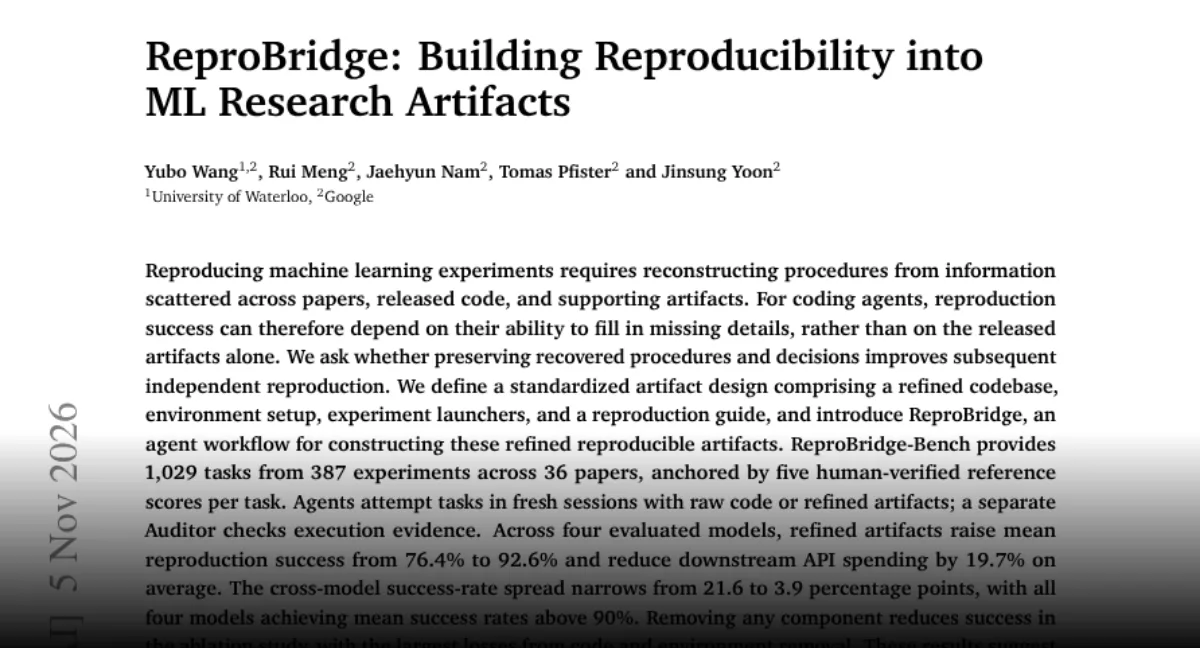
ReproBridge builds refined reproducible artifacts from research papers and official repositories, combining code, environment setup, experiment launchers, and guides. Its benchmark covers 1,029 tasks from 387 experiments across 36 papers, with human-verified scores and compatibility intervals. Across four coding agents, refined artifacts raised mean reproduction success from 76.4 percent to 92.6 percent, cut downstream API spending by 19.7 percent, and reduced model-to-model variance. An external hard benchmark also improved success, while code and data remain under internal review.
Key Takeaways
- ReproBridge converts raw paper artifacts into Refined Reproducible Artifacts (RRAs), packaging code, environment setup, experiment launchers, and reproduction guides to reduce guesswork for coding agents.
- It was tested on ReproBridge-Bench, a benchmark with 1,029 tasks from 36 ICML 2026 papers, using human-verified reference scores and an Auditor that checks whether reproduced numbers come from valid execution evidence.
- Across four coding agents, RRAs increased reproduction success from 76.4% to 92.6%, reduced API spending by 19.7%, and narrowed cross-model variance from 21.6 to 3.9 percentage points.
- The workflow and interactive benchmark results are available now, while the full code and data remain under internal review.
Headline: ReproBridge lifts coding agent reproduction success to 92.6 percent
Meta description: ReproBridge turns raw paper artifacts into refined reproducible artifacts, lifting coding agent success from 76.4 percent to 92.6 percent across four agents.
Tags: ReproBridge, coding agents, paper reproduction, RRA, AI benchmark
Featured image: Abstract technology style with code paths and score tracks, no people, no logos, no text.
Background: the artifact question behind ReproBridge
A coding agent can produce a result that appears to match a paper, yet that result may come from two different sources: the released artifacts, or the agent’s ability to fill gaps left by the paper and code. ReproBridge frames that question directly. Its goal is not only to get a higher success number, but to understand how much of that number comes from better artifacts and how much comes from agent inference.
The project centers on a Refined reproducible artifact, or RRA. An RRA packages refined code, environment setup, experiment launchers, and a reproduction guide that records the rationale behind each setting and repair. The aim is to turn sparse release material into a handoff that another agent can execute with less guesswork.
Development process: workflow, benchmark, and checks
ReproBridge is an agent workflow that constructs RRAs from a paper and its official repository. It follows Specify, Execute, and Preserve stages, with an independent Reviewer checking the work. That workflow was then tested through ReproBridge-Bench, which contains 1,029 tasks from 387 experiments across 36 ICML 2026 papers. Each task is anchored by five human-verified reference scores, giving the benchmark more than a single target number for comparison.
The evaluation design addresses a common weakness in research-agent testing: published scores are single observations. To account for variability, the team derives compatibility intervals from five independent human reproductions and applies them in both directions. Another risk is that numbers can match for the wrong reasons, so an Auditor traces each value to output files, execution records, and scripts. Against two human reviewers, that Auditor reaches 88.6 percent precision and 79.5 percent recall across 818 outcomes. The workflow also holds the task fixed and varies only the handoff, separating artifact quality from agent ability.
Latest progress: results across four coding agents
In fresh sessions with four coding agents, raw code versus RRA produced a mean success increase from 76.4 percent to 92.6 percent. Downstream API spending fell by 19.7 percent. The cross-model spread narrowed from 21.6 percentage points to 3.9 percentage points, and all four models finished above 90 percent. Ablation tests show that every component matters, with code and environment contributing the most.
An external check on CORE-Bench Hard showed capsule success rising from 62.2 percent to 73.3 percent, with cost per successful capsule at 4.34. The project page offers interactive results, a 36-paper explorer, and case studies at https://wyyyb.github.io/reprobridge_website/. Code and data remain under internal review and will be released once approved, and the team says it is happy to answer questions.
Current stage: the benchmark, workflow, and public interactive results are available, while the code and data release is still pending internal review. The reported gains indicate that refined artifacts can reduce both failure and model-to-model variance in paper reproduction tasks.
Comments
No comments yet. Be the first to comment.