
Tree-Aware Posterior Distillation Is Designed for Long-Horizon Agentic Reinforcement Learning
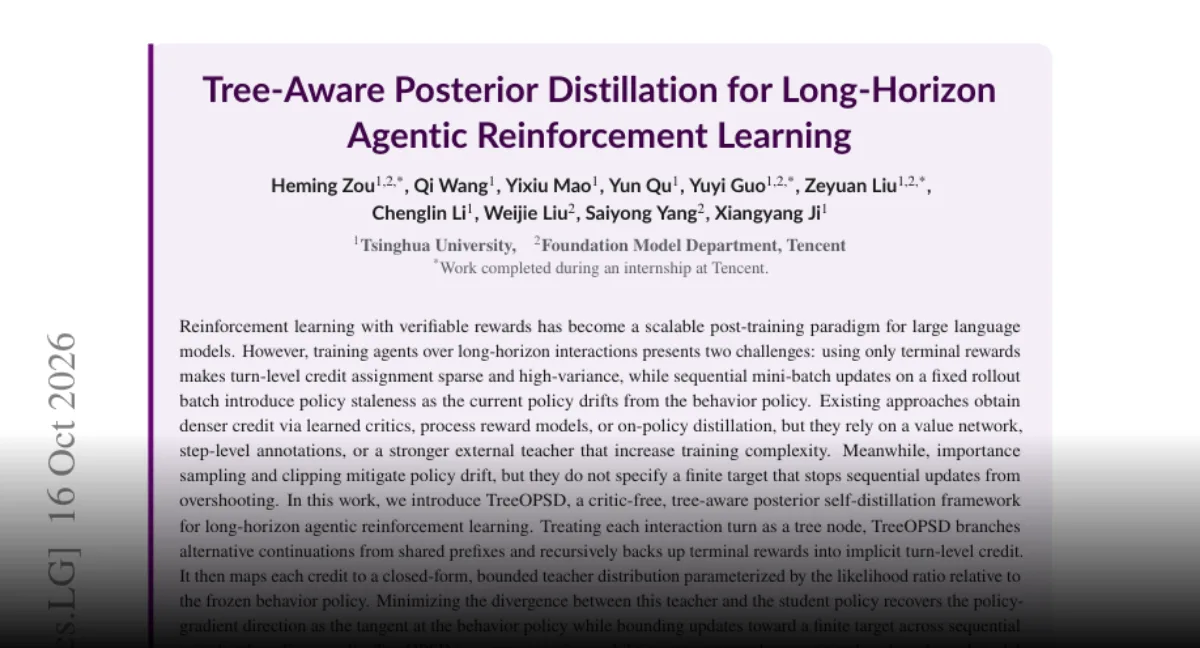
TreeOPSD tackles long-horizon LLM agent training by modeling rollouts as trees and backing up terminal rewards into turn-level credit. It creates a closed-form teacher and trains the policy with forward KL divergence, limiting drift from stale behavior policies without a critic. Benchmarks show consistent gains across model sizes, including a 4.97-point average lift for Qwen3-30B-A3B-Thinking-2507 in Deep Research under matched rollout budgets.
Key Takeaways
- TreeOPSD tackles long-horizon LLM agent training by addressing two core issues: sparse credit assignment from terminal rewards and policy staleness caused by sequential mini-batch updates.
- It uses a tree-based rollout structure to convert final rewards into implicit turn-level credit, without relying on external critics, process labels, or stronger teachers.
- The method defines a closed-form, bounded teacher distribution from the rollout tree and trains the student policy by minimizing forward KL divergence.
- This design both recovers the tree policy-gradient direction and keeps updates tied to the behavior policy, reducing drift across mini-batches.
- Across 1.7B to 30B models and benchmarks like Multi-Hop QA and Deep Research, TreeOPSD consistently outperforms GRPO, GSPO, and fixed-credit tree policy gradients under matched rollout budgets.
Meta description: TreeOPSD trains long-horizon LLM agents with critic-free self-distillation, raising Qwen3-30B-A3B-Thinking-2507 by +4.97 points in Deep Research.
Tags: TreeOPSD, LLM agents, reinforcement learning, Qwen3, Deep Research
Featured image: abstract technology style, tree-like network of glowing nodes and branching probability paths, no people, no logos, no text.
TreeOPSD, full name Tree-Aware Posterior Distillation for Long-Horizon Agentic Reinforcement Learning, addresses a practical bottleneck in training long-horizon LLM agents with verifiable rewards. The core difficulty is that terminal rewards must guide many interaction turns, while sequential mini-batch updates can make the current policy drift from the behavior policy. For agent tasks that span many turns, this matters because learning signals must connect a final outcome to intermediate decisions without letting updates drift too far from the data.
Background: Sparse Credit and Stale Policies
In long-horizon agent training, relying only on terminal rewards makes turn-level credit assignment sparse and high-variance. A final score does not directly show which turn helped or harmed the outcome.
The second bottleneck appears when mini-batch updates run sequentially on a fixed rollout batch. As the current policy changes, it can drift from the frozen behavior policy that produced the rollout. This mismatch is described as policy staleness, and it weakens the link between collected rollouts and the policy being optimized.
Previous remedies add extra components, such as learned critics, process annotations, or stronger external teachers. Other methods use importance-ratio clipping. Clipping can limit each update step, but it does not define a finite target where updates should stop.
Development: A Closed-Form Teacher From the Rollout Tree
TreeOPSD models each interaction turn as a node in a tree. From shared prefixes, it branches alternative continuations and recursively backs up terminal rewards. This converts endpoint scores into implicit turn-level credit without a separate critic.
Each backed-up credit is mapped to a closed-form, bounded teacher distribution. The teacher is parameterized by the turn-level likelihood ratio relative to the frozen behavior policy. The student policy is then trained by minimizing Forward KL divergence between the teacher and the student. The frozen behavior policy acts as the reference point for the likelihood ratio, while the student learns from the resulting teacher target.
The framework aims to do two things at once. Minimizing Forward KL divergence recovers the exact tree policy-gradient direction as its tangent at the behavior policy. At the same time, it bounds updates toward a finite target across sequential mini-batches, keeping policy updates connected to the rollout tree.
Latest Results: Gains Across Model Sizes and Benchmarks
The evaluation covers Multi-Hop QA and Deep Research benchmarks, with models ranging from 1.7B to 30B-A3B. Under matched rollout budgets, TreeOPSD consistently outperforms GRPO, GSPO, and fixed-credit tree policy gradients. The comparison is made under the same exploration cost, so the reported gains are not presented as the result of a larger rollout budget.
The reported Qwen3-30B-A3B-Thinking-2507 result is +4.97 points on average in the Deep Research setting. The method's value lies in combining tree-aware credit with a bounded self-distillation target, rather than introducing an external critic or teacher. For readers tracking long-horizon agent training, the signal is that rollout structure and bounded update targets can be used together to address sparse credit and policy staleness in the same critic-free framework.
Comments
No comments yet. Be the first to comment.