
Holo4D uses holistic four-dimensional reconstruction as geometric control for video diffusion models.
Holo4D, accepted to NeurIPS 2026, uses four-dimensional tracks to guide video diffusion for new camera views with open code.
Key Takeaways
- Holo4D, accepted to NeurIPS 2026, reshoots an existing video from a new camera path by guiding a pretrained video diffusion model.
- It builds a 4D scaffold of 3D tracks from the source video, preserving visible geometry while generating content missing from the new view.
- The method can use different 4D reconstructors without retraining and extends to real robot videos and longer sequences via windowed processing.
- The project releases open training and inference code, evaluation materials, and model checkpoints, enabling further testing and development.
- Future progress depends on better 4D reconstruction and more stable long-range video generation across extended camera paths.
Holo4D, Accepted to NeurIPS 2026, Reshoots Video From New Camera Paths
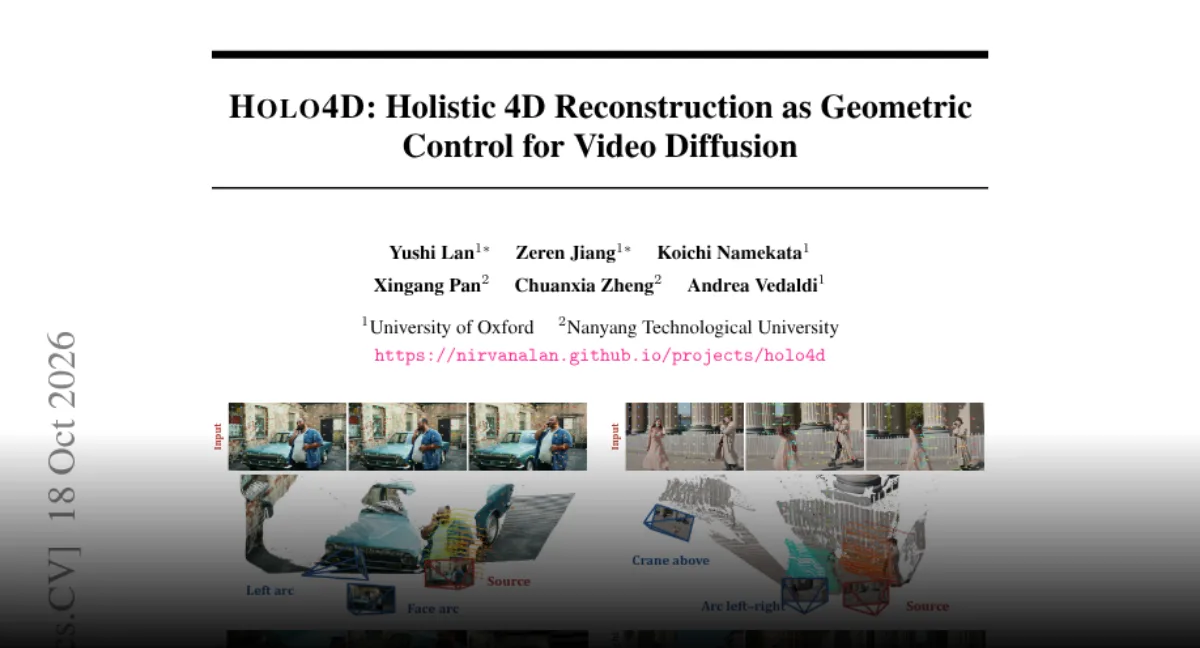
Holo4D, accepted to NeurIPS 2026, presents a way to reshoot an existing video from a new camera path. It lifts the source video into 3D tracks and uses them to guide a pretrained video diffusion model, a video generator that fills in views the original camera never captured. The value for readers is a clear separation: geometry preserves what was seen, while the video model supplies what was missing.
Background: A 4D scaffold guides the new view
The input is an existing video plus a new camera path. Holo4D builds a 4D scaffold, a set of 3D tracks that keep the source video's visible content anchored over time. The pretrained video diffusion model uses these tracks as constraints. Where the camera already saw content, the tracks keep it in place. Where content is outside the original view, the model generates it.
Development: Reconstructor flexibility and robot-video extension
The method does not require retraining when it uses different 4D reconstructors, so the output can improve as 4D reconstruction improves. Holo4D also reshoots real robot videos involving DROID arms and humanoids, despite being trained without robot videos. For longer sequences, the project extends the approach window by window, processing the video in segments instead of requiring one full-length pass.
Latest progress: Open code, checkpoints, and evaluation materials
The project says everything is open: training and inference code, evaluation code, the predictions behind every table, and 14B / 5B checkpoints. The listed project page is https://nirvanalan.github.io/projects/holo4d/, the code repository is https://github.com/NIRVANALAN/Holo4D, and the model repository is https://huggingface.co/yslan/Holo4D-2026.
What to watch next
The important follow-up is whether better 4D reconstructors and longer windowed sequences translate into more stable new camera views. The open checkpoints and evaluation code provide a concrete way to test the link between improved 3D tracks and generated video quality.
Meta description: Holo4D, accepted to NeurIPS 2026, reshoots videos from new camera paths by using 4D tracks to guide pretrained video diffusion models, with open checkpoints.
Tags: Holo4D, NeurIPS 2026, 4D reconstruction, video diffusion, camera trajectory
Featured image: An abstract visualization of a video sequence lifted into volumetric tracks, with a new camera path guiding generation.
Comments
No comments yet. Be the first to comment.