
Research finds that teams of AI agents consume excessive tokens for only marginal quality improvements.
AI agent teams cost far more tokens than solo agents, with only small quality gains; they mainly buy speed, while coordination costs reduce value.
Key Takeaways
- AI agent teams often cost far more tokens than single agents while producing only marginal quality improvements.
- On Vibe Code Bench, only GPT-6 Sol at medium reasoning showed a statistically significant gain, with teams scoring 7.3 points higher.
- Anthropic tests found that larger teams mainly improve speed, not final quality, with diminishing gains as more agents are added.
- OpenAI researchers and developers warned that multi-agent systems mostly buy speed, can create a coordination tax, and are highly task-dependent.
- Overall, the evidence suggests agent teams are rarely worth the extra compute unless speed or specific parallelizable tasks justify the cost.
Meta description: AI agent teams on Vibe Code Bench cost far more than single agents, while only GPT-6 Sol at medium reasoning gained a statistically significant 7.3 points.
Tags: AI agent teams, Vibe Code Bench, GPT-6 Sol, Opus 5.5, multi-agent systems
Featured image: Abstract AI agent network over benchmark charts, no people, no logos, no text.
Background: Why agent teams entered coding benchmarks
AI agent teams put multiple model instances into one workflow, with the hope that parallel work can solve complex tasks faster than a single agent. A solo agent is one model instance doing the work; a team splits the work across several instances. The benchmark frames the trade-off as cost per app versus score, so cost and quality can be compared directly.
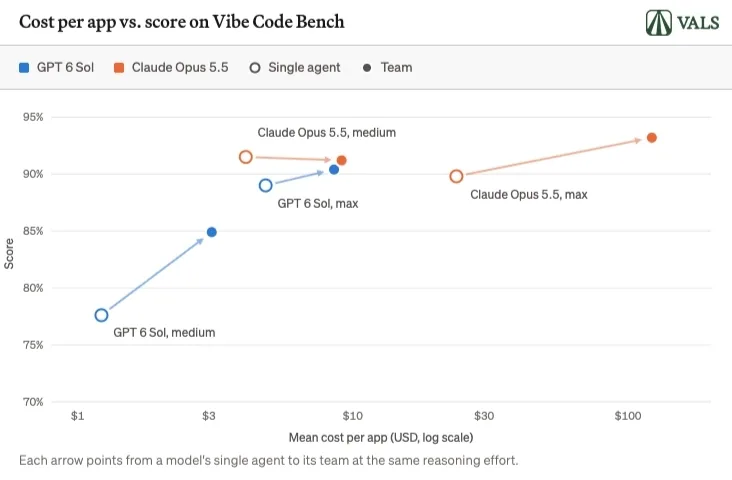
Vals AI's benchmark tested that idea on Vibe Code Bench. The chart is credited to Vals AI, and arrows point from each model's single agent to its team at the same reasoning effort. The pattern was clear: teams cost far more but barely improve scores.
The comparison covered four cases between teams and solo agents. Only one showed a statistically significant improvement: GPT-6 Sol at medium reasoning, where the team scored 7.3 points higher. At maximum reasoning, the team setup gave neither Sol nor Opus 5.5 any real advantage. The results suggest that the extra cost of agent teams is not worth it in most cases, especially when models are already running at full compute.
Development: Anthropic tests showed shrinking gains
Anthropic saw quality gains shrink as it added more agents in two of its own tests with Opus 5.5. Larger teams reached a given performance level faster, but going from ten to 100 agents only nudged scores up slightly after 24 hours. In separate ProgramBench tests, speed gains came with higher token usage.
The Fable 5.1 results added another boundary. It showed stronger quality gains on the Lean theorem proving task above ten agents, but still scored below Opus 5.5 across all tests. On the knowledge base task, Fable's score actually dipped slightly when scaling from 30 to 100 agents.
These results separate two effects that are often mixed together in agent discussions. More agents buy speed but not better output. More agents can reduce time to a usable answer, but they do not necessarily raise the final score. That distinction matters because many workflows pay for speed as if speed were the same thing as better output.
Latest: OpenAI researchers described the limits
OpenAI researcher Noam Brown confirmed in the Dwarkesh Podcast that multi-agent systems mainly buy speed, not better quality. Four agents solved tasks twice as fast but also cost twice as much. At 16 agents, the pattern held but grew slightly less efficient.
Brown said the effect depends heavily on the task. Web research and math parallelize well, but writing a novel does not. He said throwing 10,000 agents at a novel would be just as pointless as throwing 10,000 people at it. Brown also acknowledged that scaling to very large numbers of agents remains largely unexplored because the costs are simply too high.
OpenAI developer Eric Provencher recently warned against using agent swarms for exactly this reason. He argued they are most likely wasted money because coordination between agents breaks down. He called it the coordination tax.
Current stage: Speed helps, quality gains remain narrow
The evidence now points to a narrow set of cases where agent teams look useful. GPT-6 Sol at medium reasoning gained 7.3 points, while maximum-reasoning teams gave neither Sol nor Opus 5.5 a real edge. Anthropic's own tests showed that larger teams reached performance faster, but added agents from ten to 100 produced only slight score movement after 24 hours.
What to watch next is whether future tests make coordination cheaper enough to change the balance, or whether benchmark evidence keeps pointing to speed without much better output.
Comments
No comments yet. Be the first to comment.