
Improved Initialization Enhances LLM-Driven Discovery.
A study finds that initializing LLM discovery loops with strong parallel candidates improves success across harnesses and tasks.
Key Takeaways
- In LLM-driven discovery with fixed token budgets, the quality of the initial candidate population strongly affects final outcomes.
- Across 12 Modular harnesses and 5 discovery tasks, success is brittle and sensitive to harness design, often limited by mode collapse.
- Early discovery performance predicts eventual success, supporting the use of high-performing early candidates as initialization.
- A parallel exploration stage followed by optimized initialization yields consistent gains across harnesses, tasks, and models.
- Initialization should be treated as a core design variable in discovery systems, not merely an incidental starting condition.
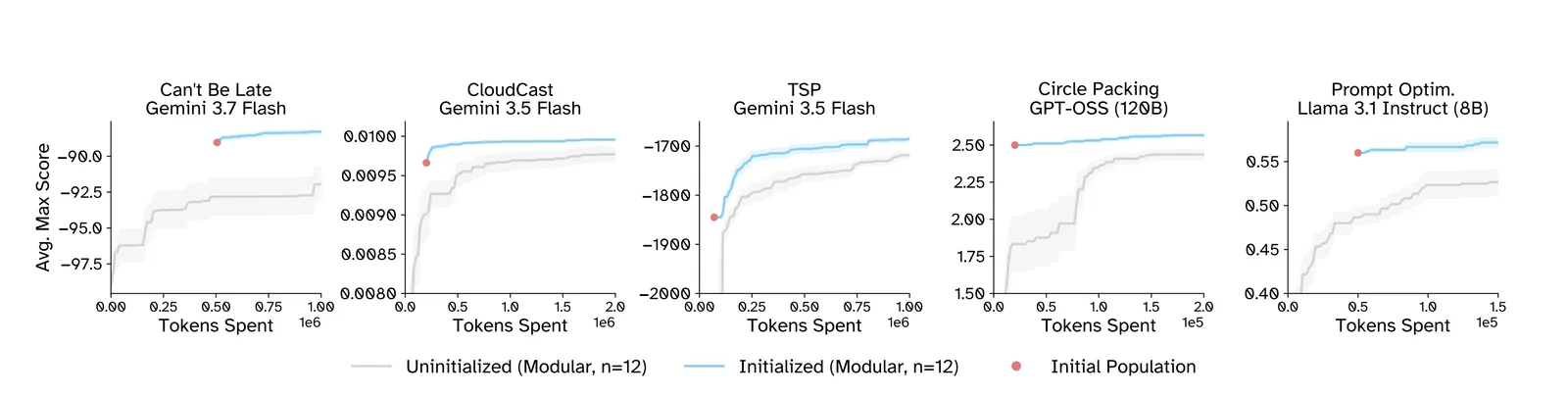
A study of LLM-driven discovery systems finds that the starting point of a search can shape final outcomes when the total token budget is fixed. Across 12 Modular harnesses and 5 diverse discovery tasks, initializing each run with a high-performing population of early candidates improves downstream success in different harness designs, task settings, and model choices.
Background: Harnesses turn LLMs into discovery workers
LLMs have been used for novel discovery in algorithms, theorems, drugs, and other tasks through harnesses. A harness is a structured prompting and evaluation loop that asks an LLM to produce candidates, compare them against an objective, and revise them over repeated iterations. The study examines how the population of previous iterates relates to eventual discovery success.
The practical challenge is that discovery runs consume a finite token budget. If early candidates are weak, later optimization may spend the remaining budget refining poor solutions instead of exploring promising regions. If early candidates are strong, the search may begin from a higher performance floor.
Development: Testing 12 Modular harnesses exposes brittle gains
The study generalizes prior harness-design work into Modular, a suite of 12 harnesses, and measures performance on 5 diverse discovery tasks. The results show that discovery success is brittle and sensitive to harness design.
A common failure mode is mode collapse, defined in the study as a dramatic drop in the diversity of iterates. When diversity falls, the search becomes narrower and may repeatedly revisit similar solutions. Popular state-of-the-art harnesses and diversity-inducing harness interventions intended to delay mode collapse yield inconsistent gains.
Latest: Early results predict the value of parallel initialization
The study reports that the performance of early discoveries predicts eventual success. Based on this pattern, it proposes a universally applicable intervention: begin with an initial stage of parallel exploration, then use the resulting high-performing population to initialize the main iterative optimization.
Rather than treating the starting population as incidental, the method samples candidates in parallel first and then uses the strongest early results to begin the main optimization loop. Across many harnesses and target applications, this yields consistent gains, reinforcing initialization as an important part of LLM-driven discovery.
Current stage: Initialization becomes a first-class harness variable
The finding places early population quality alongside later optimization strategy as a central design variable for discovery harnesses. The evidence covers 12 Modular harnesses and 5 tasks, and it links initialization gains to downstream success across harnesses, tasks, and LLMs.
What to watch next is whether discovery systems treat initialization as a separate stage rather than an incidental starting condition. Because the gains are tied to the tested settings, future work will need to show how far the same parallel-exploration step transfers to broader harness families, additional discovery tasks, and other LLM configurations.
Comments
No comments yet. Be the first to comment.