
Branching On-Policy Distillation is a technique that creates multiple branches while maintaining on-policy training.
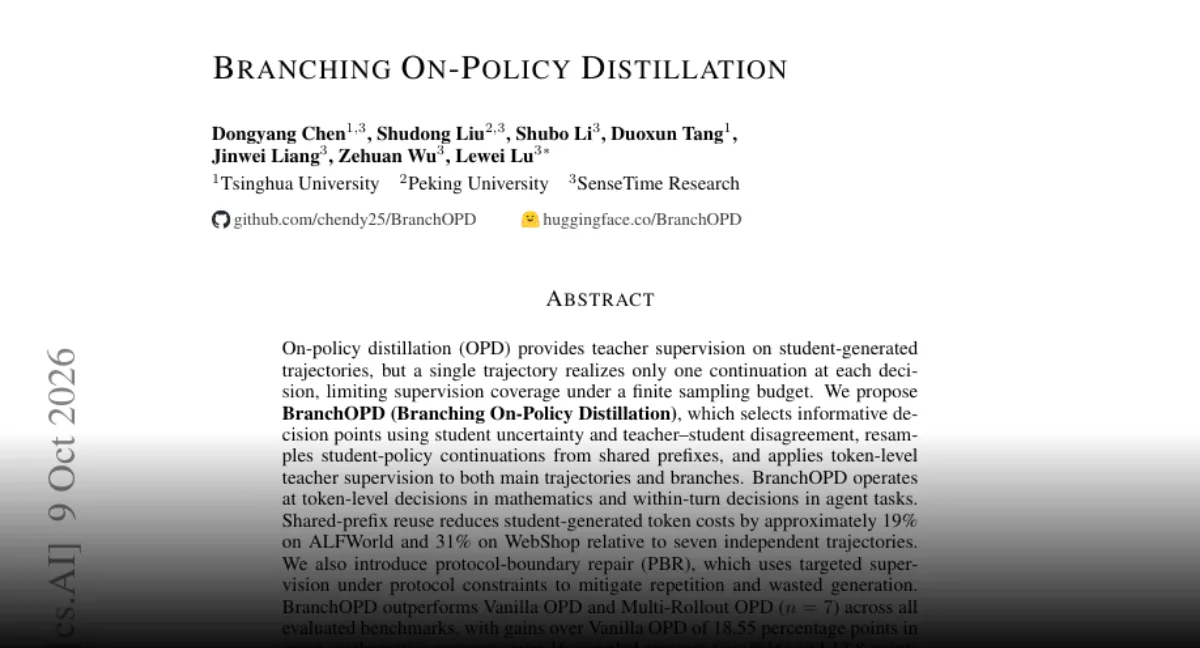
BranchOPD branches on-policy distillation at uncertain decisions, reuses prefixes, adds PBR, cuts token costs, and improves math and agent results.
Key Takeaways
- BranchOPD extends on-policy distillation by branching student-generated trajectories at uncertain or teacher-student disagreement points, increasing supervision coverage.
- It applies token-level teacher feedback to both main trajectories and branches, using a shared branching principle for mathematics and agent tasks.
- Shared-prefix reuse lowers student token costs by about 19% on ALFWorld and 31% on WebShop compared with seven independent trajectories.
- Protocol-boundary repair (PBR) targets repetition and wasted generation under protocol constraints.
- BranchOPD outperforms Vanilla OPD and Multi-Rollout OPD, including an 18.55 percentage-point gain in avg@16 mathematics accuracy and a 13.8-point gain in ALFWorld ID/OOD success.
Meta description: BranchOPD adds branching on-policy distillation, PBR, and shared-prefix reuse, cutting token costs on ALFWorld and WebShop and improving math and agent results.
Tags: BranchOPD, On-policy Distillation, AI Training, Agent Benchmarks, Mathematics Reasoning
Featured image: abstract branching network over a computational grid, no real people, no company logos, no text.
Background: One Trajectory Limits Teacher Supervision
On-policy distillation (OPD) provides teacher supervision on student-generated trajectories. Because the supervision follows the trajectories the student itself produces, it is aligned with the student's behavior. The limitation appears when each trajectory realizes only one continuation at each decision. At every decision point, the rollout exposes one sampled future while other possible continuations are not visited.
Under a finite sampling budget, that structure limits supervision coverage. OPD can still give token-level teacher feedback, but a single path cannot show what would happen along many alternative continuations. Branching On-Policy Distillation, or BranchOPD, is built around that coverage gap.
Development: Branching from Uncertain Decision Points
BranchOPD selects informative decision points using student uncertainty and teacher-student disagreement. It resamples student-policy continuations from shared prefixes and applies token-level teacher supervision to both main trajectories and branches. Instead of treating a rollout as one linear continuation, it turns selected decision points into multiple supervised continuations.
The method operates at token-level decisions in mathematics and within-turn decisions in agent tasks. This gives it one branching principle across different task formats: it adds teacher supervision where the student is uncertain or where the teacher and student diverge.
Progress: Shared Prefixes, PBR, and Benchmark Gains
BranchOPD also changes the cost structure of on-policy supervision. Shared-prefix reuse reduces student-generated token costs by approximately 19% on ALFWorld and 31% on WebShop relative to seven independent trajectories. The lower cost comes from reusing a common prefix and branching from it, rather than generating seven fully separate trajectories.
The approach also introduces protocol-boundary repair (PBR), which uses targeted supervision under protocol constraints to mitigate repetition and wasted generation. PBR is a repair layer aimed at those inefficiencies.
Across all evaluated benchmarks, BranchOPD outperforms Vanilla OPD and Multi-Rollout OPD (n = 7). The gains over Vanilla OPD include 18.55 percentage points in mean mathematics accuracy over 16 sampled answers (avg@16) and 13.8 points in mean ALFWorld ID/OOD success. These results show improvement in both sampled mathematical accuracy and agent success in ALFWorld.
Current Stage: Branching as a More Efficient Supervision Layer
Mechanistic analyses and selection ablations show that branching at uncertain decisions expands subsequent supervision coverage. The reported setup places BranchOPD as an extension of OPD: it keeps student-generated trajectories, adds branches at selected decision points, applies teacher supervision across main paths and branches, and reduces token cost through shared-prefix reuse. PBR addresses repetition and wasted generation within the same framework. The current results indicate that the method is aimed at denser supervision without the full token cost of independent multi-rollout baselines.
Comments
No comments yet. Be the first to comment.