
Vela Uses User Behavior as Supervision to Spark LLM Intelligence
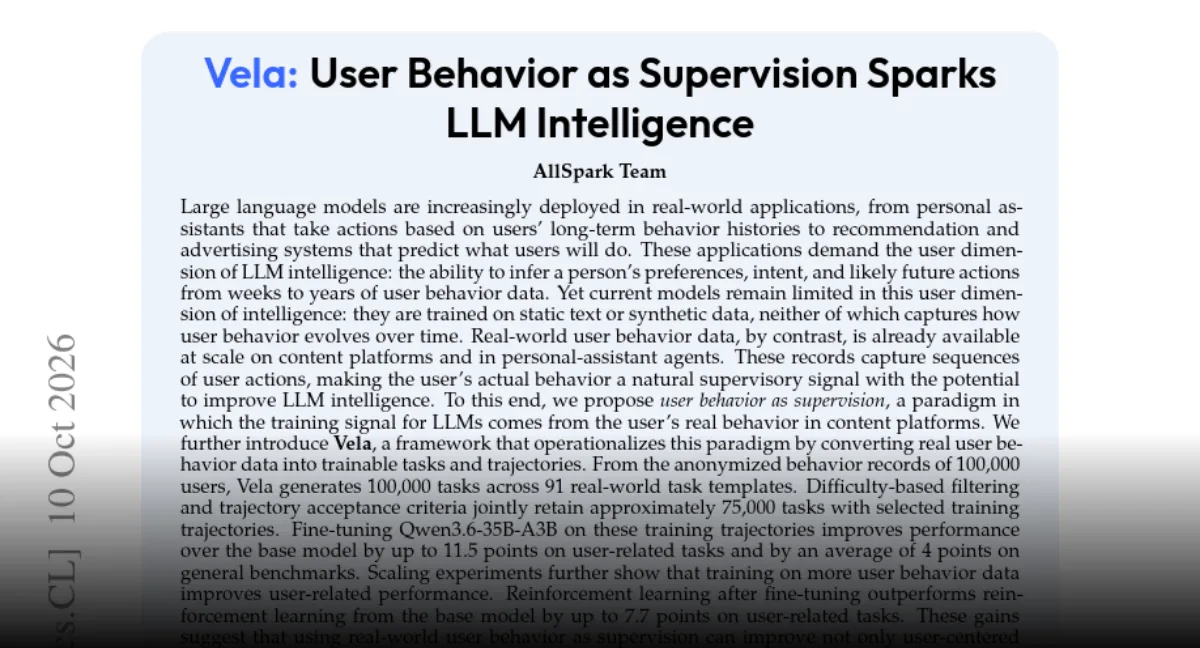
Vela fine-tunes Qwen3.6-35B-A3B on anonymized user behavior tasks, improving VelaBench by 11.5 points and user-related benchmarks by 6.2 points.
Key Takeaways
- Vela fine-tunes Qwen3.6-35B-A3B using anonymized user behavior as supervision to improve long-term context understanding, preference tracking, and evidence-grounded decision making.
- It converts behavior histories from 100,000 users into tasks across 91 templates, retaining about 75,000 training examples after filtering and trajectory selection.
- The training records were anonymized, platform-authorized, and reviewed for privacy and ethics before use.
- The fine-tuned model improves on all ten evaluated benchmarks, gaining 11.5 points on VelaBench, 6.2 points on average across four user-related benchmarks, and 4.0 points across five general benchmarks.
- The work is currently at the discussion stage regarding method, evaluation, and applications.
Meta description: Vela fine-tunes Qwen3.6-35B-A3B on anonymized user behavior, gaining 11.5 points on VelaBench and 6.2 across four independent user-related benchmarks.
Tags: Vela, Qwen3.6-35B-A3B, VelaBench, LLM fine-tuning, user behavior
Featured image: abstract anonymized behavior graph over a timeline, no real people, no company logos, no text
Background
Large language models (LLMs) deployed across more real-world scenarios need to learn from long-term context, understand evolving user preferences and intent, and make decisions grounded in behavioral evidence. Yang Xiao, first author of Vela, said in a Hugging Face community post that these capabilities provide a foundation for organizations deploying LLMs in high-value real-world scenarios, including complex decision-making, long-term planning and autonomous agent execution.
Development process
Vela explores anonymized user behavior as supervision to develop those capabilities and strengthen broader LLM intelligence. It converts behavior histories from 100,000 users into tasks across 91 templates. Filtering and trajectory selection retain approximately 75,000 training examples. Records were anonymized before task construction, and their use was platform-authorized and underwent privacy and ethics review.
Latest progress
Fine-tuning Qwen3.6-35B-A3B improves performance on all ten evaluated benchmarks. Compared with the base model, Vela gains 11.5 points on VelaBench, with average gains of 6.2 points across four independent user-related benchmarks and 4.0 points across five general benchmarks. The work is now at the discussion stage for method, evaluation and applications.
Comments
No comments yet. Be the first to comment.