
The Delta Token-to-Go method trains multi-turn agents with a token-to-go progress meter.
Delta Token-to-Go learns a progress meter from trajectories, converting sparse terminal rewards into step-level signals for multi-turn agents.
Key Takeaways
- DeltaTTG improves multi-turn agent RL training by learning a reusable progress signal from recorded trajectories, reducing reliance on sparse terminal rewards.
- The method uses Token-to-Go, the number of tokens remaining until task completion, as a low-cost, task-agnostic proxy for progress.
- During training, DeltaTTG redistributes outcome-based advantages across intermediate steps without changing trajectory reward signs or token-average scale.
- On ALFWorld, PaperSearchQA, and BFCLv3, DeltaTTG outperforms GRPO and other RL baselines with similar actor-training GPU cost.
- Results also show better sample efficiency and out-of-domain performance, though transferability across larger actors and new domains remains an open question.
Reinforcement learning with verifiable rewards (RLVR) gives multi-turn agents a signal only at the end of a task. That sparse terminal reward says little about which intermediate steps helped or hurt. DeltaTTG, a new method, addresses this by learning a reusable progress signal from a shared progress meter, trained on low-cost supervision drawn from the recorded trajectories of diverse policies, without task-specific progress rules.
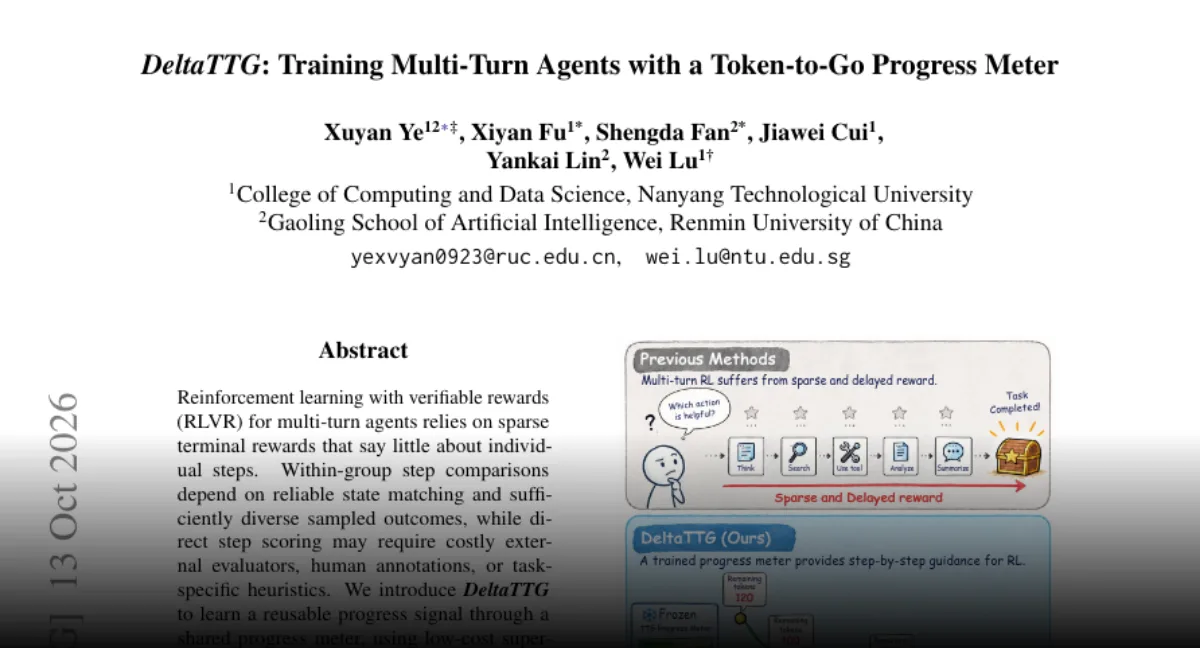
Why Sparse Rewards Limit Multi-Turn Agents
RLVR for multi-turn agents depends on terminal rewards that arrive once a task finishes. Within-group step comparisons then rely on reliable state matching and sufficiently diverse sampled outcomes. Direct step scoring offers an alternative, but it may require costly external evaluators, human annotations, or task-specific heuristics. Each of these raises cost or narrows the settings where step-level learning can be applied.
Token-to-Go as an Observable Progress Proxy
DeltaTTG's supervision target is Token-to-Go (TTG): the number of tokens remaining to be generated until task completion. TTG serves as an observable proxy for remaining completion effort. Because it is measured in tokens rather than task-specific milestones, it does not depend on hand-written progress rules for each environment.
During actor training, changes in the frozen meter's estimates redistribute outcome-derived advantages across steps. This redistribution does not alter the reward, and it preserves each trajectory's advantage sign and token-average scale.
Benchmark Results Across Three Tasks
The method was evaluated on ALFWorld, PaperSearchQA, and BFCLv3. DeltaTTG improves the average score over GRPO by 5.7 points with Qwen3-4B and by 7.2 points with Llama-3.1-8B-Instruct. It also outperforms all compared RL baselines on average, while keeping actor-training GPU-hours close to GRPO.
Further experiments show improved sample efficiency and out-of-domain performance. They also support the meter's ability to distinguish step quality and to guide test-time action selection across actor sizes.
What to Watch Next
The results position DeltaTTG as a way to obtain step-level learning signals without external evaluators, human annotations, or task-specific heuristics, and without adding substantial GPU-hour cost relative to GRPO. The remaining question is how far the frozen meter's estimates transfer as actor sizes and task domains change, since the reported evidence covers Qwen3-4B and Llama-3.1-8B-Instruct on ALFWorld, PaperSearchQA, and BFCLv3.
Comments
No comments yet. Be the first to comment.