
Beyond Policy Rollouts, Embedding-Space Directional Exploration with Anchored Noise Is Applied to LLM Reinforcement Learning with Verifiable Rewards
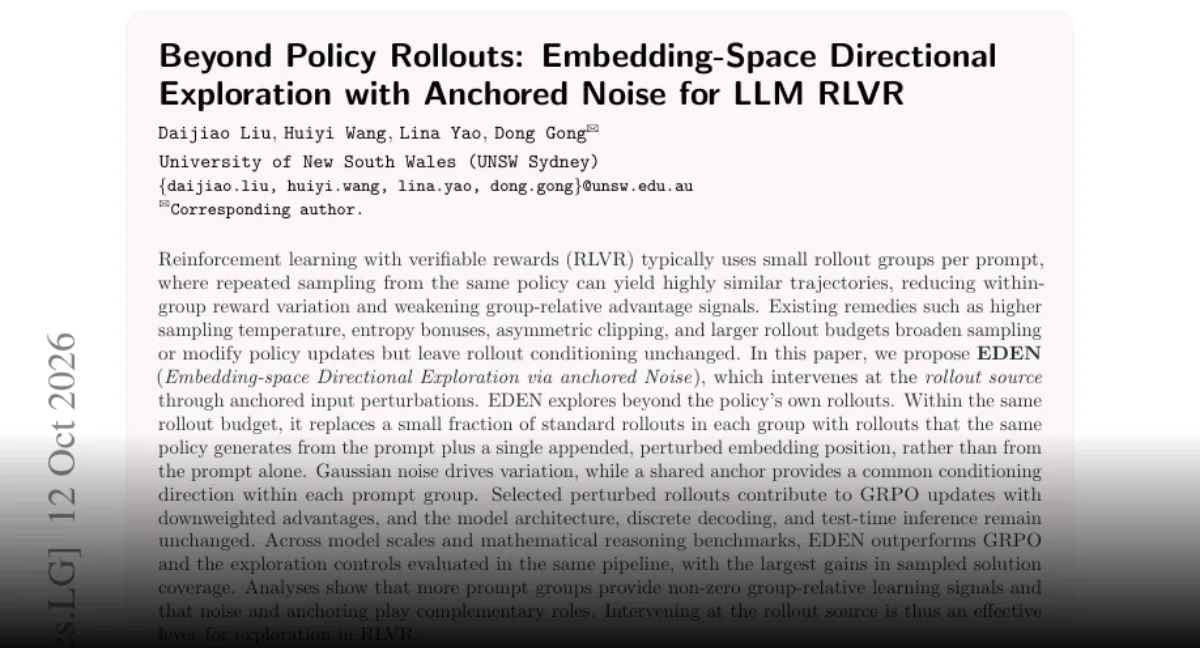
EDEN is a reinforcement learning post-training method for LLMs that adds anchored Gaussian noise to rollout inputs in embedding space. The noise expands exploration while keeping samples controlled. Useful perturbed rollouts are filtered and reweighted by advantage. On Qwen2.5-Math-7B and 14B, EDEN improves average accuracy and Pass@256 over GRPO, showing that controlled input-space noise can help models discover solutions beyond their usual sampling behavior.
Key Takeaways
- EDEN is an LLM reinforcement learning post-training method that adds anchored Gaussian noise to rollout inputs in embedding space to broaden exploration beyond near-identical GRPO rollouts.
- It uses an anchor direction to keep noise controlled, then selects useful perturbed rollouts with an advantage-gated filter and noise-aware reweighting to maintain stable learning.
- On Qwen2.5-Math-7B and 14B, EDEN outperforms GRPO, raising average accuracy by 1.5 and 2.1 points and average Pass@256 by 1.8 and 3.5 points.
- It also improves Pass@256 by 6.4 points on a DeepMath-103K subset, showing it expands the range of solvable problems rather than only increasing raw accuracy.
- Overall, EDEN positions controlled embedding-space noise as a practical exploration tool for RL post-training with verifiable rewards.
Meta Description: EDEN adds anchored noise in embedding space to LLM reinforcement learning post-training, improving Qwen2.5-Math results over GRPO on Pass@256 and accuracy.
Tags: EDEN, reinforcement learning, LLM post-training, Qwen2.5-Math, GRPO
Featured image: abstract technology scene of an embedding-space grid with noise vectors converging toward a solution; no people, no company logos, no text.
EDEN is a reinforcement learning post-training method for large language models that inserts anchored noise into rollout inputs in embedding space, helping the model search beyond the trajectories it would normally sample. The method is evaluated on Qwen2.5-Math-7B and 14B, and it reports gains over GRPO on average accuracy and Pass@256.
Background: Identical Rollouts Limit Group-Relative Learning
In reinforcement learning with verifiable rewards, a policy that samples the same prompt many times often produces nearly identical trajectories. That repetition leaves little reward variation for group-relative learning, because the training signal depends on differences among sampled outcomes. The result is a narrow exploration problem: the model may repeatedly draw from the same region of its output distribution instead of reaching solutions that lie outside its usual sampling behavior.
Development: Anchored Noise Expands the Input Space
EDEN changes the sampling sequence for each prompt. It first generates standard rollouts, then creates additional rollouts from inputs perturbed in embedding space. The perturbation is Gaussian noise, which introduces variation, while an anchor embedding gives every rollout in the group a common direction. This anchored structure is meant to keep the noise controlled rather than random.
The most informative perturbed rollouts enter training through an advantage-gated filter and a noise-aware advantage reweighting. In practice, the method filters which perturbed trajectories are useful, then adjusts their contribution to training so that noise-driven exploration can still support stable learning.
Latest Results: Qwen2.5-Math Improvements Over GRPO
On Qwen2.5-Math-7B and 14B, EDEN outperforms GRPO. It improves average accuracy by 1.5 and 2.1 points, respectively. Average Pass@256 improves by 1.8 and 3.5 points. On a DeepMath-103K subset, Pass@256 rises by 6.4 points over GRPO.
These figures show that the method is not only increasing raw accuracy; it also expands the range of problems that the model can solve when allowed to sample many attempts.
Current Stage: Controlled Noise as a Post-Training Tool
The current result positions EDEN as a practical exploration technique for reinforcement learning post-training. It uses a simple intervention: add anchored noise to the input representation, filter useful rollouts, and reweight their advantage. The reported Qwen2.5-Math and DeepMath-103K numbers indicate that controlled noise in the input representation can help a model reach solutions beyond its usual sampling path.
Comments
No comments yet. Be the first to comment.