
Routing policies are optimized for online diffusion reinforcement learning.
Routing policy optimization learns from attention-route reward differences, improving visual generation with nearly fourfold training efficiency.
Key Takeaways
- RPO introduces reinforcement learning into visual generators by treating attention routing as a stochastic exploration action, avoiding costly perturbations of the reverse denoising trajectory.
- It samples sparse attention routes at selected denoising levels and uses a Gaussian score-function objective around the dense velocity to evaluate route choices.
- A controlled two-rollout estimator compares paired rollouts that differ only in sampled routes, isolating the reward advantage of better attention paths.
- After training, routing is removed and dense attention is restored, preserving the original deterministic sampler at inference.
- Experiments on text-to-image and text-to-video generation show improved generation quality and nearly 4x higher training efficiency than Flow-GRPO-style methods.
Meta description: Routing Policy Optimization or RPO explores attention routes inside visual generators and reports nearly 4x training efficiency versus Flow-GRPO-style methods.
Tags: RPO, reinforcement learning, visual generation, attention routing, score-function methods
Featured image: abstract routing paths through a denoising grid for visual generation, no text, no people, no logos
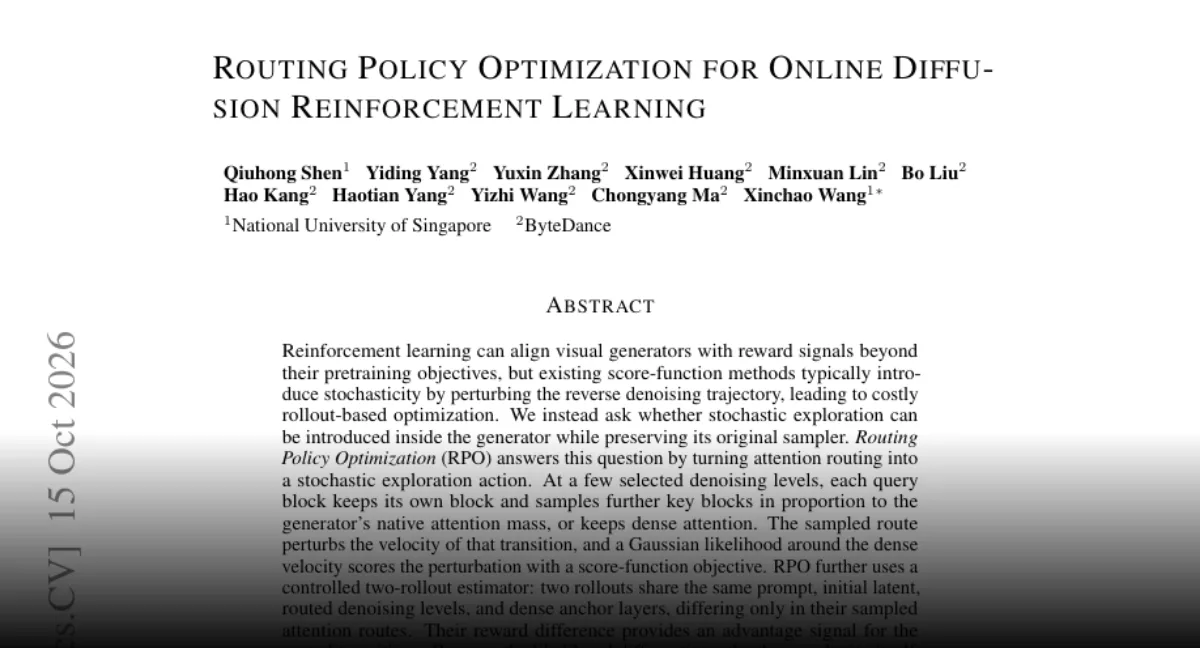
Routing Policy Optimization (RPO) applies reinforcement learning to guide visual generators toward reward signals beyond their pretraining objectives. The method matters because existing score-function approaches add stochasticity by perturbing the reverse denoising trajectory, which leads to costly rollout-based optimization. RPO instead asks whether stochastic exploration can be introduced inside the generator while preserving its original sampler.
Background: Score-Function Methods Add Costly Rollouts
Reinforcement learning can align visual generators with rewards that were not part of their pretraining objectives. Existing score-function methods typically introduce stochasticity by perturbing the reverse denoising trajectory. The reverse denoising trajectory is the sequence of steps that transforms an initial latent state into an image or video. When randomness is added along that sequence, training may need repeated rollouts to evaluate the generated result, making optimization costly.
Development: RPO Turns Attention Routing Into Exploration
RPO answers the question by turning attention routing into a stochastic exploration action. Attention routing selects which key blocks a query block attends to inside the generator. At a few selected denoising levels, each query block keeps its own block. It then samples further key blocks in proportion to the generator’s native attention mass, or it keeps dense attention. Dense attention means the query block attends to all key blocks rather than a sampled subset.
The sampled route perturbs the velocity of that transition. In this setting, velocity refers to the predicted update direction for a denoising step. A Gaussian likelihood around the dense velocity scores the perturbation with a score-function objective. A Gaussian likelihood can be understood as a probability model centered on a reference value; here, the reference value is the dense velocity.
Latest Progress: A Controlled Two-Rollout Estimator Supports Dense Inference
RPO further uses a controlled two-rollout estimator. The two rollouts share the same prompt, initial latent, routed denoising levels, and dense anchor layers. Dense anchor layers are layers kept unchanged between the paired rollouts. The estimator isolates the effect of route choice by holding the rest of the rollout fixed. The rollouts differ only in their sampled attention routes. Their reward difference provides an advantage signal for the routed transitions. An advantage signal is a relative comparison used by reinforcement learning to judge whether one sampled route was better than the other.
Because the likelihood differentiates the dense velocity itself, the learned updates remain effective after routing is removed. At inference, RPO restores dense attention and retains the original deterministic sampler. A deterministic sampler follows the same generation path for the same input, without adding stochasticity at inference time.
Current Stage: Training-Only Exploration With Nearly 4x Efficiency
Experiments on text-to-image and text-to-video generation show that RPO improves generation quality while achieving nearly 4x higher training efficiency than Flow-GRPO-style methods. The current stage is therefore a training-only exploration mechanism: routing is used to learn from reward differences, then removed so the generator can restore dense attention and keep its original deterministic sampler.
Comments
No comments yet. Be the first to comment.