
Acting Is Conducted Through the Registers
RegisterWAM uses non-spatial registers and flow-matching to reorganize visual features, improving robot action success and real-world manipulation.
Key Takeaways
- RegisterWAM improves World Action Models by adding learnable non-spatial registers to organize action-relevant visual information for robot action conditioning.
- It addresses persistent high-norm spatial outliers in generative visual representations, which make it unclear which visual features drive action decisions.
- The method pairs registers with observation flow-matching loss supervision to suppress spatial outliers and concentrate useful high-norm responses in the registers.
- RegisterWAM reports 81.64% success on LIBERO-Plus and 93.0% average success on RoboTwin 2.0, along with improved real-world manipulation performance.
- The core contribution is a representation reorganization that may become a stronger interface between visual representations and robot action learning.
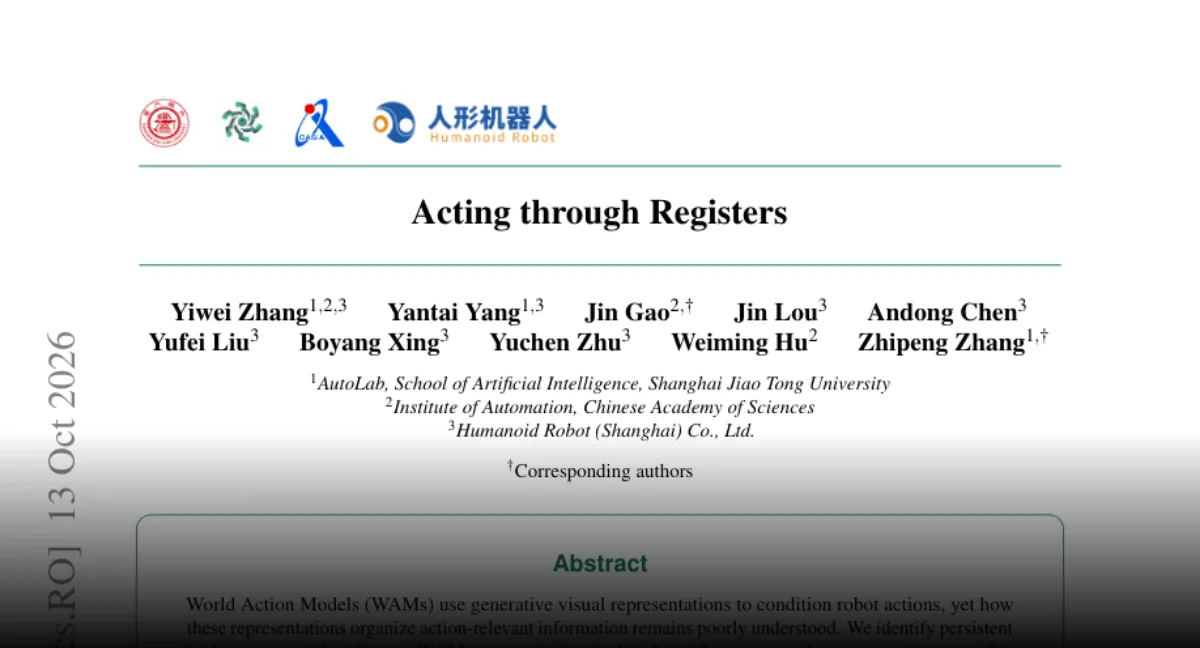
RegisterWAM changes how World Action Models handle their internal visual features. These models use generative visual representations to condition robot actions, but the organization of action-relevant information inside those representations has remained poorly understood. The new method adds learnable non-spatial registers and reports 81.64% success on LIBERO-Plus and 93.0% average success on RoboTwin 2.0, along with improved real-world manipulation performance.
Background: A Poorly Understood Representation Problem
World Action Models condition robot actions through generative visual representations. The unresolved question is not only whether those representations carry visual detail, but whether they arrange the detail in a form that action conditioning can use reliably. The work identifies persistent high-norm spatial outliers inside these representations. These are locations whose vector magnitudes stand far above surrounding features. Their action relevance persists even after normalization and key-value projection attenuate their extreme magnitude, so large magnitude and useful information can remain coupled. That coupling makes it harder to see which parts of the representation drive action choices.
Development Process: Registers, Flow-Matching Loss, and Noised Observation Recovery
RegisterWAM responds to that coupling by adding learnable non-spatial registers to the world model and using them directly for action conditioning. The registers are not tied to a particular spatial location, so they give the model another place to gather action-relevant information. Registers alone do not fully eliminate spatial outliers. The method pairs them with observation flow-matching loss supervision, which suppresses spatial outliers while concentrating high-norm responses in registers. Observation flow-matching loss supervision also improves action learning without registers, motivating an additional noised-observation flow-matching objective that learns current-scene recovery from corrupted inputs. The flow-matching supervision therefore has two roles: it reshapes where high-norm responses appear, and it strengthens action learning even when registers are absent.
Latest Progress: LIBERO-Plus, RoboTwin 2.0, and Real-World Results
The resulting model achieves 81.64% success on LIBERO-Plus without additional embodied pretraining data or foundation models. It reaches 93.0% average success on RoboTwin 2.0 and improves real-world manipulation performance. LIBERO-Plus gives a success percentage, while RoboTwin 2.0 gives an average success percentage. The LIBERO-Plus figure remains tied to the stated setup, not to extra embodied pretraining data or foundation models. The real-world gain is described as improved manipulation performance, with no separate numeric score given.
Current Stage: Reorganized Representation as the Baseline
The current stage is a representation reorganization: non-spatial registers are intended to carry high-norm action-relevant responses, observation flow-matching loss supervision suppresses spatial outliers, and noised-observation flow-matching adds recovery from corrupted inputs. The reported anchors remain 81.64% success on LIBERO-Plus, 93.0% average success on RoboTwin 2.0, and better real-world manipulation performance. The next evidence to watch is whether the register pathway remains the main interface between generative visual representation and action conditioning. What follows is whether the same register-plus-flow-matching pattern extends beyond these reported settings while preserving the condition of no additional embodied pretraining data or foundation models.
Meta description
RegisterWAM adds learnable non-spatial registers to World Action Models, reaching 81.64 percent on LIBERO-Plus and 93.0 percent on RoboTwin 2.0
Tags
RegisterWAM, World Action Models, robot manipulation, LIBERO-Plus, RoboTwin 2.0
Featured image
abstract visualization of non-spatial registers guiding robot action conditioning, no real people, no company logos, no text
Comments
No comments yet. Be the first to comment.