
Speculative Forcing Enables Efficient Autoregressive Video Generation
Speculative Forcing freezes confident tokens early in few-step autoregressive video generation, cutting denoising work while preserving quality.
Key Takeaways
- Speculative Forcing reduces wasted computation in few-step autoregressive video generation by letting tokens that need little refinement stop early.
- The method treats intermediate clean estimates as drafts, accepts some tokens early, and freezes them while keeping their cached keys and values as context for later tokens.
- It uses two verifier designs: a training-free similarity-and-stability check and a learned estimator based on intermediate features.
- On LongLive, it matches a four-step generator while averaging about 1.7 denoising steps per token and achieving over 1.5x speedup.
- On Lingbot-World 2.0, it preserves quality with about 2.5 denoising steps per token and runs 1.35x faster, showing effectiveness even under changing camera motion.
Speculative Forcing Reduces LongLive Video Generation to 1.7 Denoising Steps
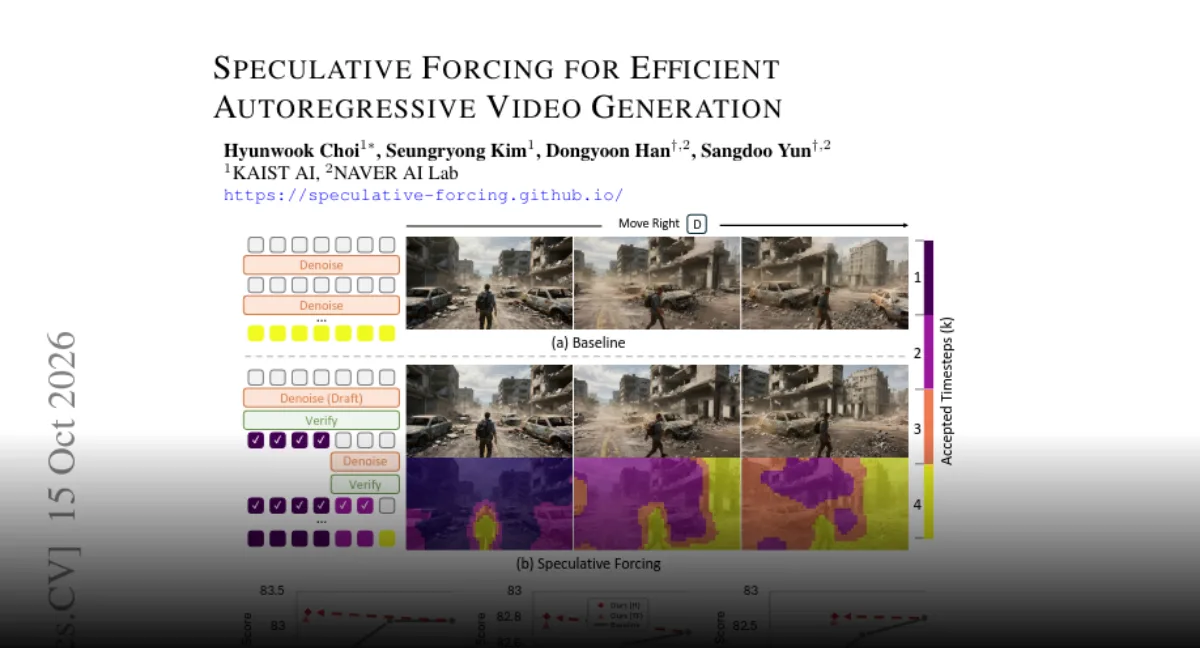
Speculative Forcing addresses an inefficiency in few-step autoregressive video generators used for streaming generation: every token passes through the final denoising step even when it needs little refinement. The method treats intermediate clean estimates as drafts, accepts some tokens early, and freezes them while leaving their cached keys and values as context for later tokens. In reported tests, it preserved full-step sampling quality while lowering the average denoising work to about 1.7 steps per token on LongLive and about 2.5 steps per token on Lingbot-World 2.0.
Background: The cost of uniform refinement
Few-step autoregressive video generators make streaming generation practical by producing content sequentially, token by token. These systems still apply the final denoising step to every token, regardless of how much refinement the token actually requires.
That uniform policy creates a gap between necessary work and wasted work. Some tokens already closely match their eventual full-step outputs during the initial steps. Others need continued refinement until the end. Treating both groups identically means the generator spends computation on tokens that are effectively finished.
Development: Drafting, accepting, and freezing tokens
Speculative Forcing reframes intermediate clean estimates as drafts. Instead of waiting for the last step for all tokens, the framework predicts when an individual token can be safely accepted early. Once accepted, the token is frozen as its final output and undergoes no further denoising.
The accepted token does not disappear from the process. Its cached keys and values remain available as context for the remaining tokens, so the generator can continue using the frozen content as part of the evolving sequence.
The framework explores two verifier designs for deciding early acceptance. The first is training-free and relies on similarity to clean content and stability across steps. The second is learned and reads the frozen generator's intermediate features to estimate each token's remaining gap to its full-step output.
Latest Progress: Speed on short, long, and world generation
The method is tested across short-video, long-video, and world generation. In these settings, Speculative Forcing preserves the quality of full-step sampling while substantially reducing computation.
On LongLive, it matches the four-step generator while averaging about 1.7 denoising steps per token. The reported speed is over 1.5x faster, with output rates of 41.7 and 37.8 fps.
On Lingbot-World 2.0, the case is more demanding because camera motion continually changes the visible content. Even there, the method maintains quality with about 2.5 denoising steps per token and runs 1.35x faster at 24.5 fps.
Current Stage: A token-level scheduling layer for streaming video models
The reported results describe Speculative Forcing as a scheduling layer for few-step autoregressive video generators. Its contribution is a decision mechanism: which tokens can stop early and which tokens should keep refining.
The next point to watch is how far token-level early acceptance can reduce computation across more generation modes. The LongLive and Lingbot-World 2.0 numbers show the mechanism working in streaming and camera-motion settings, while preserving full-step sampling quality.
Comments
No comments yet. Be the first to comment.