
Learning from executable oracle continuations enables long-horizon agent-based reinforcement learning.
SERO improves agent training via long-horizon oracle continuations from visited states, weighted by reachability, with no oracle at inference.
Key Points
- SERO addresses long-horizon agentic reinforcement learning by adding training-only oracle continuations from states actually visited by the current policy.
- Oracle-generated future steps are weighted by policy-reachability, so supervision becomes more effective when the policy behavior aligns with the oracle branch.
- The oracle loss is optimized separately from the base reinforcement learning estimator, and no oracle is used during inference.
- On ALFWorld and WebShop, learning full executable oracle continuations outperforms supervising only the root oracle action, while reachability weighting improves out-of-distribution performance.
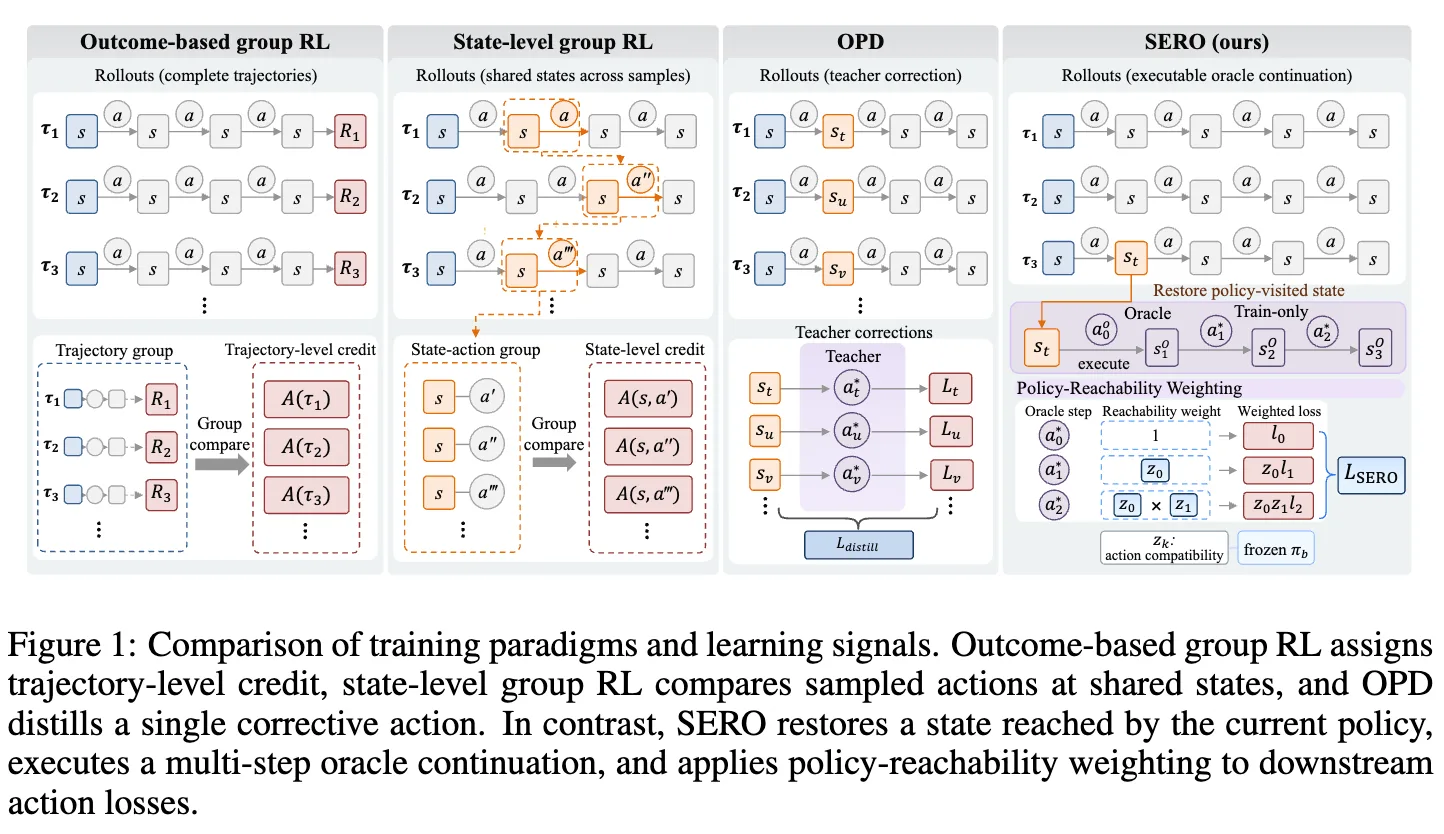
State-Rooted Executable Rollout Optimization, or SERO, addresses a practical gap in long-horizon agentic reinforcement learning: training signals depend on states and actions the current policy actually visits. When policy rollouts fail to reach useful behaviors, better credit assignment cannot supervise states and actions that were never encountered. SERO adds a training-only oracle continuation to those visited states, then weights the oracle steps according to how compatible they are with the policy's earlier behavior.
Background: Policy Visits Limit Training Reach
Long-horizon agentic reinforcement learning is constrained by the futures visited by the current policy. A rollout is a sequence of states, actions, and observations produced by the policy being trained. If that sequence never reaches useful behaviors, improved credit assignment, the process of linking rewards to earlier states and actions, has no supervision signal for the missing states and actions.
On-policy distillation introduced teacher guidance on policy-induced states, meaning states that arise from the policy's own trajectory rather than a fixed dataset. Recent multi-turn variants improved how this guidance is scheduled, replayed, refined, or validated. Yet a remaining limitation is that those variants do not directly use the oracle-controlled future itself as the training trajectory.
Development: Executable Oracle Continuations and Reachability Weighting
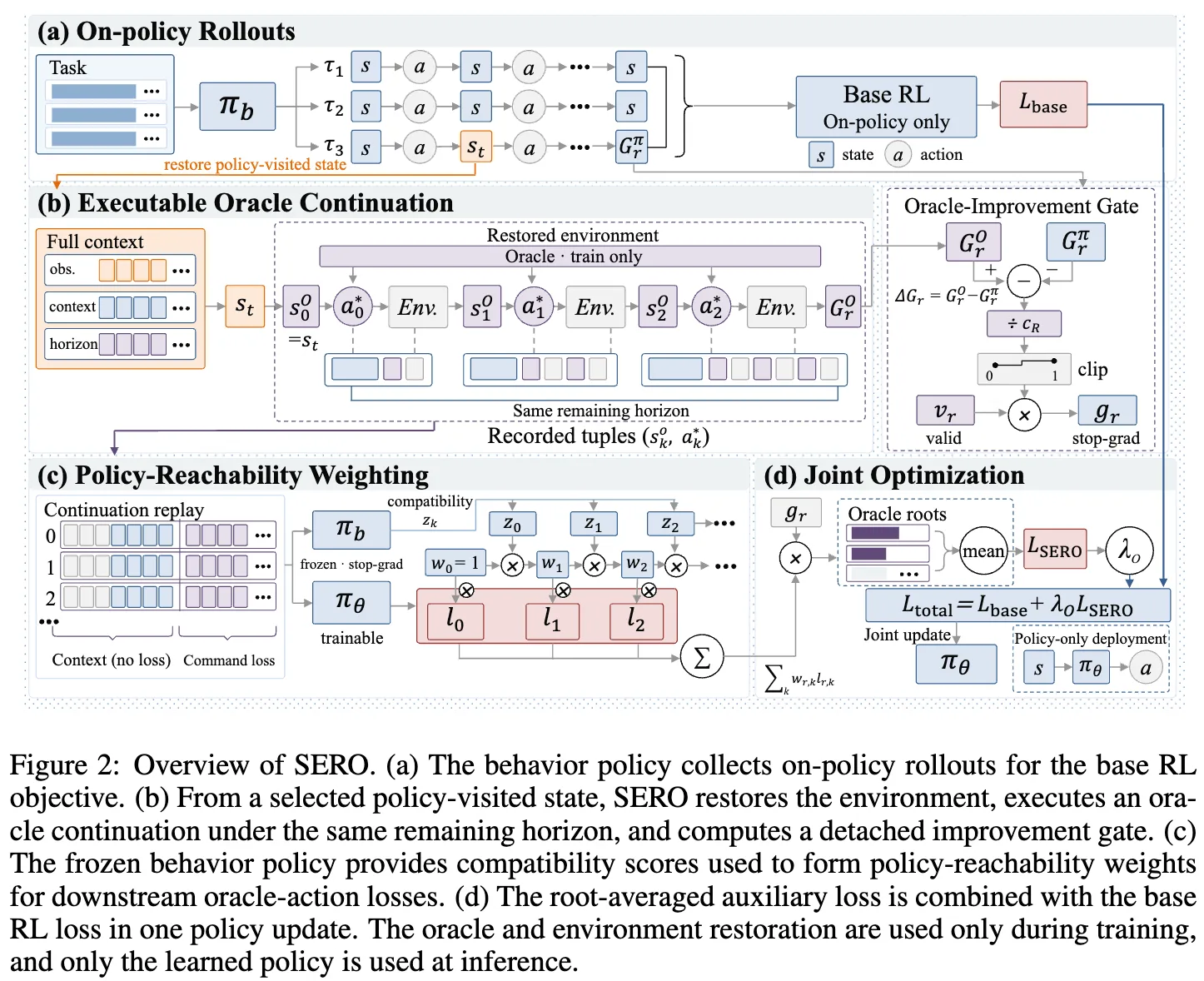
SERO changes the training path by starting from a state actually reached by the current policy. From that restored state, a training-only oracle continues interacting with the real environment. The resulting downstream observations and oracle actions become available for learning.
The method then applies policy-reachability weighting. Each oracle step is weighted by the compatibility between the frozen behavior policy, a fixed policy used for this weighting, and the preceding oracle actions. This design lets deeper supervision become effective as the policy becomes more compatible with the oracle branch. The oracle loss is optimized separately from the base reinforcement learning estimator. No oracle is used at inference time.
Latest Progress: Results on ALFWorld and WebShop
The evaluation covers two challenging interactive-agent benchmarks, ALFWorld and WebShop, and uses two model scales: Qwen2.5-1.5B-Instruct and Qwen2.5-7B-Instruct. On ALFWorld, learning the full executable continuation is substantially more effective than supervising only the root oracle action. Policy-reachability weighting further improves out-of-distribution performance.
The current stage, based on the reported setup, is a training-only augmentation path for on-policy agentic reinforcement learning. It restores policy-reached states, lets an oracle continue in the real environment during training, and uses reachability weighting to decide how much the oracle branch should influence learning. What to watch next is how the combination of executable oracle continuations, separate oracle loss, and no inference oracle behaves when applied to additional interactive-agent tasks.
Comments
No comments yet. Be the first to comment.