
Conformal Self-Verification Enables Web Agent Training and Test-Time Scaling
Conformal self-verification turns judge feedback into a reusable question bank for dense training and test-time selection without external judges.
Key Points
- CLIFT converts expensive judge feedback into a reusable bank of verification questions, each tied to a URL scope, polarity, and calibrated trust weight.
- The verification bank provides dense training signals and enables Conformal Trajectory Selection (CTS) at test time, removing the need for an external judge during evaluation.
- CLIFT improves web agent performance: 74.6% on WebArena Infinity, 53.7% on VisualWebArena, and 61.0% on Online Mind2Web.
- The method supports transfer to frozen models and adaptation to new environments without necessarily fine-tuning the underlying policy.
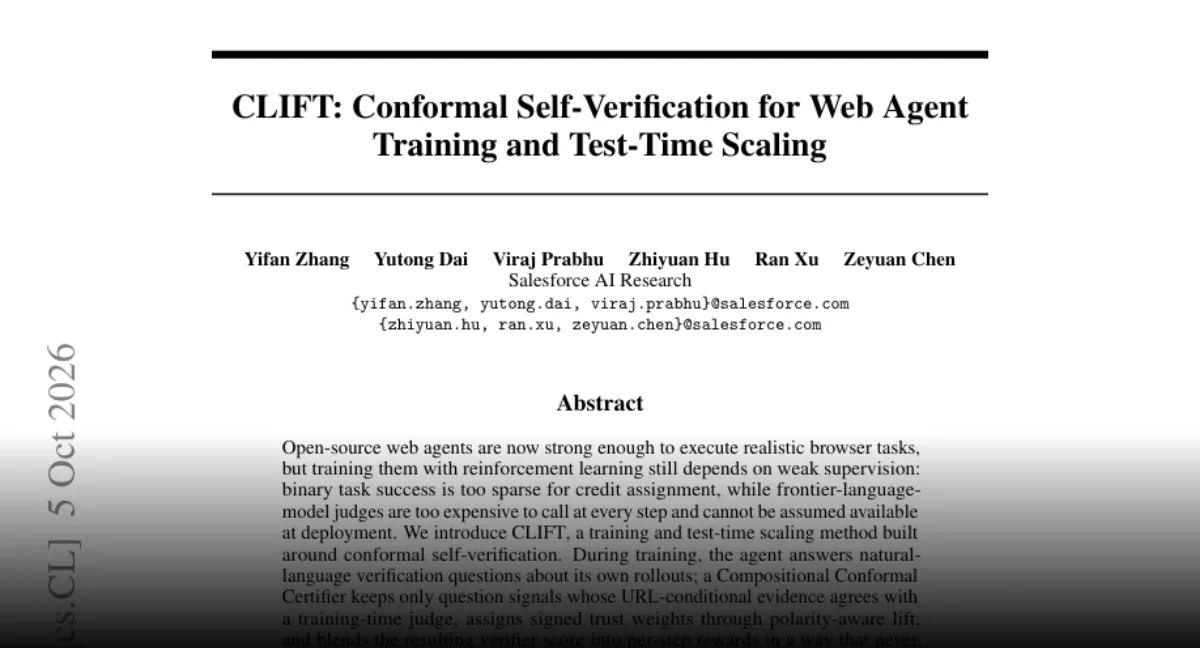
Researchers have introduced CLIFT, short for Conformal Self-Verification for Web Agent Training and Test-Time Scaling, a method that converts costly judge feedback into a persistent bank of verification questions. Each question in the bank carries a URL scope, a polarity, and a calibrated trust weight. The bank supplies dense feedback during training and then powers Conformal Trajectory Selection (CTS) at test time, removing the need for an external judge during evaluation.
Background: Why Judge Feedback Is the Bottleneck
Web agents are typically trained and evaluated with the help of a judge model that scores trajectories. That feedback is expensive and, once used, is usually discarded. CLIFT's premise is that the same feedback can be captured as reusable verification questions rather than one-off scores. Scoping each question to a URL, assigning it a polarity, and calibrating a trust weight lets the resulting bank serve two roles: a dense training signal and a selection mechanism at inference. CTS then picks one trajectory per task from the candidates the agent produces, using the bank instead of an external judge.
Development: Three Evaluation Settings
The reported results cover three settings, each exercising a different part of the pipeline.
On WebArena Infinity, Gemma-4 combined with CLIFT and CTS reached 74.6% success, a gain of 12.8 percentage points over the base model at K = 3.
On VisualWebArena, transferring the bank to a frozen GPT-5.5 produced 53.7% weighted success at K = 4.
On Online Mind2Web, the method reached 61.0% success, 11.3 points above GPT-5.5 running at high effort. This result came from bank adaptation and recalibration without any policy fine-tuning specific to OM2W, at K = 4.
Latest Progress: Selection Without an External Judge
Across the CTS evaluations, each task returns exactly one selected trajectory. That detail matters for deployment: the selection step is self-contained once the bank exists, so evaluation does not depend on calling a judge for every candidate. The Online Mind2Web result further suggests the bank can be adapted and recalibrated to a new environment without retraining the underlying policy, while the VisualWebArena result points to transfer onto a frozen model.
What to Watch
The open questions center on how well a bank built in one web environment holds up in another, and on how trust weights should be recalibrated when the target environment shifts. The researchers are soliciting feedback on reusable verification and on transfer across web environments, so expect follow-up work to probe the boundaries of both.
Comments
No comments yet. Be the first to comment.