
Persistent Planar Memory Supports Video World Models
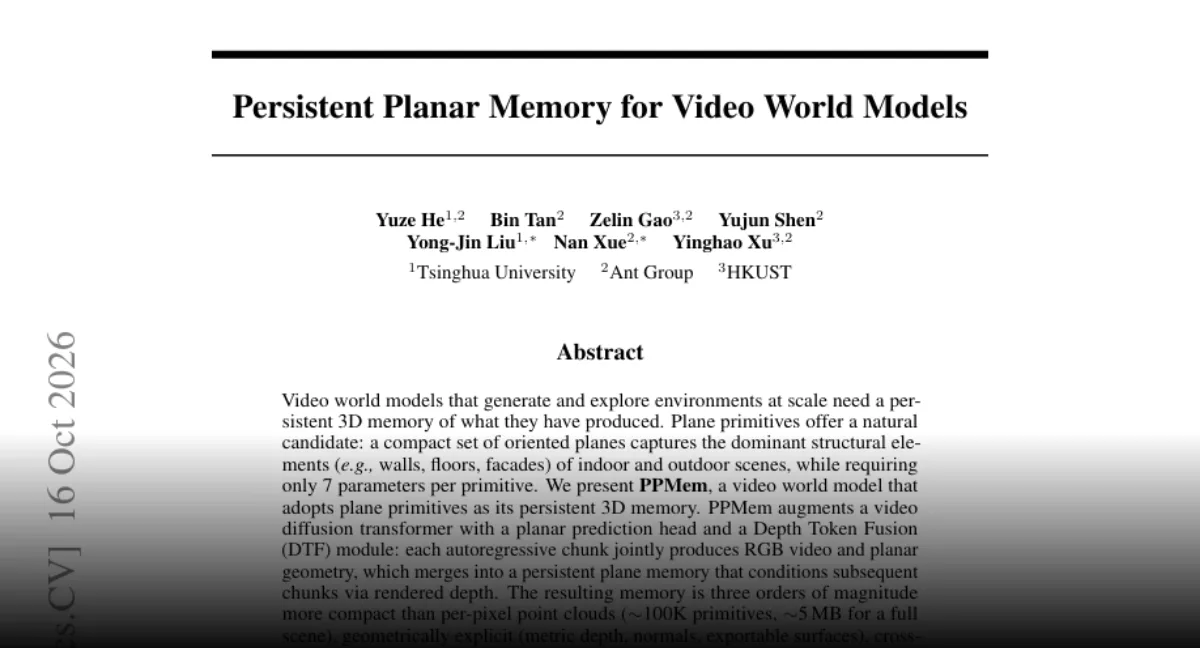
PPMem uses plane primitives as persistent 3D memory in video diffusion models, enabling coherent long videos with metric depth, normals, and surfaces.
Key Takeaways
- PPMem uses compact oriented plane primitives as persistent 3D memory to help video world models generate long, coherent videos.
- Each plane primitive requires only 7 parameters, making the memory much more compact than dense per-pixel point clouds.
- The system adds a planar prediction head and Depth Token Fusion to a video diffusion transformer, allowing each generated chunk to produce both video and geometry.
- Later video chunks are conditioned on rendered depth from the stored plane memory, improving cross-view consistency and reducing the need to reconstruct scenes from scratch.
- Reported results show about 100,000 primitives and roughly 5MB per full scene, with metric depth, surface normals, exportable planar geometry, and coherence across hundreds of frames.
Meta description: PPMem uses plane primitives as persistent 3D memory in a video world model, adding Depth Token Fusion for coherent long videos and metric geometry on DL3DV.
Tags: PPMem, video world models, 3D memory, plane primitives, Depth Token Fusion
Featured image: Abstract technology style: translucent oriented planes inside a streaming video frame, no real people, no company logos, no text.
Background: Why Video World Models Need Persistent Memory
PPMem video world model is described as a system that uses compact plane primitives as persistent 3D memory to generate long coherent videos with explicit metric geometry. The problem it addresses is scale. Video world models that generate and explore environments need to remember what they have already produced, because the next generated views must stay aligned with earlier ones. Without persistent memory, generated views can drift, lose consistency, or fail to preserve the geometry of walls, floors, facades, and other large structures.
Plane primitives offer a natural candidate. Each primitive is a compact oriented plane that captures dominant structural elements in indoor and outdoor scenes while requiring only 7 parameters. The method frames this as a practical path toward persistent memory: the representation is small enough to store, but structured enough to guide later generation.
Development Process: How PPMem Turns Planes into Memory
The method builds on a video diffusion transformer and adds two components: a planar prediction head and a Depth Token Fusion module. The model generates video in autoregressive chunks. Each chunk jointly produces red-green-blue video and planar geometry. The planar geometry is merged into a persistent plane memory.
Later chunks are conditioned on that memory through rendered depth, so the model does not need to reconstruct the whole scene from scratch at every step. This makes the memory adaptive, because the merging procedure refines the stored planes as generation proceeds. It also keeps the memory cross-view consistent, because the shared backbone jointly predicts the video and geometry rather than treating them as unrelated outputs.
Because each chunk produces both video and geometry, the model has a direct path from generated pixels to a stored 3D representation that can guide later frames.
Latest Progress: Compact Memory and Explicit Geometry
The reported memory is three orders of magnitude more compact than per-pixel point clouds, with about 100,000 primitives and 5MB for a full scene. It is geometrically explicit, providing metric depth, surface normals, and exportable surfaces.
On DL3DV and RealEstate10K, PPMem is said to outperform prior 3D-grounded world models in video quality while jointly producing metric-scale depth, surface normals, and exportable planar geometry. The system sustains coherence across hundreds of frames under large viewpoint changes. The project page is https://hyzcluster.github.io/ppmem.
The compact memory and explicit outputs together address two needs: efficient storage and geometry that can be reused for later generation.
Current Stage: A Research Demonstration of Plane-Based Memory
PPMem is presented as a research system for video world modeling, not as a finished consumer platform. Its contribution is the use of plane primitives as persistent 3D memory inside a video diffusion pipeline. The key numbers are the 7 parameters per primitive, the about 100,000 primitives and 5MB full-scene estimate, and the hundreds-of-frames coherence claim.
The current stage shows that a compact planar representation can support long video generation and explicit geometry output. Further evaluation beyond the reported DL3DV and RealEstate10K results will determine how broadly the approach can be used. The public project page provides the entry point for inspecting the method and its reported results.
Comments
No comments yet. Be the first to comment.