
We Scale Parameter-Efficient Fine-Tuning for Brain Encoding
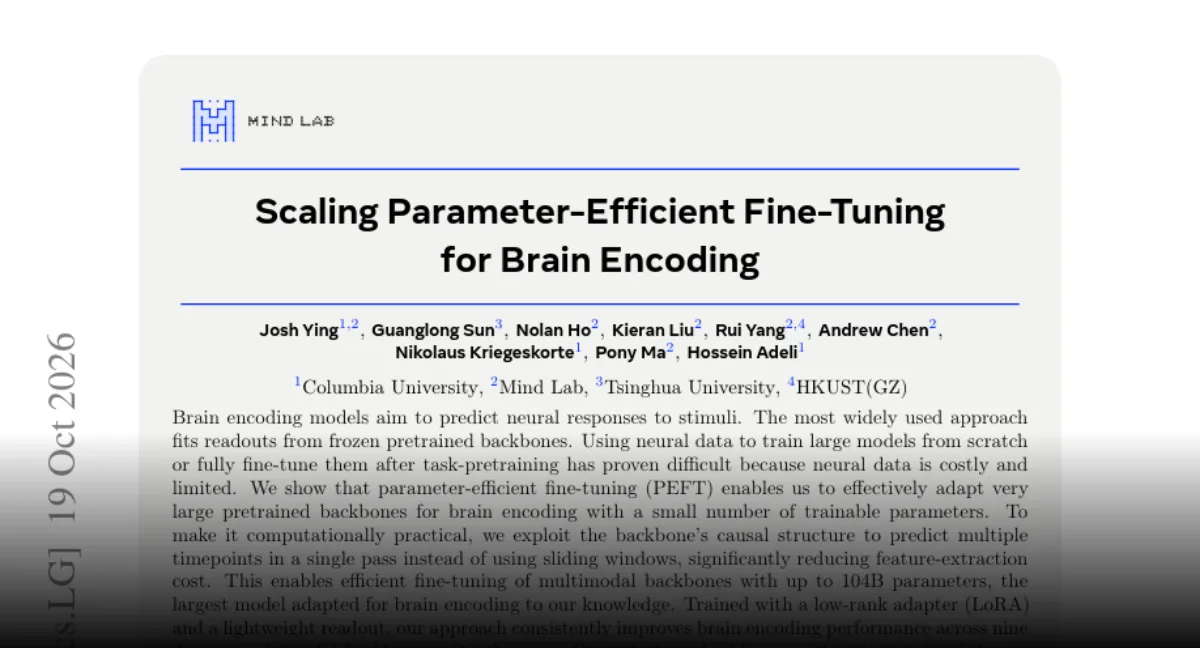
BrainLoRA uses low-rank adapters to fine-tune 104B multimodal backbones, boosting brain encoding and topping Algonauts 2025 with 200+ models.
Key Takeaways
- BrainLoRA shows that parameter-efficient fine-tuning (PEFT), especially LoRA, can adapt very large multimodal pretrained backbones for brain encoding, helping overcome the high cost and limited scale of neural datasets.
- By combining low-rank adapters with causal multi-timepoint prediction, the method makes fine-tuning computationally practical and enables adaptation of backbones with up to 104B parameters.
- On the Algonauts 2025 Challenge, using the same Qwen3-Omni backbone as prior state-of-the-art systems, BrainLoRA achieves the best published brain encoding performance.
- A multi-LoRA kernel accelerates joint training of many adapters, enabling a 200+ model ensemble that ranks first on the public post-challenge leaderboard.
Meta description: BrainLoRA applies PEFT to 104B multimodal backbones for brain encoding, lifting performance on the Algonauts 2025 Challenge and a 200+ model ensemble.
Tags: BrainLoRA, PEFT, LoRA, Qwen3-Omni, Algonauts 2025
Featured image: Abstract neural network with multimodal input streams, low-rank adapter nodes, and a prediction graph; no text, no people, no logos.
BrainLoRA shows that parameter-efficient fine-tuning (PEFT) can adapt very large multimodal pretrained backbones for brain encoding, turning expensive neural data into a smaller training problem. For researchers building models that predict neural responses to stimuli, the result points to a path around a long-standing bottleneck: neural datasets are costly and limited, while the most widely used approach fits readouts from frozen pretrained backbones.
Background: Frozen Backbones Hit a Data Wall
Brain encoding models aim to predict neural responses to stimuli. The dominant workflow attaches readouts to frozen pretrained backbones, leaving the backbone weights unchanged. That strategy avoids the largest cost of training on neural data, but it also limits how closely the backbone can match the structure of brain activity.
Training large models from scratch on neural data, or fully fine-tuning them after task-pretraining, has proven difficult. The limiting factor is not model size alone; it is the high cost and limited scale of neural data. The practical question became how to adapt very large pretrained backbones without paying the full price of training them directly on brain measurements.
Development: LoRA and Causal Prediction Reduce the Cost
PEFT provides a way through the data wall by changing only a small number of trainable parameters. In this work, the adaptation uses a low-rank adapter (LoRA) plus a lightweight readout. That keeps the bulk of the pretrained backbone frozen while still allowing task-specific behavior to emerge.
To make the approach computationally practical, the method exploits the backbone's causal structure. Instead of using sliding windows over time, it predicts multiple timepoints in a single pass. This significantly reduces feature-extraction cost, which matters because multimodal backbones can be extremely large and brain encoding requires repeated inference over stimulus sequences.
The efficiency gain enabled fine-tuning of multimodal backbones with up to 104B parameters, the largest model adapted for brain encoding to our knowledge. Across nine diverse multimodal backbones, the approach consistently improved brain encoding performance.
Latest Progress: Best Published Result and a 200+ Model Ensemble
The benchmark result came on the Algonauts 2025 Challenge. Using the same Qwen3-Omni backbone as the prior state-of-the-art, BrainLoRA achieved the best published performance on that challenge. The result showed that a small trainable adapter layer can compete with, and surpass, prior brain encoding systems built around the same large model.
The adapted multimodal backbones also remained interpretable. Modality attribution recovers the canonical sensory topography that prior work often obtains by construction from separate unimodal encoders. Neural adaptation further increased the contribution of audio inputs and cross-modal mixing within the backbone, giving a clearer view of how multimodal features are reshaped during adaptation.
To scale the number of adapted models, this work develops a multi-LoRA kernel that accelerates joint training of multiple LoRAs on a shared backbone. This enabled an ensemble of 200+ adapted models that ranks first on the public Algonauts post-challenge leaderboard at the time of writing.
What to Watch Next
The broader signal is that PEFT can serve as an efficient and powerful paradigm for brain encoding when neural data remains expensive and limited. What to watch next is whether this pattern holds as multimodal backbones grow larger, as more LoRA variants are trained jointly, and as challenge leaderboards expand the number of adapted models that can be compared directly.
Comments
No comments yet. Be the first to comment.