
Progress-Aligned Recurrence Enhances Length Generalization in State Tracking
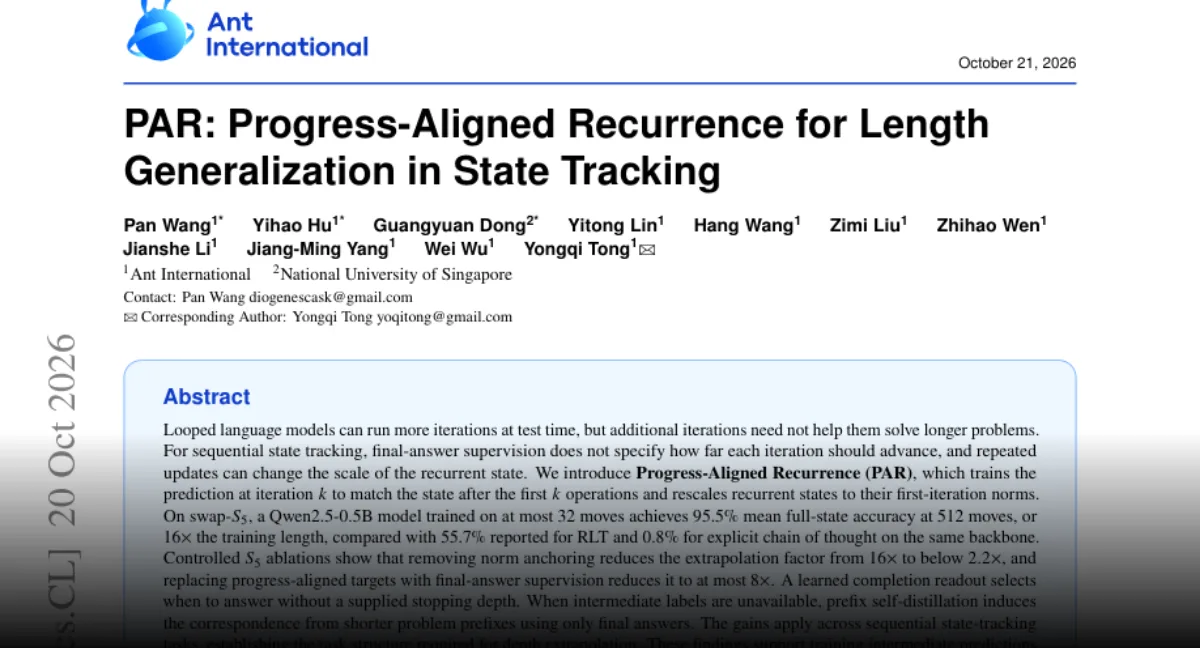
Progress-aligned recurrence aligns loops with task progress and rescales hidden states, enabling length extrapolation on S5 state-tracking tasks.
Key Takeaways
- PAR improves length extrapolation in looped language models by aligning each loop with task progress and rescaling hidden states to reduce drift.
- Baseline methods struggle when test sequences exceed training length, with fixed-depth models often falling to near-random accuracy at 16x extrapolation.
- On swap-S5, a 0.5B PAR model reaches 95.5% full-state accuracy at 512 steps, outperforming RLT and chain-of-thought.
- On single-query S5, PAR substantially beats fixed-depth Qwen2.5 and Qwen3 models, with best Qwen2.5 runs achieving 100% accuracy at 16x training length.
- PAR can be trained using only final-answer supervision, eliminating the need for step-by-step intermediate state labels in the tested setting.
Meta description: PAR improves length extrapolation in looped language models by predicting per-loop states and rescaling hidden states, raising accuracy on S5 tasks.
Tags: PAR, looped language models, length extrapolation, Qwen, S5
Featured image: abstract technology-style looped network with five boxes and arrows, no real people, no company logos, no text
PAR is a new method for length extrapolation in looped language models, tested on a state-tracking task where a model must follow swaps among five boxes. Its results matter because looped models reuse computation across steps, but earlier evidence showed that extra loops or larger fixed-depth models could fail when test sequences became longer than training sequences.
Background: Short Training, Long Testing
The task gives five boxes, one object in each. A sequence of swaps is applied, and the model must answer what is inside each box. Models are trained on short sequences and tested as sequences become much longer. The source notes that simply running more loops is not enough: performance breaks down at just 2 times the training length. Scaling up the model alone does not solve it either. On single-query S5, fixed-depth Qwen2.5 models from 0.5B to 7B achieve only around 20% accuracy at 16 times the training length, which is described as roughly random guessing.
Two obstacles are identified. First, supervising only the final answer leaves the model without clear guidance on how far to advance in each loop. Second, repeatedly applying the same layers hundreds of times causes the hidden-state scale to drift. In this setting, hidden states are the internal activations that carry the model's representation of the task as it processes or revises a sequence.
Development: PAR Aligns Loops With Progress
PAR introduces two changes to the looped-model setup. At loop k, the model predicts the state after the first k steps. After each loop, the hidden states are rescaled to match their scale in the first loop. These changes are intended to align loops with task progress, making the rule effectively one loop, one step. The method therefore treats loop count as a visible signal of how far the model should have moved through the swap sequence, while the rescaling step attempts to keep repeated computation stable.
Latest Progress: Results on swap-S5 and single-query S5
On swap-S5, a 0.5B model trained on sequences of at most 32 steps reaches 95.5% full-state accuracy at 512 steps. That corresponds to a 16 times length extrapolation from the training horizon. The previous best method, RLT, achieves 55.7%, while the same model using chain-of-thought reaches just 0.8%.
On single-query S5, PAR is reported to substantially outperform fixed-depth models at every tested size. The tested Qwen2.5 sizes are 0.5B, 1.5B, 3B, and 7B. The tested Qwen3 sizes range from 0.6B to 4B. Across all four Qwen2.5 sizes, the best training runs achieve 100% accuracy at 16 times the training length.
The model can also learn when to stop. PAR can be trained with final-answer supervision alone, without intermediate-state annotations. This reduces the need for step-by-step labels that directly tell the model the state after each part of the task.
Current Stage: Loop-Aware State Tracking
PAR positions length extrapolation as a problem of matching internal loops to external task steps and controlling hidden-state drift, rather than only adding loops or increasing parameter count. The reported results show high accuracy on swap-S5 and single-query S5 at tested model sizes, including full-state tracking at 512 steps for a 0.5B model and 100% accuracy at 16 times training length for the best Qwen2.5 runs. The evidence also shows that final-answer supervision can be enough to train the method, suggesting that intermediate state labels are not required in the tested setting.
At present, PAR is presented as a method evaluated on S5 state-tracking tasks with looped language models. Its contribution is the demonstration that loop-aligned prediction and hidden-state rescaling can improve performance when sequences grow well beyond the training length.
Comments
No comments yet. Be the first to comment.