
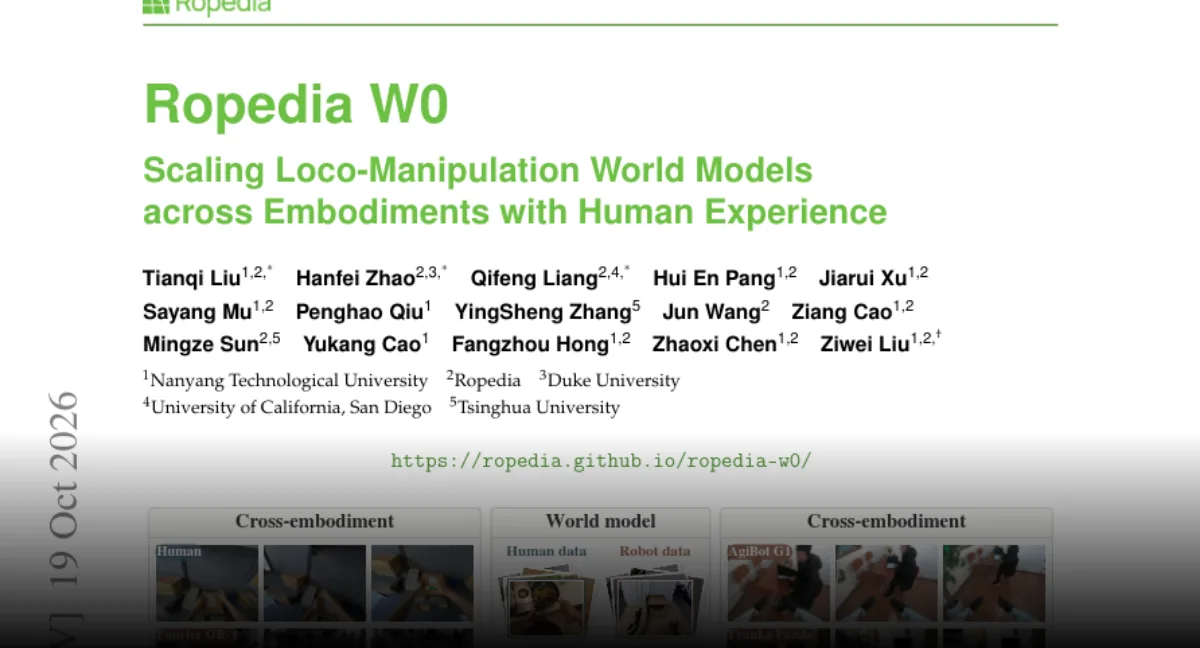
Ropedia Whitepaper 0 scales loco-manipulation world models across embodiments using human experience.
Ropedia W0 learns loco-manipulation from 13,000 hours of human and robot video, transferring predictions across embodiments and enabling VR rollouts.
Key Takeaways
- Ropedia W0 is an egocentric world model that learns loco-manipulation from 13,000 hours of human and robot video.
- It uses a shared interface of camera poses and projected kinematic skeletons to transfer across humans, robot arms, humanoids, grippers, and dexterous hands.
- Large-scale human video improves prediction quality, while robot video grounds the model in real embodiments.
- The model leads on five robot benchmarks and held-out human videos across zero-shot, few-shot, and full-data settings.
- It supports practical uses such as real-time minute-long VR rollouts, policy evaluation, model-based planning, and world-action modeling.
Meta description: Ropedia W0 learns loco-manipulation from 13,000 hours of human and robot egocentric video and transfers it across robot arms and humanoid robots.
Tags: Ropedia W0, egocentric world model, robot learning, loco-manipulation, humanoid robots
Featured image: abstract technology style showing camera poses, projected skeletons, and robot arm and humanoid forms without people, logos, or text.
Ropedia W0 is an egocentric world foundation model built to learn loco-manipulation, or coordinated movement and object handling, from human and robot video. Its value lies in a shared interface: camera poses and projected kinematic skeletons let the same predictive model span human experience, robot arms, humanoids, grippers, and dexterous hands.
Background: Shared Experience Becomes a Common Interface
The core idea is not to train a separate model for each robot form. Ropedia W0 uses one kinematic interface for humans and diverse robots. The model is conditioned on camera poses and projected kinematic skeletons, so a first-person view can be interpreted whether the body is a person, a robot arm, a humanoid, or an end effector such as a gripper or dexterous hand.
This shared representation is what makes transfer possible. Human video can supply experience that helps predict robot scenes, while robot video can anchor predictions to actual machine embodiments. The reported dataset totals 13K hours, or 13,000 hours, combining 10K hours of human egocentric video and 3K hours of robot egocentric video.
The practical meaning is that the model does not treat camera movement and body motion as isolated inputs. It uses them as a bridge between first-person visual experience and robot execution, allowing the same world model to read both human and machine motion patterns.
Development: 10K Human Hours and 3K Robot Hours Build the Model
The data layer gives the model more than raw first-person footage. It includes metric camera trajectories, kinematic skeletons, and hierarchical captions. Those components tie movement, body structure, and scene description together, turning egocentric video into a structured training signal for world prediction.
The scaling result is a key part of the timeline. More human pre-training data consistently improves world prediction for both humans and robots. In other words, the reported trend is that human experience does not simply add volume; it improves the model's ability to predict how scenes evolve across embodiment types.
The dataset design also separates source type: human video supplies scale, while robot video supplies embodiment-specific evidence. That division matters because it supports the central transfer claim, showing that the model can learn from broad human first-person experience and still make predictions for robot cameras and robot bodies.
Latest Progress: Five Benchmarks, Held-Out Humans, and Minute-Long Virtual Reality
The reported results are leading on five robot benchmarks and held-out human videos, spanning zero-shot, few-shot, and full-data post-training settings. This shows transfer at multiple levels of task exposure, rather than a single deployment scenario.
Because the evaluation includes held-out human videos, the result tests not only robot-to-robot transfer but also human-to-robot transfer and consistency in unseen human footage. The zero-shot, few-shot, and full-data settings also indicate how much extra robot experience is needed under different assumptions.
Applications move beyond passive prediction. Ropedia W0 supports real-time, minute-long interactive virtual reality rollouts through distillation, alongside policy evaluation, model-based planning, and world-action modeling. That places the model in a practical position: it can be used to test policies, plan actions, and generate long interactive predictions, not only score future frames.
Policy evaluation and model-based planning use the predictive world as a testbed, while world-action modeling connects predicted outcomes to action choices. The distillation step supports the real-time interactive rollout setting, where minute-long sequences require responsive generation.
The current stage is a transfer and scaling result built on 13K hours of unified experience. The next signal to watch is how far more human pre-training data can push prediction quality beyond the reported 10K human hours and 3K robot hours.
Comments
No comments yet. Be the first to comment.