
PaperCritic trains AI reviewers to assess the soundness of papers.
PaperCritic uses PaperSound-23K and reinforcement learning with quality rewards to assess soundness, beats frontier models, and transfers cross-domain.
Key Takeaways
- PaperCritic focuses on paper soundness, the most objective part of peer review, rather than subjective criteria like interestingness or clarity.
- It builds PaperSound-23K from 1K ICLR submissions, turning reviews into 23K labeled human- and LLM-written review points that can be scored.
- PaperCritic is trained with reinforcement learning using an F1 reward that balances precision and recall, encouraging correct and complete review points.
- It outperforms frontier models and other AI reviewer training methods on in-domain paper soundness evaluation.
- The method also transfers beyond ICLR paper review to Nature-family papers and tasks such as code, legal contract, and story-feedback review.
Meta description: PaperCritic uses PaperSound-23K and reinforcement learning to judge paper soundness, beating frontier models and transferring to cross-domain review.
Tags: PaperCritic, PaperSound-23K, AI reviewers, ICLR, reinforcement learning
Featured image: Abstract technology style diagram of paper review points and soundness scores, with no real people, company logos, or text.
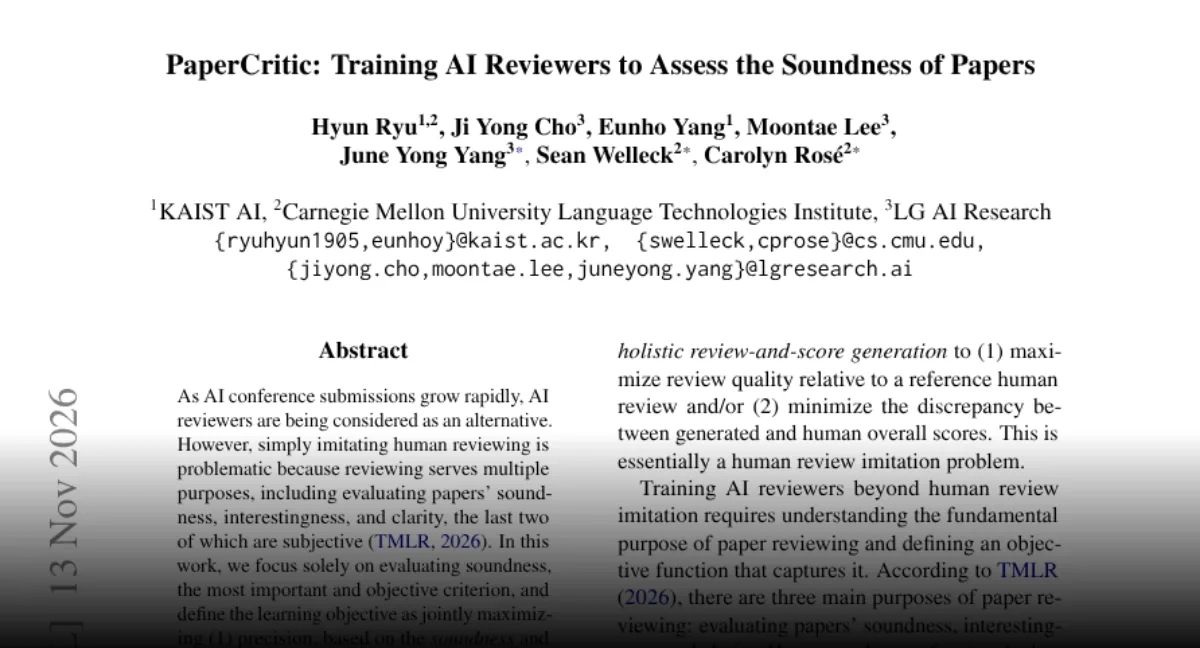
AI conference submissions are growing rapidly, and AI reviewers are being considered as an alternative. PaperCritic addresses the part of that problem that can be defined most objectively: whether a paper is sound.
Background: AI Reviewing Faces a Subjectivity Problem
Human peer review is not a single task. It evaluates soundness, interestingness, and clarity. The last two criteria are subjective, which makes a direct imitation of human reviewers difficult for an automated system. The approach behind PaperCritic narrows the objective instead: it focuses solely on soundness, described as the most important and objective criterion.
Development: From 1K ICLR Submissions to PaperSound-23K
The work begins with 1K ICLR submissions. From those submissions, it builds PaperSound-23K, a quality-labeled review point dataset containing 23K review points. The points are human-written and LLM-generated. This structure turns reviewing into a set of discrete claims that can be scored.
The learning goal is to maximize two measures at once. Precision looks at whether generated review points are sound and substantive. Recall looks at how many high-quality reference review points are covered. By optimizing both, the model is trained to produce useful points rather than merely many points.
Latest Progress: PaperCritic Uses F1 Reward to Learn Reviewing
Using PaperSound-23K, the work trains PaperCritic through reinforcement learning. The reward is the F1 score of precision and recall, combining coverage with quality in one target. In experiments on an in-domain test set, PaperCritic outperforms frontier models and models trained with other AI reviewer training methods.
The result suggests that a narrow, measurable objective can make AI review more effective than a broad imitation of human feedback. It also gives a clearer way to compare models: not by style, but by whether review points are correct and complete.
Current Stage: Transfer Beyond Paper Soundness
The broader finding is that training on ICLR submissions does not appear to be locked to that venue alone. The source reports transfer to reviewing Nature-family papers and to out-of-domain reviewing tasks, including code review, legal contract review, and feedback on story writing.
For now, the significance is methodological: AI review can improve by separating objective soundness from subjective judgment and by training on labeled review points. The next question is how far that transfer holds across more tasks and evaluation settings.
Comments
No comments yet. Be the first to comment.