
OpenGCUA Advances Toward a Fully Open Software Stack for General-Purpose Computer Use.
OpenGCUA's first release gives computer-use agents model-led execution, OSWorld-v2 gains, macOS real-device support, Cross-Device SDK, and labs.
Key Takeaways
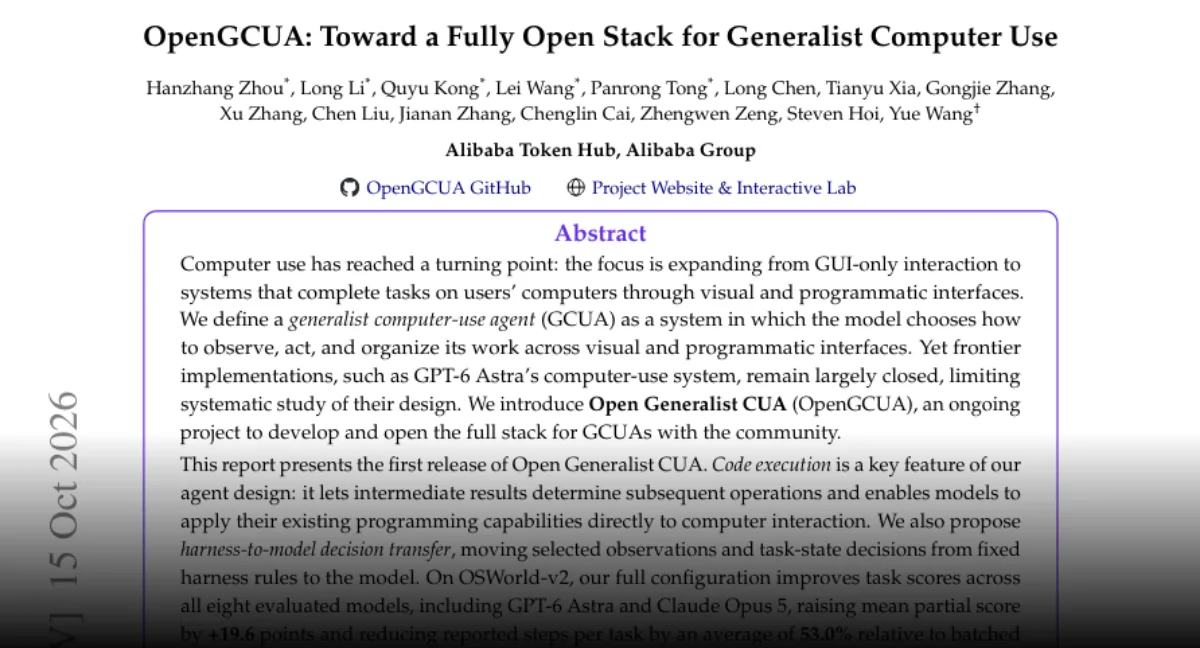
- Alibaba MAI-UI released OpenGCUA, an open full-stack harness for general-purpose computer-use agents, including a technical report, GCUA design, evaluation trajectories, macOS real-device harness, Cross-Device SDK preview, and online labs.
- OpenGCUA shifts from fixed screenshot-to-click workflows to model-led execution, where the agent decides how to observe, act, and combine GUI code, accessibility APIs, shell commands, and other tools.
- On OSWorld-v2, eight frontier models improved by +19.6 points on average while using 53% fewer steps, and the performance gap between the strongest and weakest models narrowed significantly.
- The project extends beyond benchmark environments to real-user devices, with macOS support and a Cross-Device SDK preview that lets one program coordinate computers, browsers, and phones.
- OpenGCUA is currently at its first open release, with next steps including a unified computer-and-browser-use GCUA model, better execution efficiency, and more real-device evaluation environments and benchmarks.
Meta description: Alibaba MAI-UI team releases OpenGCUA, an open full-stack computer-use agent harness with OSWorld-v2 gains, macOS real-device tests, and online labs.
Tags: OpenGCUA, Alibaba MAI-UI, computer-use agents, OSWorld-v2, Cross-Device SDK
Featured image: Abstract technology style with translucent device outlines, flowing control paths, and code-like structures; no real people, no company logos, no text.
Background: OpenGCUA Builds on a New Computer-Use Frontier
The announcement presents GPT-6 as the model that made computer use a frontier capability, and OpenGCUA is positioned as the effort to make that capability open. Alibaba's MAI-UI team introduces OpenGCUA as an ongoing project to develop and open the full stack for generalist computer-use agents, or GCUAs. The first release is described as something to be built together with the community.
This initial release includes the technical report, the GCUA design and its harness, evaluation trajectories from eight frontier models, a real-device harness for macOS, a Cross-Device SDK preview, and an interactive lab that can be tried online.
Development Process: From Fixed Actions to Model-Led Execution
OpenGCUA's core change is the agent paradigm it describes. Instead of following a fixed screenshot-to-click pattern, the GCUA model decides for itself how to observe, how to act, and how to organize its work. It can read the accessibility tree, call APIs, run shell commands, and operate the graphical interface only when needed. The release notes present GPT-6 Astra's computer-use system as a typical GCUA.
The design also combines code execution with a transfer of decision-making from the harness to the model. GUI actions are written as code and mixed with accessibility, API, and shell operations in a single program. Loops, branches, and intermediate results determine what happens next. Rather than relying on fixed harness rules to choose the workflow, the harness provides the mechanism, and the model decides when to use it. For example, a screenshot is requested only when the model needs one.
The evaluation results give the first public numbers for this direction. On OSWorld-v2, eight models, including GPT-6 Astra, Claude Opus 5, and Gemini 3.8 Flash, gain +19.6 points on average while taking 53% fewer steps. The gap between the strongest model and the weakest model shrinks by more than half. The OpenGCUA harness implementation, prompts, and all evaluation trajectories are open-sourced.
Latest Progress: Real Devices, Cross-Device Control, and Seven Labs
The release moves beyond benchmark environments and toward user-owned hardware. A macOS menu-bar app brings the agent onto the user's own computer, and the release describes solving and documenting a range of problems that only appear on real devices. The Cross-Device SDK preview connects computers, browsers, and phones through one programming interface, allowing a single program to coordinate several devices within one task.
Real-device testing also reveals a wider spread between models than benchmark summaries alone. In the reported tests, Qwen3.8-Max uses 19.4× as many reasoning tokens as GPT-6 Astra, and the gap between models is described as even larger on real devices.
To make the release explorable, the team provides seven interactive labs, each tied to one of seven questions from the technical report. The labs let users take a real Mac apart in 3D, compare four ways to act side by side to see what code execution changes, break down challenges unique to real devices, run one program across a phone, a browser, and a Mac, and replay real-device trajectories from five models. The description also says the labs work on a phone.
What to Watch Next: The Current Stage of OpenGCUA
The project is currently at its first open release: a public stack, benchmark trajectories, a macOS harness, a preview SDK, and online labs. The next items listed are a GCUA model that unifies computer use and browser use, systematic improvements to execution efficiency, and real-device evaluation environments and benchmarks. The team says it wants to build the project with the community.
The interactive lab is available at tongyi-mai.github.io/OpenGCUA, the technical report at arxiv.org/abs/2610.22200, and the GitHub repository at github.com/Tongyi-MAI/OpenGCUA.
Comments
No comments yet. Be the first to comment.