
Paris-based Mistral releases Le Chonk, a strong coding model that still trails China overall
Mistral released Large 4, a multimodal coding model with cheaper API pricing, but tests show it trails leading Chinese open models overall.
Key Takeaways
- Mistral released weights for Mistral Large 4, nicknamed “Le Chonk,” claiming its largest model yet excels at coding, but independent tests show it trails China’s strongest open models overall.
- The model has about 1 trillion total parameters and 52 billion active per step, accepts text and images, and outputs text and code.
- Additional reinforcement learning improved coding scores, but Claude Opus 5.5 remains far ahead, and unreleased Chinese models such as Kimi K3.1 Pro may quickly overtake Mistral.
- Mistral positions Large 4 as a strong cyber-defense open model, but benchmark charts place it third behind DeepSeek and MiMo, with high refusal rates and relatively high task costs.
- Pricing is lower than the preview, under a modified MIT license, but the model needs substantial GPU hardware and remains cheaper mainly in speed and token efficiency, not overall capability.
Mistral has released the weights for Mistral Large 4 on Hugging Face, three weeks after the model's public preview. The company claims its largest model yet beats open rivals at coding, but independent testing shows it fast and relatively cheap while still trailing Chinese open models in overall rankings. The release, nicknamed "Le Chonk," accepts text and images as input and outputs text and code, with roughly one trillion total parameters and 52 billion active per step.
Background: A Two-Year Reinforcement Learning Bet
Since the preview, Mistral continued training Large 4 with reinforcement learning, which the company says delivered large gains, particularly in coding and cyber defense. Researchers Pierre Stock and Corentin Petit described the process on a press call: the team built in-house tasks that grew harder as training progressed, and they said the only limit on performance is how difficult a task the team can still create and verify. Mistral calls the effort a "two-year bet" now paying off.
Running the model requires substantial hardware. According to documentation for the inference framework SGLang, the standard version runs on eight Nvidia B300 GPUs, while a more heavily compressed variant runs on four GB300 GPUs.
Development: Coding Gains, but Claude Remains Far Ahead
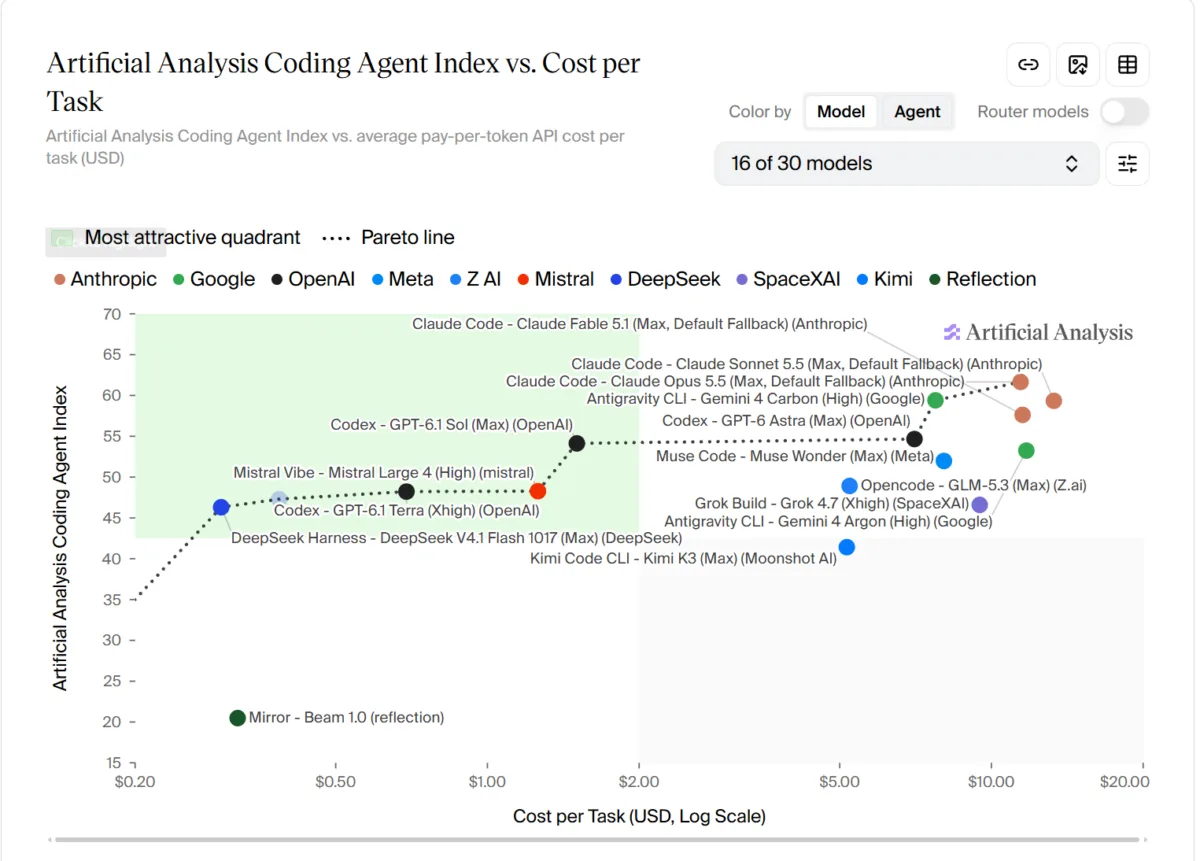
The additional training lifted Large 4's Terminal-Bench 4.0 score from 28 to 41 percent, just ahead of GLM-5.3 at 40 percent. Mistral reports 48 percent on Artificial Analysis' Coding Agent Index, practically tied with GLM-5.3, though Large 4 uses 47 percent fewer tokens to reach that result. Claude Code with Claude Opus 5.5 tops the index at 62 points.
On Cognition's new FrontierCode 2.0 benchmark, Large 4 leads open models at 19.7 percent, while Claude Opus 5.5 scores 46 percent. In blind comparisons run by Surge, testers preferred Large 4's code over output from GLM-5.3, Kimi K3, and DeepSeek more often than not, but against Opus 5.5 it won only 22 percent of matchups.
Mistral's comparisons exclude Moonshot's Kimi K3.1 Pro, whose weights are not yet public; Moonshot plans to release them by November 4, 2026. That omission matters because Kimi K3.1 Pro tops Terminal-Bench 4.0 at 67 percent, suggesting Mistral's coding lead may be short-lived.
Cyber Defense: Third Among Open Models, Not First
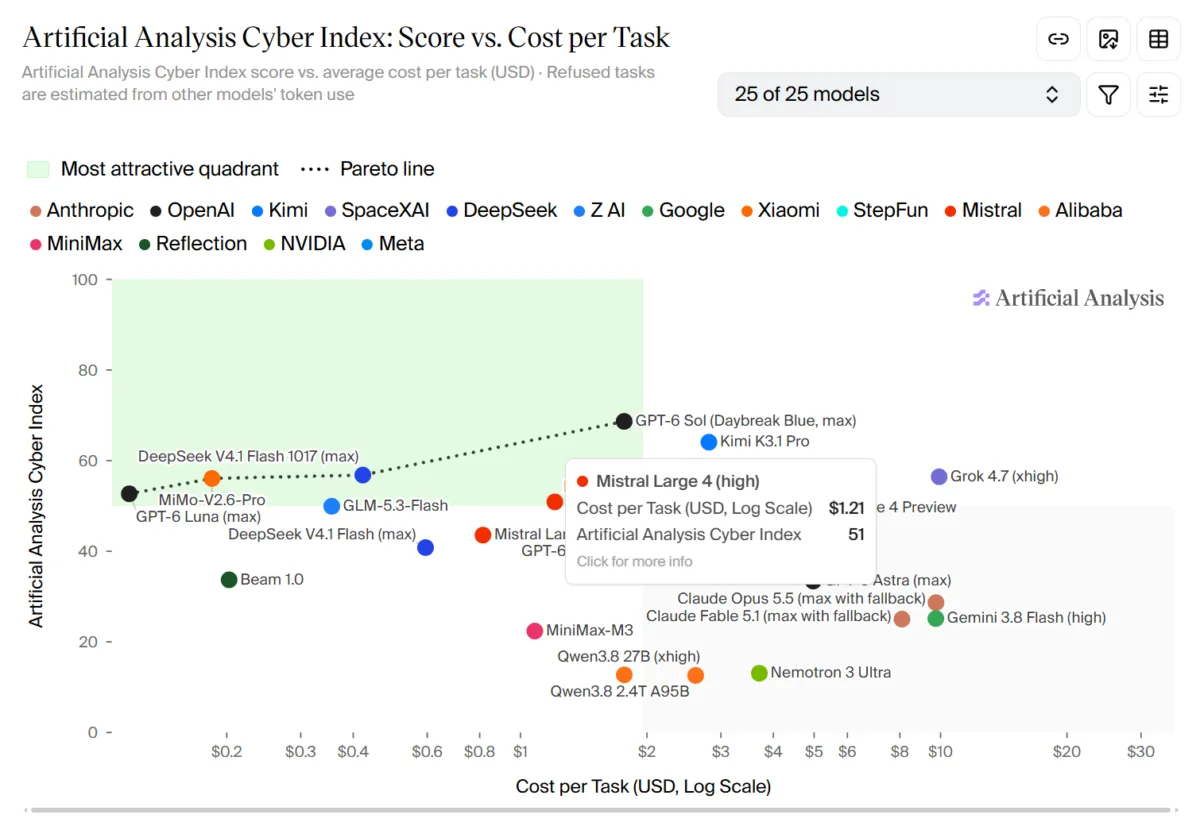
Mistral calls Large 4 the leading open model for cyber defense, citing a 51 percent score on Artificial Analysis' Cyber Index, which measures whether a model can find, reproduce, and patch security holes without breaking existing features. Mistral's own chart, however, places DeepSeek V4.1 Flash at 57 percent and MiMo-V2.6-Pro at 56 percent ahead of it, leaving Large 4 third among open models, just ahead of GLM-5.3 Flash at 50 percent. Kimi K3.1 Pro leads the entire index at 64 percent. The extra training barely moved this metric: Artificial Analysis recorded 50 points for the preview, just one point below the final version.
Large 4 (high) scores 51 on the Cyber Index at $1.21 per task, far pricier than alternatives such as DeepSeek V4.1 Flash 1017, which scores higher at a fraction of the cost. The model does refuse harmful requests more often, rejecting 96.6 percent of malicious cyber requests on average, more than any other open model. Mistral acknowledges the model could make real attacks easier and plans to tighten safeguards in coming months; select partners including Orange Cyberdefense are already testing a special penetration-testing version under review and contractual restrictions.
Pricing and Licensing: Cheaper API, Modified MIT
Through the API, Large 4 costs $0.70 per million input tokens and $2.10 per million output tokens, down from preview list prices of $1.36 and $4.18. Mistral cut prices to $0.68 and $2.09 for two weeks at launch, so the new rate roughly matches that discount. Kimi K3.1 Pro, by comparison, costs $2 for input and $10 for output.
The model ships under a modified MIT license: use, modification, and commercial deployment are free, but companies offering Large 4 as a commercial cloud service need a separate license. Mistral pitches the model as "sovereign" AI, trained entirely in Europe and runnable on your own servers; it is also available on Microsoft Foundry and other platforms.
Latest: Independent Index Shows Speed and Cost Edge, Not Overall Leadership
Artificial Analysis released version 5 of its Intelligence Index on Wednesday and rated the final Large 4 in high mode at 26 points. Three-fifths of the index now rely on tests whose tasks or solutions are not public, including Terminal-Bench 4.0 and FrontierCode 2.0. The preview scored 25 points, so three extra weeks of training added just one point overall. Large 4 beats the 23-point median for open models of similar size but falls short of China's strongest: DeepSeek V4.1 Flash and GLM-5.3 each score 32 points, and MiMo-V2.6-Pro gets 30. The gap is not new—on the old index, the preview scored 38 points against GLM-5.3's 45.
Speed and cost remain Large 4's strengths. It generates 161 tokens per second, up from 111 in the preview, with only DeepSeek V4.1 Flash and Muse Wonder faster in head-to-head comparison. An index task costs $2.06 on average, down from $5.54, making Large 4 cheaper than GLM-5.3 ($5.01) and Kimi K3.1 Pro ($3.68) but much more expensive than DeepSeek V4.1 Flash ($0.60) and MiMo-V2.6-Pro ($0.26). Artificial Analysis still considers its per-token price high side relative to similar-sized open models.
Token efficiency improved: Large 4 generated 110 million output tokens across the full index, down from 150 million for the preview, though the median for comparable models is 100 million.
At the top of the index, Google's Gemini 4 Carbon leads with 59 points, one point ahead of Claude Opus 5.5, though only select cybersecurity partners can use it so far. The top open model is Kimi K3.1 Pro at 46 points, with weights still unreleased. Mistral's team said on the press call that it works with a fraction of the resources US and Chinese labs have and would be at the top with ten times more capital. Large 4 is meant as the base for specialized Mistral models; the company would not comment on smaller versions built on it.
Comments
No comments yet. Be the first to comment.