
Latent Three-Dimensional Gaussian World Generates Infinite Worlds in Real Time Using Latent Three-Dimensional Gaussian Memory
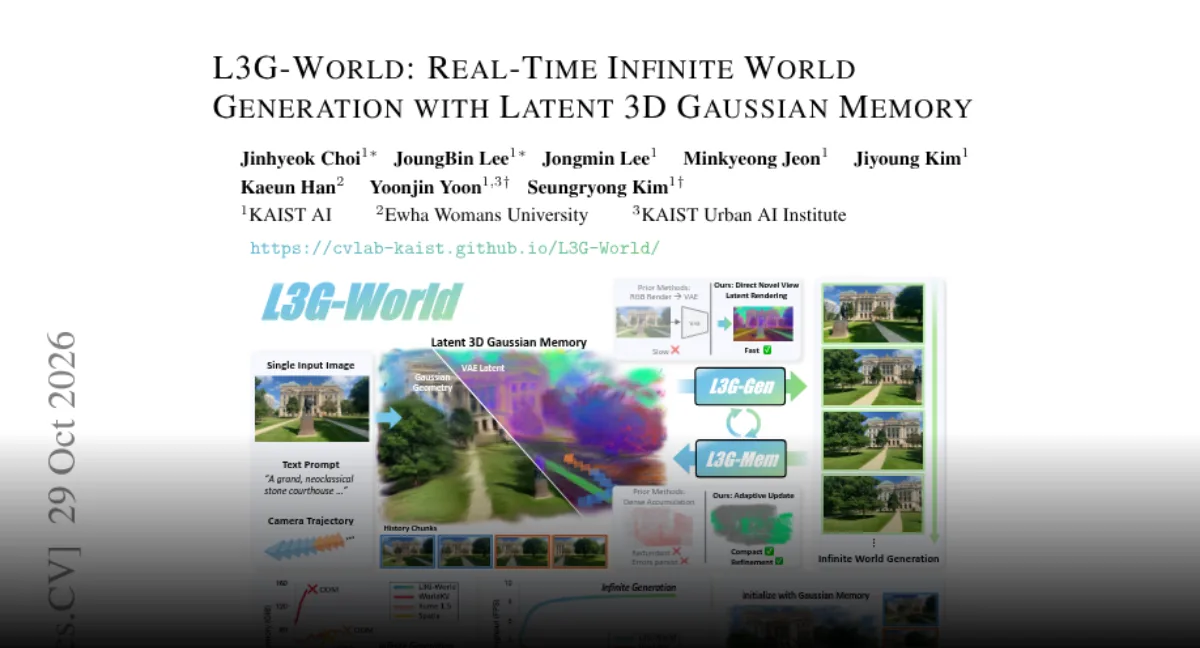
L3G-World is a real-time interactive world generator that uses a latent 3D Gaussian memory and a video diffusion transformer. It grows memory with scene extent, not video length, and renders latent Gaussians directly into the transformer. This reduces primitives and speeds updates and rendering, enabling 9 frames per second while preserving spatial consistency over long exploration paths.
Key Points
- L3G-World is a real-time interactive world generator that produces consistent visual content at 9 frames per second during long exploration paths.
- It uses a Latent 3D Gaussian Memory to store scenes compactly, so memory grows with the spatial extent of the scene rather than with the length of the generated video stream.
- The system alternates between a memory updater and a video diffusion transformer, creating or refining 3D Gaussians as new regions become visible.
- By attaching VAE latent features to each Gaussian, L3G-World feeds the diffusion model directly, avoiding slow RGB re-encoding and enabling real-time generation.
- It reports major efficiency gains over prior 3D-memory baselines, including up to 38.6× fewer 3D primitives, 3.2× faster memory updates, and 359× faster memory rendering.
Meta Description: L3G-World uses a latent 3D Gaussian memory and a video diffusion transformer to generate interactive worlds in real time at 9 frames per second.
Tags: L3G-World, latent 3D Gaussian memory, video diffusion transformer, interactive world models, real-time generation
Featured image: abstract glowing three-dimensional Gaussian points forming a latent memory grid, no real people, no company logos, no text.
L3G-World Reaches 9 Frames Per Second With Latent 3D Gaussian Memory
The work presents L3G-World, a real-time interactive world generator that reports 9 frames per second while preserving spatial consistency across long exploration paths. The method matters because it separates two problems that often compete in generated worlds: visual quality over time and the cost of remembering what the user has already seen.
Background: The Long-Horizon Consistency Problem
For interactive world models, visual content must respond to user actions, but coherent spatial behavior across extended exploration paths is hard to preserve. The challenge is not only producing a convincing frame. It is producing a frame that remains consistent with the rest of the scene as the user keeps moving through it.
Earlier approaches fall into two broad groups. One depends on temporal context, carrying recent frames forward. The other depends on explicit 3D memory, storing scene structure so that viewpoints can be related across time. Both groups become less efficient as the generated stream lengthens, because memory grows with it. Explicit memory also creates a practical delay: latent video generators are conditioned by first re-encoding rendered red-green-blue views, which stops the pipeline from running in real time.
Development: Building L3G-World Around a Compact Memory
The core component is L3G, a Latent 3D Gaussian Memory designed to keep feed-forward reconstruction efficient while storing the scene in a compact form that can be rendered quickly. L3G-World builds on that memory by alternating autoregressive updates between a memory updater and a video diffusion transformer.
When new areas become visible, the updater creates Gaussians there; for areas already stored, it refines the existing Gaussians. This design changes what drives memory size: the memory grows with the extent of the scene rather than with the length of the generated stream. Every Gaussian also carries a latent feature produced by a Variational Autoencoder. That lets the memory be turned straight into latent input for the video diffusion transformer, removing the need for another Variational Autoencoder encoding pass.
The generation loop can be read as a sequence of small state changes. The video diffusion transformer produces visual content; the memory updater spawns Gaussians where new regions are observed and refines existing Gaussians; the updated latent rendering then feeds the next autoregressive step.
Latest Progress: Efficiency Gains and Real-Time Generation
The reported results place L3G-World at the state-of-the-art level for generation quality and for spatial consistency over long horizons. Against the most efficient earlier 3D-memory baseline, the system reports up to 38.6 times fewer 3D primitives, memory updates 3.2 times faster, and memory rendering 359 times faster, measured separately for each metric. Together, those gains support real-time generation at 9 frames per second.
The reported reductions explain why the system can remain interactive. Fewer primitives mean a smaller scene representation to maintain. Faster memory updates mean the Gaussian scene can absorb new observations without stalling the generator. Faster memory rendering means the latent 3D Gaussian memory can feed the video diffusion transformer directly, avoiding a slow re-encoding path.
Current Stage: A Working Real-Time World Generator
L3G-World is at a stage where spatial consistency and real-time output are not treated as separate constraints. The compact latent memory gives the system a persistent 3D structure, while the direct latent rendering path keeps the video diffusion transformer fed without repeated red-green-blue re-encoding. The 9 frames per second result shows that the approach is not only consistent in principle but usable as an interactive output stream.
What to watch next is how far the memory-size rule can be stretched. Because L3G-World ties memory growth to scene extent rather than generated stream length, the cost of continuing to explore an already represented region is decoupled from the number of frames already produced.
Comments
No comments yet. Be the first to comment.