
Drex represents a step toward Foundation Decision Models.
Drex offers four open decision models that return calibrated probabilities in one pass, reduce option-order flips, and score 67.52 on Decision Index.
Key Points
- Drex is an open family of four decision models designed to answer choice-based questions with calibrated probability outputs in a single forward pass.
- Its training combines supervised fine-tuning with reinforcement learning from adjusted feedback, improving accuracy and reducing sensitivity to option order.
- Drex Max reports a state-of-the-art Decision Index 0.4.1 score of 67.52, outperforming Jev 1.14.0’s 60.70.
- The models are publicly available with open weights and inference code on GitHub, making Drex a transparent step toward foundation decision models.
Meta description: Drex open decision models return calibrated probabilities in one pass, score 67.52 on Decision Index 0.4.1, and publish weights and code on GitHub.
Tags: Drex, Decision Index, OpenRouter, reinforcement learning, GitHub
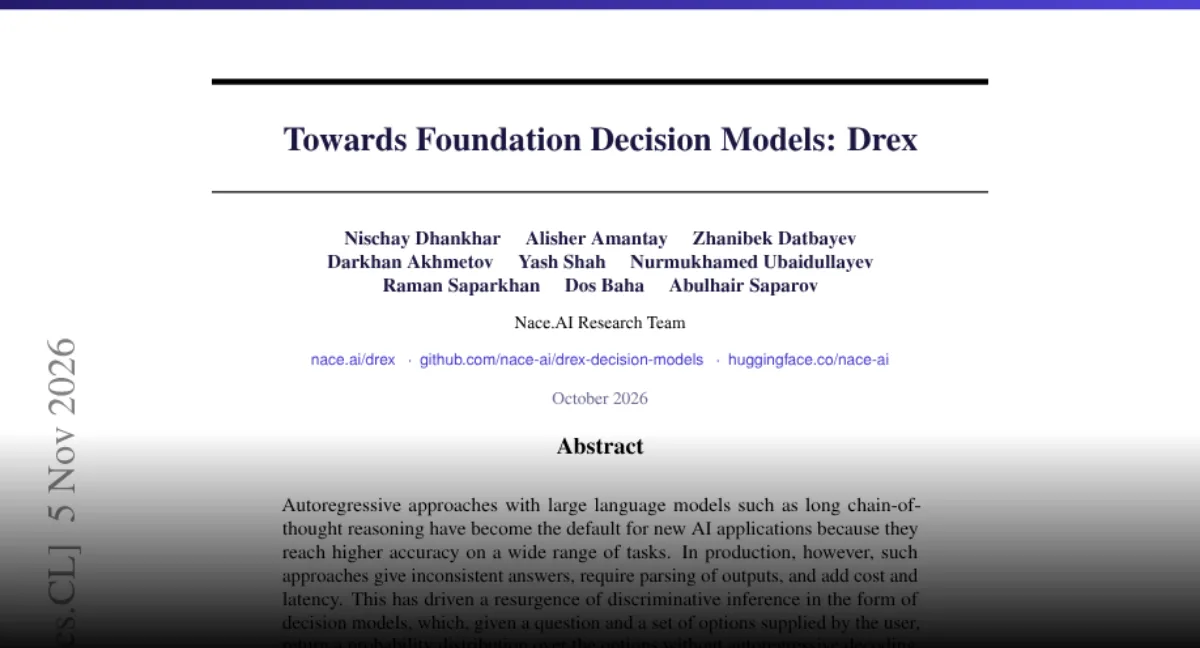
Featured image: Abstract technology-style visualization of probability distributions and model weights, no real people, no company logos, no text.
Drex decision models are presented as an open family of four models designed to answer choice-based questions. Their key design choice is to return a calibrated probability distribution over user-defined options in a single forward pass, without autoregressive decoding. That matters because the release combines a defined input format, a reported training recipe, benchmark scores, and open weights and inference code.
Background: Defining the model family and input format
The family spans four sizes: the 8-billion-parameter DLM model, the 9-billion-parameter v1.5 model, the 35B-A3B v2.0 model, and the 27-billion-parameter Max model. In each case, a request pairs a state with a question. The state may be a document, a record, or an agent context, and images can be optional parts of the input. The question can ask for a choice, a yes/no judgment, or a score on an ordered scale.
A forward pass means the model processes the input through its network once. This is different from autoregressive decoding, where output is generated one step after another. For decision tasks, the reported output is a calibrated probability distribution over the options supplied by the user.
Development process: supervised fine-tuning and adjusted feedback
The training process combines supervised fine-tuning with an in-house reinforcement learning recipe. The recipe is called reinforcement learning from adjusted feedback. It blends verified outcomes with a reasoning judge under a Kullback-Leibler constraint.
The reported ablations show two effects. Reinforcement learning from adjusted feedback raises accuracy. Consistency losses cut option-order flips from 6.3% to 4.2%. An option-order flip is a change in answer that occurs when the same choices are presented in a different order. The reduction indicates the models are less sensitive to option sequence.
Latest progress: scores, comparisons, and platform presence
Drex Max is reported to set a new state of the art among decision models on Decision Index 0.4.1. The score is 67.52, compared with 60.70 for Jev 1.14.0. The same section says Max holds its score on maintainer-run private tests at 66.60.
On the independently run Artificial Analysis Decision Index, Max has the second-highest score among decision models. Drex is also described as among the most widely used decision models on OpenRouter.
Current stage: open availability and what the numbers mark
All weights and inference code are open at github.com/nace-ai/drex-decision-models. The current stage is therefore a public availability stage: the model family, its training approach, its reported benchmark results, and its code are presented together.
The figures that mark this stage are the four model sizes—8 billion, 9 billion, 35B-A3B, and 27 billion—the option-order flip reduction from 6.3% to 4.2%, the Decision Index 0.4.1 score of 67.52, the comparison score of 60.70 for Jev 1.14.0, and the private-test score of 66.60. These details place Drex as an open decision model family centered on single-pass probability outputs, reinforcement learning from adjusted feedback, and published benchmark performance.
Comments
No comments yet. Be the first to comment.