
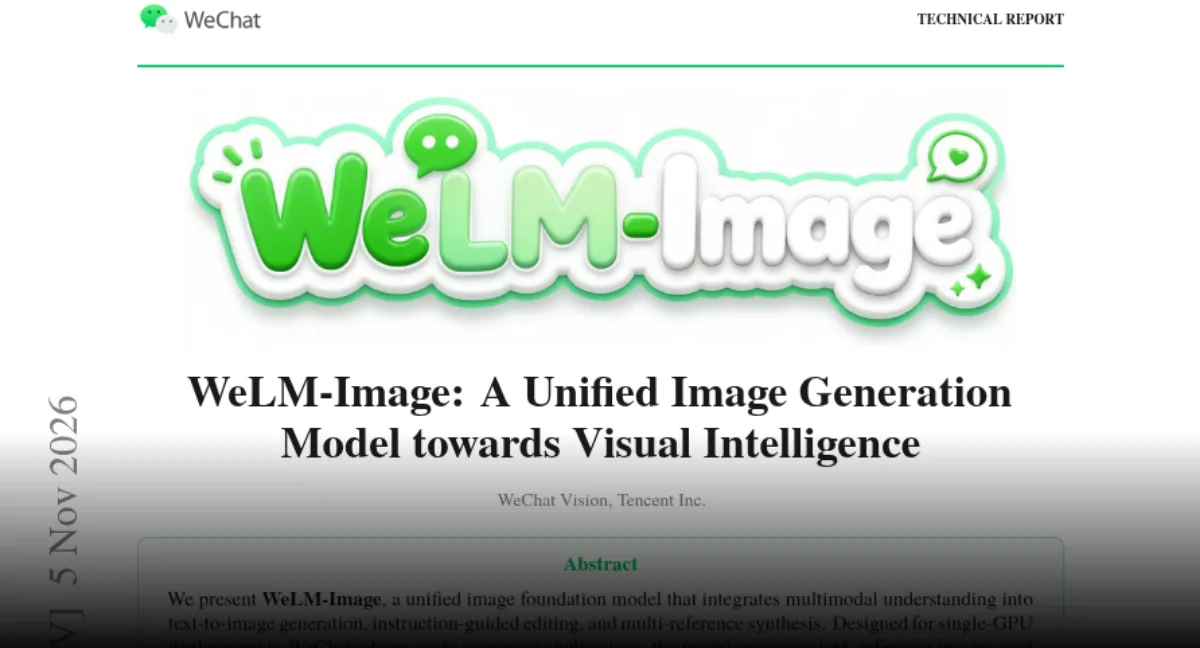
WeLM-Image is a unified model for generating images toward visual intelligence.
WeLM-Image unifies multimodal understanding, generation, editing and reference tasks in one model with sparse architecture for single GPU deployment.
Key Takeaways
- WeLM-Image is a unified image foundation model designed for text-to-image generation, instruction-guided editing, and multi-reference synthesis, with a focus on single-GPU deployment in WeChat-scale applications.
- It processes text, reference images, and target latents as a single interleaved sequence, allowing one model to handle both understanding and generation tasks within one serving path.
- The architecture uses a Mixture-of-Transformers backbone with shared attention but separate understanding and generation parameters, plus Mixture-of-Experts modules for sparse activation: 31.7B stored parameters and about 5.4B generation parameters activated per target latent token.
- Training relies on a generation-oriented data engine, bilingual annotations, progressive resolution up to native 1.5K, task-specific reward optimization, and noise-aware on-policy distillation to unify generation and editing capabilities.
- WeLM-Image ranks first among evaluated open-source models on PRISM-Bench, Qwen-Image-Bench, and UnicBench at 1536 resolution, while WeLM-Image-Turbo generates a 1024 x 1024 image in 4.98 seconds on a single NVIDIA H20 GPU using eight guidance-free steps.
WeLM-Image is presented as a unified image foundation model that brings multimodal understanding into text-to-image generation, instruction-guided editing, and multi-reference synthesis. The reported design is aimed at single-GPU deployment in WeChat's large-scale consumer applications, making the model's value proposition less about a single isolated capability and more about handling several image tasks inside one serving path.
Background: One Sequence for Understanding and Generation
The model treats text, reference images, and target latents as one interleaved sequence. That sequence design lets the same model route input information through understanding and generation processes rather than relying on separate systems for each task. For consumer applications, this matters because a single deployment target can simplify serving, reduce handoff between components, and keep the model closer to the requirements of high-volume use.
Architecture: Shared Attention with Separate Parameters
The backbone uses a Mixture-of-Transformers design that combines shared attention with independent understanding and generation parameters. The separation is intended to limit optimization interference between the two functions. Each pathway also uses Mixture-of-Experts modules to provide sparse capacity. The reported parameter count is 31.7B stored parameters, with approximately 5.4B generation parameters activated per target latent token. This sparse activation pattern is central to the model's deployment story: the system can carry a large parameter footprint while activating only a subset of generation capacity for each token.
Training: Data Engine and Progressive Resolution
The development path described in the material includes a generation-oriented data engine. It combines a knowledge-grounded visual vocabulary with large-scale visual clustering to balance semantic coverage and editing tasks. Training-time evaluation guides iterative data refinement. Bilingual annotations and verified editing supervisions support progressive training up to native 1.5K resolution.
The optimization process treats generation and editing separately. It uses rubric-based and checklist-based rewards, then consolidates the specialized policies through noise-aware on-policy distillation. This suggests the model was not simply trained once on a mixed objective; it was shaped through task-specific reward signals and then unified through distillation.
Latest Progress: Benchmark Rankings and Turbo Inference
In reported overall comparisons, the 1536-resolution model ranks first among the evaluated open-source models on PRISM-Bench, Qwen-Image-Bench, and UnicBench. The reported benchmark set covers the kinds of capabilities the model is designed to support, although no individual scores are provided.
The latest deployment-oriented result is WeLM-Image-Turbo. It is obtained through MeanFlow-based few-step distillation. The material reports that it generates a 1024 x 1024 image in 4.98 seconds on a single NVIDIA H20 GPU using eight guidance-free steps.
Current Stage: A Deployment-Focused Unified Model
At the stage described, WeLM-Image appears positioned as an integrated image foundation model for WeChat's consumer applications, with unified task handling, sparse capacity, benchmark rankings, and a distilled fast-generation variant. The key next questions implied by the material are how the reported single-GPU deployment performs under sustained application traffic and how the open-source model comparisons relate to future releases.
Comments
No comments yet. Be the first to comment.