
Cross-teacher guarding extends multi-teacher on-policy distillation beyond domain-routed supervision.
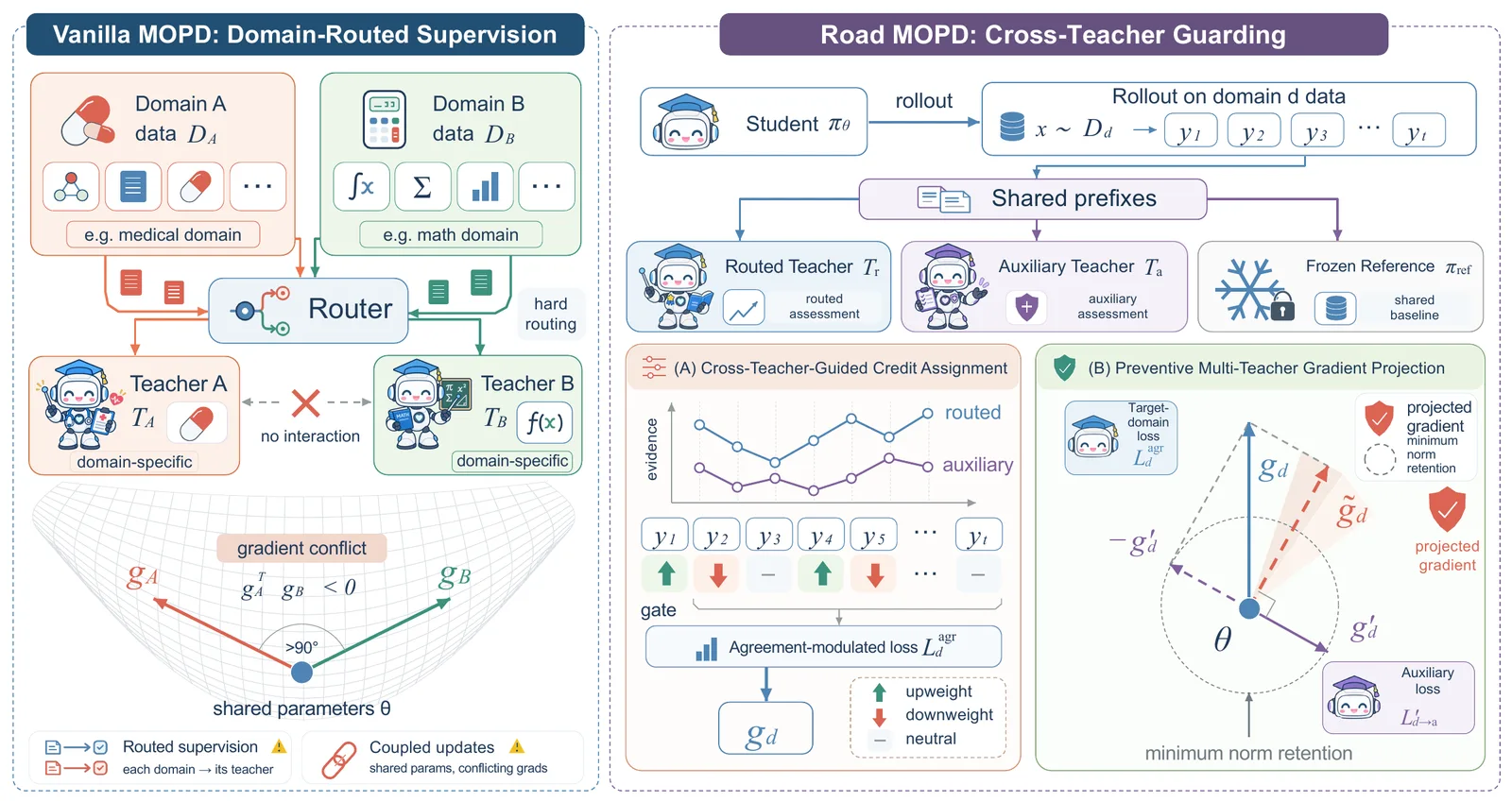
RoadMOPD, developed by JD.com's OxygenVLM team and Nanjing University, tackles conflicting correction signals in multi-teacher on-policy distillation. It evaluates the same student response with routed and auxiliary teachers, strengthens token-level corrections with teacher agreement, and applies gradient projection to suppress conflicting updates. Tested with Qwen3-4B, it beats Vanilla MOPD, raising average medical accuracy by up to 8.78 percentage points in high-conflict Math-Medical and Code-Medical settings, with gains in Math-Code and joint training. Code release is expected within 1-2 months pending internal approval.
Key Takeaways
- RoadMOPD addresses a core problem in multi-teacher training: conflicting corrections from teachers with different styles and expertise can degrade student performance in some domains.
- The method uses teacher agreement as a filter, strengthening jointly supported token-level corrections while attenuating conflicting ones.
- It applies preventive gradient projection to suppress update directions that conflict across domains, while preserving useful learning signals for the target domain.
- Evaluated on Qwen3-4B, RoadMOPD improved high-conflict settings with up to 8.78 percentage-point average medical accuracy gains over Vanilla MOPD, and also helped in joint Math-Code-Medical training.
- The code is pending internal approval and expected to be open-sourced within 1–2 months; the reported gain should be understood as a tested-setting result, not a universal benchmark.
RoadMOPD, a method developed jointly by JD.com's OxygenVLM team and Nanjing University, is aimed at one of the practical problems in multi-teacher model training: when a student model receives corrections from teachers with substantially different response styles and domain expertise, those corrections can conflict and degrade the student's performance in at least one domain. The reported evaluation uses Qwen3-4B and compares RoadMOPD with Vanilla MOPD, showing an average medical accuracy gain of up to 8.78 percentage points in high-conflict settings. The approach is relevant to teams working with student models trained from several specialized teachers, because it treats teacher disagreement as a controllable signal rather than an unavoidable side effect.
Background: Why multiple teachers can create conflicting signals
A student model can learn from several teacher models at once, especially when the teachers cover different domains. The difficulty appears when the teachers do not only differ in subject knowledge but also in how they answer. One teacher may produce concise mathematical reasoning, another may provide more detailed medical explanation, and another may favor code-specific wording. If the student treats all correction signals as equally useful, it may become better in one domain while losing accuracy in another. RoadMOPD is designed to reduce that degradation and help the student integrate multiple experts' capabilities.
Development: Agreement checks and gradient projection
RoadMOPD's workflow starts by bringing routed and auxiliary teachers together to evaluate the same student-generated response. The method then uses teacher agreement as a filter: corrections that are jointly supported by the teachers are strengthened at the token level, while conflicting signals are attenuated. This matters because token-level corrections are the direct training units that can shift a student model's next-token behavior.
After that filtering step, RoadMOPD applies preventive gradient projection. The goal is to suppress update components that would push the student in conflicting directions, while adaptively preserving the learning signal from the target domain. In other words, the method tries to keep the useful part of each teacher's correction and block the part that would undermine another domain.
Results: Gains in high-conflict and joint training settings
The source reports two evaluation groups with Qwen3-4B. In the high-conflict Math-Medical and Code-Medical settings, RoadMOPD improves both domains over Vanilla MOPD, boosting average medical accuracy by up to 8.78 percentage points. The benefits also extend to the more compatible Math-Code combination. Under joint Math-Code-Medical training, the method shows improvements across all three domains.
Current stage: Code approval and release window
The code is currently undergoing internal company approval for open-source release and is expected to be released within the next 1-2 months. At this point, the established facts are the method's design, its evaluation with Qwen3-4B, the reported 8.78 percentage point medical accuracy gain, and the planned release window. Readers should treat the 8.78 percentage point figure as the source's reported maximum average medical accuracy gain in the tested high-conflict settings, not as a general benchmark across all domains. The method is still at the pre-publication code-release stage, so the next milestone is open availability rather than additional performance claims.
Comments
No comments yet. Be the first to comment.