
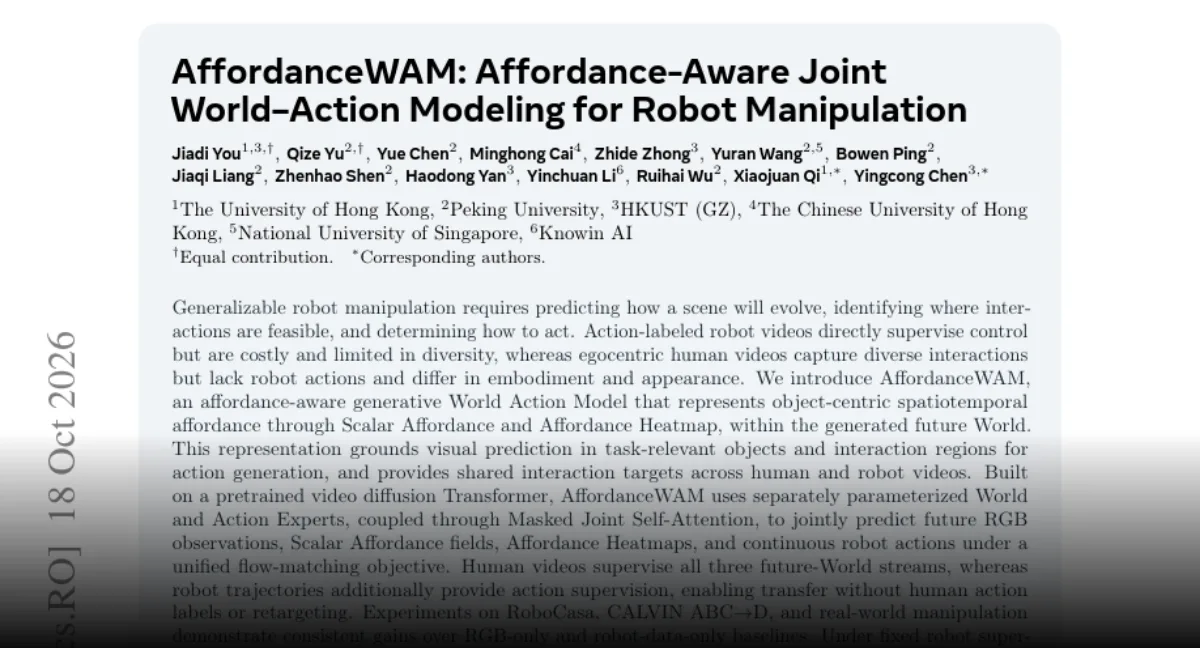
An affordance-aware joint world-action modeling approach is proposed for robot manipulation.
AffordanceWAM uses affordance prediction to link human videos and robot actions, improving RoboCasa, CALVIN, and real manipulation tasks.
Key Takeaways
- AffordanceWAM bridges human egocentric videos and robot manipulation by using affordances as shared prediction targets, avoiding the need for robot-style action labels or motion retargeting.
- The model jointly predicts future visual observations, affordances, and robot actions, allowing robot trajectories to provide action supervision while human videos contribute scene understanding.
- On RoboCasa, with robot supervision held fixed, adding more affordance-annotated human videos steadily improves performance, suggesting human videos can scale robot learning when organized around shared affordance targets.
- Evaluations on RoboCasa, CALVIN, and real-world manipulation tasks indicate the affordance-based approach is not limited to a single task setup.
A robot can learn to act from human videos only if the learning bridge is clear. AffordanceWAM offers that bridge. The method uses affordances, the possibilities for interaction that objects and scenes present, to connect egocentric human video learning with robot action generation. Instead of asking for robot-style action labels in human videos, it asks what matters in the scene, where interaction is likely, and how the scene changes over time. The result is a training path that lets robot trajectories teach action while human videos still contribute useful predictive targets.
Why Human Videos Are Hard to Turn Into Robot Actions
Egocentric human videos are useful because they are recorded from a person's own viewpoint. They show how people approach objects, reach into spaces, and change a scene. But robots cannot copy those videos directly. A human video does not contain actions expressed in the robot's action space. Converting people into robot motions usually requires retargeting, and retargeting can be difficult when human and robot bodies, objects, and viewpoints differ.
That creates a practical question: how can human video improve robot policy learning when the video has no robot action labels? AffordanceWAM addresses the question by changing the shared target. It does not try to make human video look like robot video. It looks for prediction targets that both can provide.
How AffordanceWAM Connects the Gap
The method jointly predicts three kinds of information: future visual observations, affordances, and robot actions. Future visual observations ask the model to anticipate what the scene will look like. Affordance prediction asks which objects matter, where interactions happen, and how the scene evolves. Robot action prediction asks what the robot should do next.
The important design choice is that human and robot videos can share the affordance prediction targets. Robot trajectories add the missing action signal. In this setup, human videos can be used with affordance annotations rather than robot-style action labels or motion retargeting. Robot supervision can remain fixed while additional affordance-annotated human video is introduced, giving the model more scene understanding without changing the robot action data already available.
Reported Results and Latest Progress
The reported evaluation settings include RoboCasa, CALVIN, and real-world manipulation. That spread suggests the affordance bridge is not limited to a single task setup.
For RoboCasa, the reported result says that with robot supervision held fixed, adding more affordance-annotated human video steadily improves performance. That is the central signal: human video helps when it is organized around affordance targets that overlap with robot learning. The introduction also points to project materials, demos, and code, framing the approach as an open training path rather than only a conceptual proposal.
What to Watch Next
The next question is how far shared affordance targets can stretch as human video grows. If more affordance-annotated human video keeps improving robot performance under fixed robot supervision, the approach points to a scalable way to use everyday videos for manipulation learning. The project also asks how others are using human videos for robot learning, which could shape future datasets, annotation schemes, and evaluation settings.
Meta description: AffordanceWAM uses affordance prediction to connect human egocentric videos with robot action learning, showing gains on RoboCasa, CALVIN, and real-world tasks.
Tags: robot learning, human video, affordances, manipulation, AffordanceWAM
Featured image: abstract technology style with human video frames transforming into robot action paths through shared affordance targets; no real people, no company logos, no text.
Comments
No comments yet. Be the first to comment.