
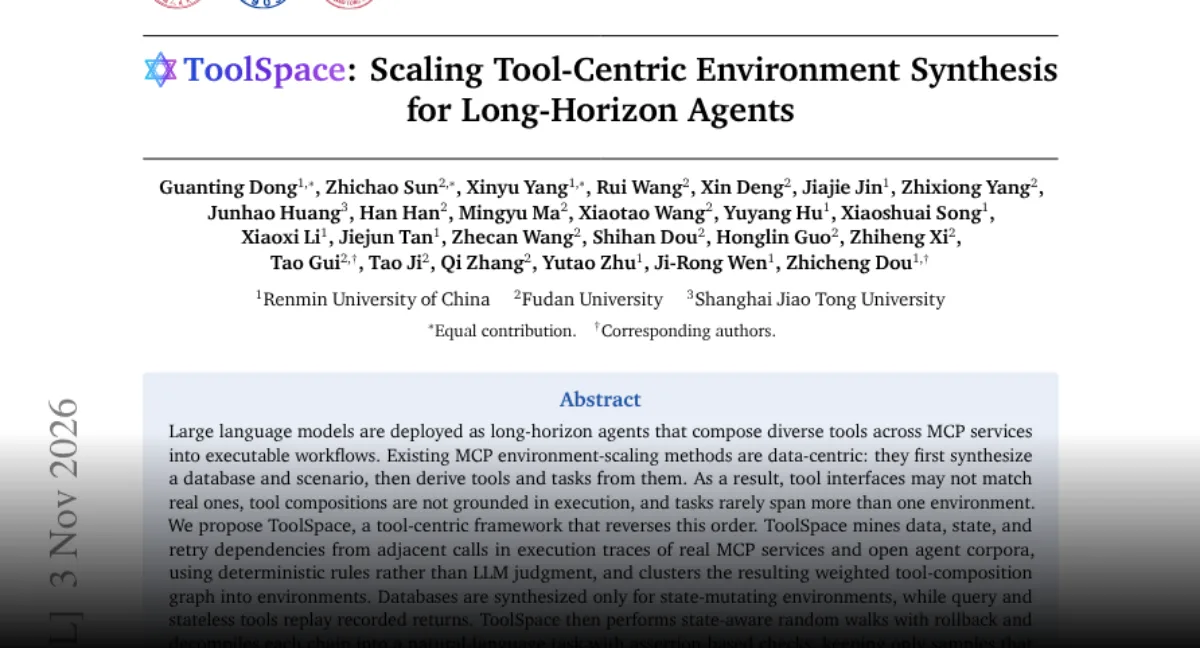
ToolSpace scales tool-focused environment synthesis for long-horizon agents.
ToolSpace replaces data-first environment synthesis with tool-first graphs, enabling verifiable long-horizon agent tasks and stronger benchmarks.
Key Takeaways
- ToolSpace reverses data-centric environment synthesis by starting from real tool call traces, linking tools into a tool universe, and generating databases only when state changes are needed.
- It builds a tool-world graph and uses state-aware traversal to decompile executable tool chains into verifiable tasks and training data, supporting cross-environment long-horizon agents.
- The method introduces harder evaluation upgrades, including AutomationBench Pro and τ³-Bench Banking Pro, where strong existing models score below 40.
- ToolSpace-744B achieves an average score of 56.6 across seven long-horizon tool benchmarks, roughly matching Claude Opus 5, with performance scaling as environments and data grow.
- ToolSpace is released as an open-source tool-first synthesis method, benchmark set, code, and models, offering a verifiable alternative to data-first pipelines.
A new method called ToolSpace changes how environments for long-horizon agents are built. Instead of first creating a database and then attaching tools, it starts from real tool call traces, links those tools into a larger tool universe, and synthesizes databases only when state must change. That sequence keeps tool interfaces closer to real use while making tasks that move across multiple environments. The work evaluates ToolSpace-8B, 35B, and 744B on seven long-horizon tool benchmarks, and ToolSpace-744B reaches an average score of 56.6.
Background: Data-Centric Synthesis Leaves Tools Detached
Most existing environment synthesis methods are data-centric. They build the underlying database first, then synthesize tools and tasks around that database. That order creates two weaknesses. Tool interfaces can drift from reality because they are generated from a constructed data layer rather than from observed use. Tasks are also hard to form across environments, since each database may stand alone. ToolSpace takes the opposite approach: collect tools from real call traces, chain real tool sets into a tool universe, then synthesize the underlying database on demand. The design goal is to preserve authenticity while flexibly generating verifiable tasks across any environment and any tool.
Development: Real Traces Become Graphs and Verifiable Tasks
ToolSpace uses three linked methods. First, tool universe exploration mines tool dependencies from real traces and links them into a tool-world graph. Databases are synthesized only for environments that change state, so the graph carries the structure while stateful environments get the data they need.
Second, verifiable task synthesis walks the graph with state-aware traversal and backtracking. It decompiles executable tool chains into tasks and verification scripts, keeping environment state continuous. The same chain can produce high-quality supervised fine-tuning data and mixed-environment reinforcement learning data. This turns a tool sequence into both a test and a training example.
Third, the method creates harder evaluation benchmarks. ToolSpace upgrades two frontier benchmarks into AutomationBench Pro and τ³-Bench Banking Pro. Strong existing models all score below 40 on these upgraded benchmarks, raising the evaluation bar for the field.
Latest Progress: 744B Scores Near Claude Opus 5
The experiments cover ToolSpace-8B, 35B, and 744B on seven long-horizon tool benchmarks. ToolSpace-744B averages 56.6, on par with Claude Opus 5. Its named scores include AutomationBench 54.7, Harvey LAB 27.5, SkillsBench 67.8, OfficeQA Pro 67.1, and JobBench 57.5. The results also show that agent performance scales as environment and data scale grow.
The paper is available at https://arxiv.org/pdf/2611.05036, the project page is https://toolspace-agent.github.io/, the code is at https://github.com/dongguanting/ToolSpace, and the models are listed in a Hugging Face collection at https://huggingface.co/collections/dongguanting/toolspace. The current stage is an open-source method and benchmark set, with tool-first environment synthesis offering a verifiable alternative to data-first pipelines.
Comments
No comments yet. Be the first to comment.