
WebHarbor integrates real websites to evolve environments for graphical user interface agents.
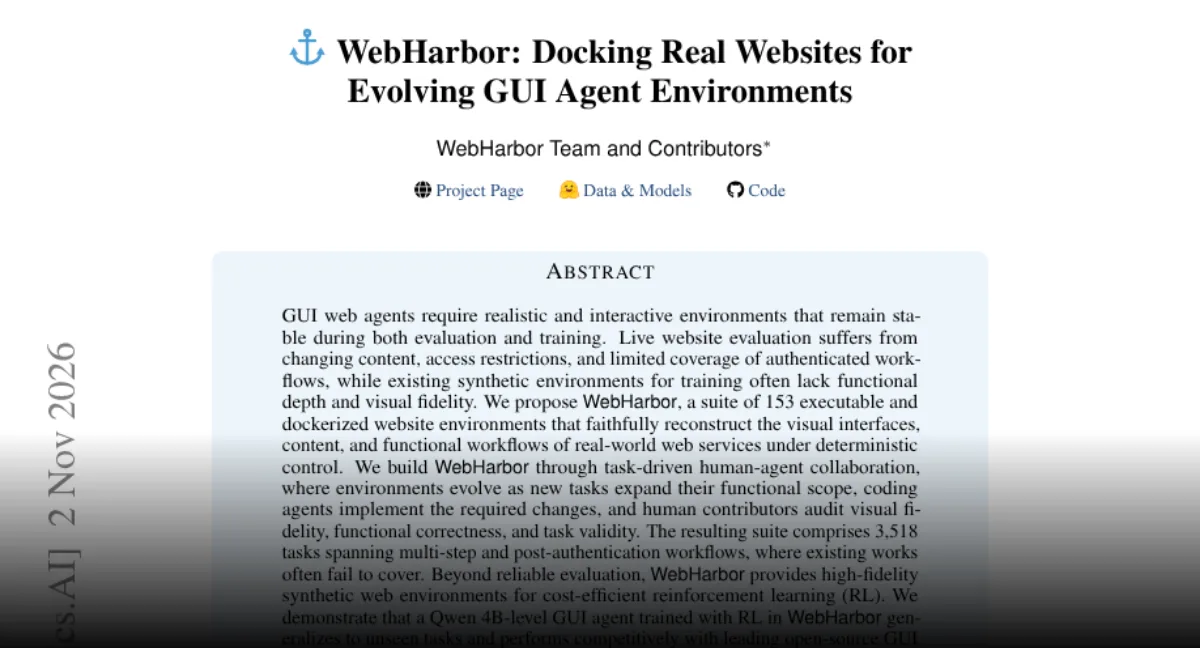
WebHarbor introduces 153 dockerized web environments and 3,518 tasks for evaluating and training graphical user interface web agents. It addresses live-web instability by providing controlled sites, workflows, verifiers, and fast resets. WebHarbor-4B, trained with reinforcement learning only in these environments, reaches 75.8 average on WebVoyager and Online-Mind2Web, showing transfer to excluded live-web benchmarks.
Key Takeaways
- WebHarbor provides 153 dockerized website environments and 3,518 tasks to create a stable, executable benchmark for training and evaluating GUI-based web agents.
- It addresses the instability of live-web testing, where failures may result from bot detection, outdated pages, or website changes rather than agent capability.
- The environments reconstruct real websites with high visual and functional fidelity, including complex post-authentication workflows, and support verifier-based grading and fast resets for reinforcement learning.
- WebHarbor-4B, trained only in these simulated environments, reaches a 75.8 average on WebVoyager and Online-Mind2Web, showing strong transfer to live-web benchmarks despite excluding WebVoyager sites during training.
Meta description: WebHarbor introduces 153 dockerized web environments and 3,518 tasks for graphical user interface web agents, while WebHarbor-4B reaches 75.8 average.
Tags: WebHarbor, web agents, dockerized environments, reinforcement learning, benchmark
Featured image: abstract technology style, no real people, no company logos, no text.
WebHarbor is a suite of 153 executable, dockerized website environments and 3,518 tasks for evaluating and training web agents that operate graphical user interfaces. The release addresses a practical weakness in live-web testing: when agents interact with real websites, benchmark results can depend on unstable conditions rather than agent capability. By packaging reconstructed sites in containers and pairing them with tasks, WebHarbor creates a controlled setting for both measurement and training.
Background: Live-Web Evaluation Becomes Unstable
The source describes live-web evaluation as unstable. In reported runs, about 38% of Online-Mind2Web tasks were blocked by bot detection, while 22% of WebVoyager tasks were outdated. Those failures make it hard to tell whether an agent improved because it learned a workflow or because the external website changed, rejected the browser, or removed a page.
This instability matters because web agents are expected to perform multi-step actions in browser interfaces, not only answer text-based questions. The stated concern is that live-web results can reflect temporary access conditions, while a stable environment can isolate the agent’s planning, perception, and state-changing behavior.
Development: 153 Environments Built Over Five Months
WebHarbor was built through a task-driven collaboration between coding agents and human reviewers. Coding agents implemented each site, while human reviewers audited visual fidelity, functional correctness, and task validity. In total, 57 contributors from 26 affiliations completed the suite in five months.
The environments average 37.3 pages and 1,319.9 images, figures described as the most of any compared suite. Each site reconstructs the visual interface, content, and workflows of a real web service. The goal is to preserve the structure a human user would encounter, while making the environment executable, resettable, and usable for evaluation and training.
The 3,518 tasks focus on workflows that live-web benchmarks largely lack, including post-authentication flows such as accounts, bookings, and transactions. These tasks are graded by verifiers that check the final answer and the state changes produced by the agent. The design also includes fast resets for reinforcement learning, allowing agents to try again after completing or failing a task.
Latest Results: WebHarbor-4B Raises Scores Without Live-Web Training
The reported model is WebHarbor-4B, trained with reinforcement learning only inside WebHarbor. It reaches a 75.8 average on WebVoyager and Online-Mind2Web. That is 5.2 points above the live-web-trained OpenWebRL-4B and 22.2 points above the shared supervised fine-tuning checkpoint.
A key detail is that all 15 WebVoyager websites were excluded from training. The result therefore suggests that an agent trained in reconstructed environments can transfer to a separate live-web benchmark set. It also positions WebHarbor as both a training substrate and an evaluation harness: the same suite provides the websites, tasks, verifiers, and reset mechanism needed for reinforcement learning.
The current stage is a research release phase. The materials cover environments, tasks, model weights, code, and related resources. The next point to watch is how widely the suite is adopted for training and evaluating web agents, and whether its multi-step, post-authentication workflows and verifier-based grading become a standard reference for future benchmark work.
Comments
No comments yet. Be the first to comment.