
Youtu-Parsing-Omni unifies all modalities using one encoder and one schema.
It unifies image, audio, and video parsing into structured output, with strong benchmarks and simple deployment.
Key Takeaways
- Youtu-Parsing-Omni is a compact 5B model that unifies image, audio, and audio-visual video parsing using a single omni encoder and one structured schema.
- It handles seven parsing families, including documents, natural images, charts, flowcharts, geometry figures, audio, and video, while outputting a JSON envelope that combines perception and cognition.
- The model extracts structured elements such as bounding boxes, reading order, LaTeX/OTSL tables, Markdown charts, Mermaid flowcharts, timestamps, speaker labels, and semantic descriptions in one inference step.
- It delivers strong benchmark results, including 96.96 on OmniDocBench v1.6 and 75.08 on OmniParsingBench, ranking as the best open-weight model behind Gemini-3-Pro.
- Deployment is simplified through a dedicated vLLM plugin with pinned serving settings, predefined task prompts, and inference examples, reducing the need for multiple specialized models.
Background: The Need for Compact Multi-Modal Parsing
Recent advances in large language models have highlighted a gap between raw perception and structured understanding. While many models excel at generating text from images or audio, few can simultaneously parse complex layouts, extract precise coordinates, and generate coherent narratives within a single inference step. Youtu-Parsing-Omni addresses this by introducing a compact 5B model designed to handle seven distinct parsing families through a unified schema.
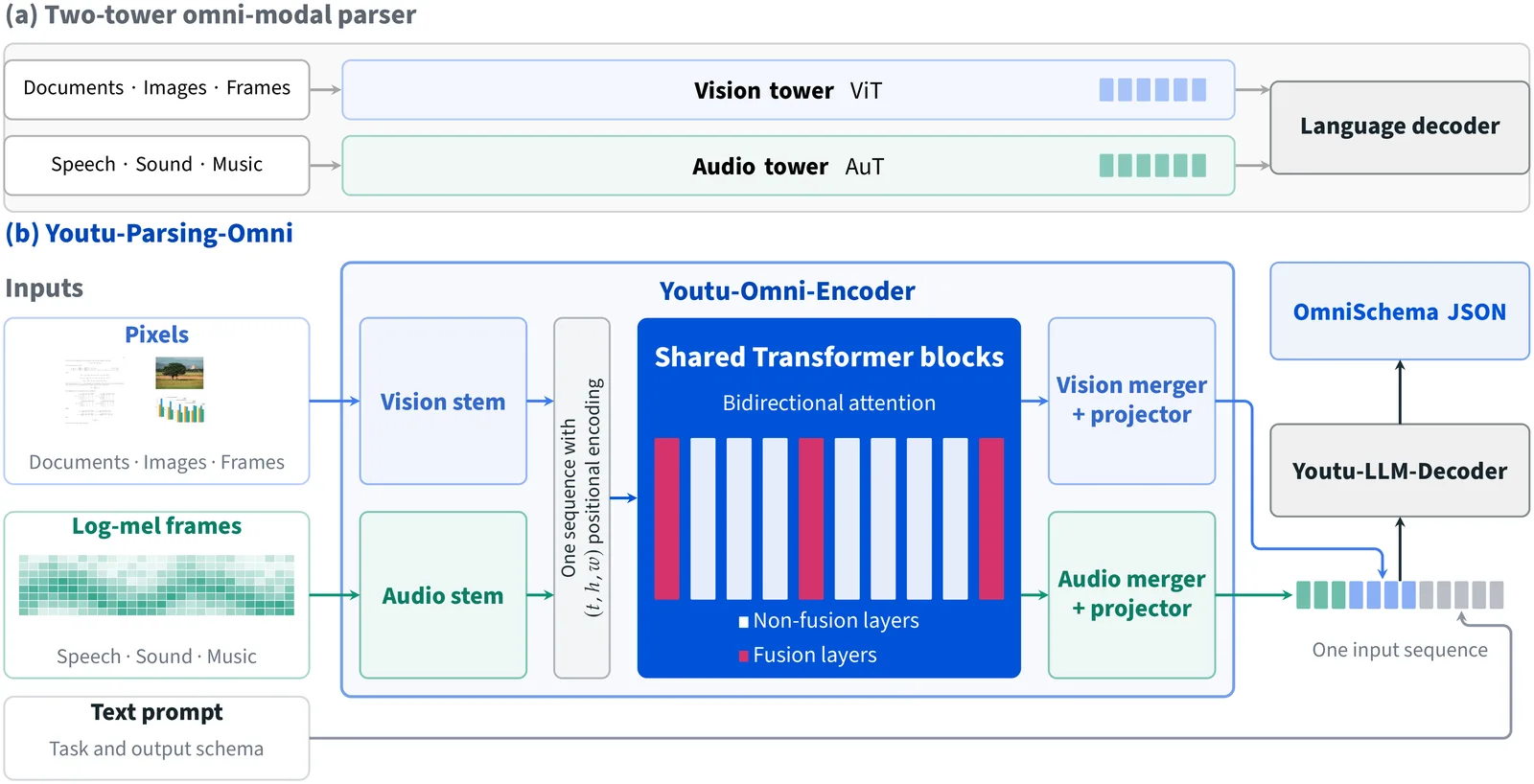
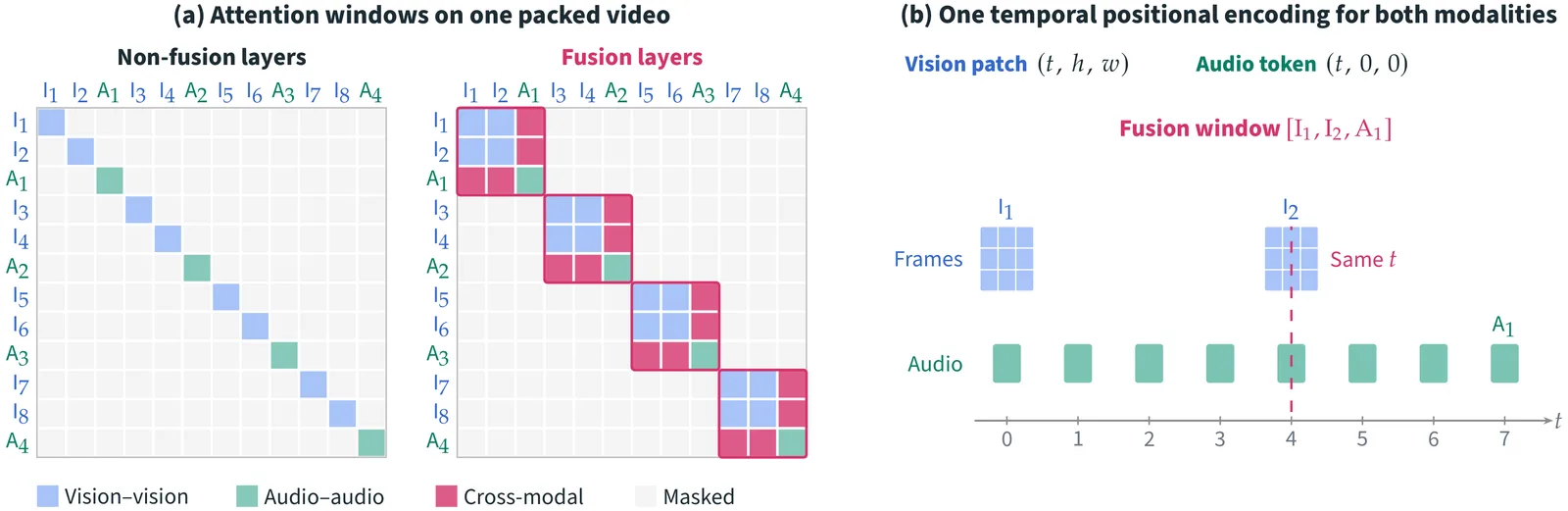
The core innovation lies in its "omni encoder," which accepts image, audio, and interleaved audio-visual video inputs—combining frames with audio tracks—in a single architecture. This allows the model to process a document page, a natural image, a chart, a flowchart, a geometry figure, an audio clip, or a text-rich video as one coherent input stream. The output is always a structured JSON envelope that bridges perception (layout elements, bounding boxes, timestamps) and cognition (captions, narratives, reports).
Development Process: Unified Schema and Task-Specific Inputs
The model operates by switching between specific task prompts to determine the modality and subtype of the input. For document pages, it identifies layout elements with bounding boxes, extracts text in LaTeX or OTSL formats for tables, and generates Markdown charts or Mermaid flowcharts while preserving reading order. For natural images, the model detects entities and text with bounding boxes, assigns tags, and provides global descriptions alongside captions.
When processing charts, Youtu-Parsing-Omni isolates single chart elements into Markdown tables with associated notes and captions. Similarly, for flowcharts, it converts visual structures into Mermaid code with descriptive captions. Geometry figures are parsed by identifying points, lines, arcs, shapes, and geometric relations with precise measurements. Audio inputs are segmented into vocal and non-vocal parts with timestamps, speaker identification, ASR results, and acoustic event descriptions.
Video processing is split into two categories. Natural videos are analyzed for temporal segments containing visual elements, actions, interactions, camera motion, and audio tracks. Text-rich videos combine OCR and ASR outputs to generate a Markdown structured report of the entire video content. This comprehensive coverage ensures that both the spatial structure and the semantic meaning of diverse media types are captured in one pass.
Current Status: Benchmark Performance and Deployment Ease
Youtu-Parsing-Omni demonstrates strong performance despite its small size. It achieves state-of-the-art results on OmniDocBench v1.6 with an overall score of 96.96. On OmniParsingBench, it ranks as the best open-weight model with an average score of 75.08, trailing only Gemini-3-Pro. The model also remains competitive with specialized tools in niche domains, such as chemical structure recognition (ChemOCR) and music score recognition (PDMX-Synth).
Deployment is streamlined through a dedicated vLLM plugin, which includes pinned serving settings, predefined task prompts, and inference examples. This reduces the complexity of integrating an omni-modal model into existing pipelines. By consolidating perception and cognition tasks into a single JSON output format, Youtu-Parsing-Omni simplifies the workflow for developers who need structured data extraction from varied media sources without managing multiple specialized models.
Comments
No comments yet. Be the first to comment.