
Axion 1.0 Simplifies Open Agent Foundation Models
ByteDance introduces Axion 1.0, open agent foundation models trained through a compact recipe of two supervised fine-tuning stages followed by reinforcement learning for tool use. Using about 18,000 examples, the 35B and 122B models report competitive results across six evaluations, and the 35B checkpoint is released under Apache 2.0 with code, data, paper, and project links.
Key Takeaways
- Axion 1.0 introduces a simplified open agent foundation model recipe for scientific reasoning and tool use, built from two supervised fine-tuning stages and one reinforcement-learning stage.
- The public training setup uses about 18,000 examples, with 35B and 122B variants reported across six evaluation settings including HLE, BioMysteryBench, SEAL-0, HiPhO, and FrontierScience splits.
- The 35B reproduction checkpoint lists competitive scores such as 52.8 on HLE, 60.4 on SEAL-0, and 85.0 on FrontierScience Olympiad.
- The 35B checkpoint is released under Apache 2.0, supported by links to the paper, code, training data, project site, and Hugging Face model for reproducible evaluation.
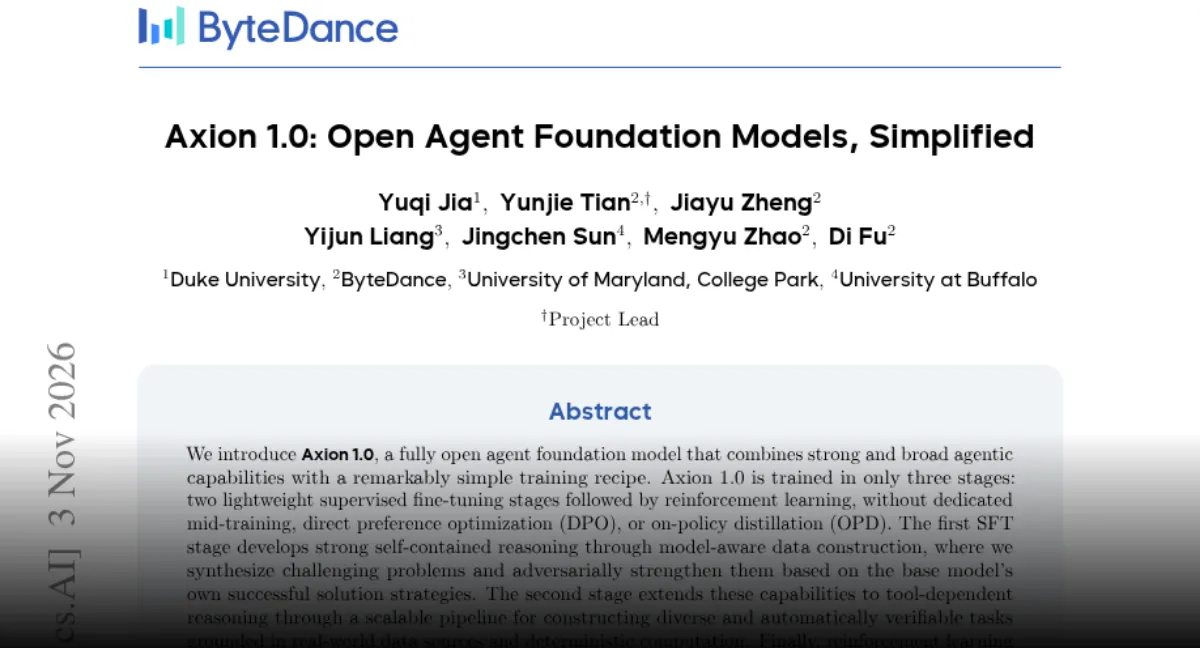
ByteDance Axion 1.0 open agent foundation models are introduced as a simplified way to train models for scientific reasoning and tool use. The project describes the release as open agent foundation models made simpler. It presents the result as achievable through a compact post-training sequence, and the 35B reproduction checkpoint is now available under Apache 2.0. The headline claim is simplicity: a short training path is paired with public evaluation results and open checkpoint access.
Background: A Simpler Route for Agent Work
Axion 1.0 targets agent models that reason through scientific problems and use tools to investigate them. The recipe is presented as lightweight. It starts with two supervised fine-tuning stages and then moves to reinforcement learning. The first stage focuses on reasoning by constructing hard, self-contained scientific problems in a model-aware way. The second stage focuses on investigation through checkable tasks that require information retrieval and tool use. The final stage is interaction-based, applying reinforcement learning to sequences of agent actions. This staged design gives each part of the agent task a distinct training focus before the interaction phase begins.
Development: 18,000 Examples and Six Evaluation Settings
The public summary reports approximately 18,000 supervised fine-tuning examples as the training-data scale. That scale is the numeric anchor of the recipe. With that setup, Axion 1.0-35B and 122B are said to reach competitive results across six evaluation settings: HLE, BioMysteryBench, SEAL-0, HiPhO, and the Olympiad and Research splits of FrontierScience. The detailed score table is provided for the 35B reproduction checkpoint. It lists 52.8 on HLE, 35.3 on BioMysteryBench, 60.4 on SEAL-0, 45.9 on HiPhO, 85.0 on FrontierScience Olympiad, and 55.0 on FrontierScience Research. Those numbers place the release in a benchmark-driven stage, where the model is judged against the named evaluation settings.
Latest: Checkpoint, Code, Data, and Paper Are Listed
The Apache 2.0 license is the stated release term for the 35B reproduction checkpoint. The project also lists supporting artifacts: a paper at arxiv.org (https://arxiv.org/abs/2611.03233), a project site (https://axion1-0.github.io/), code under bytedance on GitHub (https://github.com/bytedance/axion1_0), training data at Hugging Face (https://huggingface.co/datasets/Axion1-0/axion-training-data), and the 35B model at Hugging Face (https://huggingface.co/Axion1-0/Axion-1.0-35B). This combination moves Axion 1.0 from a model announcement to a reproducible release path: the checkpoint, training data, code, and project links are all referenced, while the 122B variant remains described as part of the reported competitive result set. The project site, paper, code, data, and model links are the public reference points attached to the release.
For readers, the timeline shows a clear progression from a compact training recipe to benchmark reporting and then to artifact release. The key numeric markers are the approximately 18,000-example training scale, the 35B checkpoint size, the six evaluation settings, and the six benchmark scores listed for the 35B reproduction checkpoint. The release path is therefore best read as a staged public report: method, benchmark table, then checkpoint and repository links.
Meta description: Axion 1.0 uses supervised fine-tuning and reinforcement learning; 35B Apache 2.0 checkpoint reports 52.8 on HLE and 85.0 on FrontierScience Olympiad.
Tags: Axion 1.0, open agent models, scientific reasoning, reinforcement learning, HLE
Featured image: abstract technology style neural network pathways over a scientific workspace, no real people, no company logos, no text
Comments
No comments yet. Be the first to comment.