
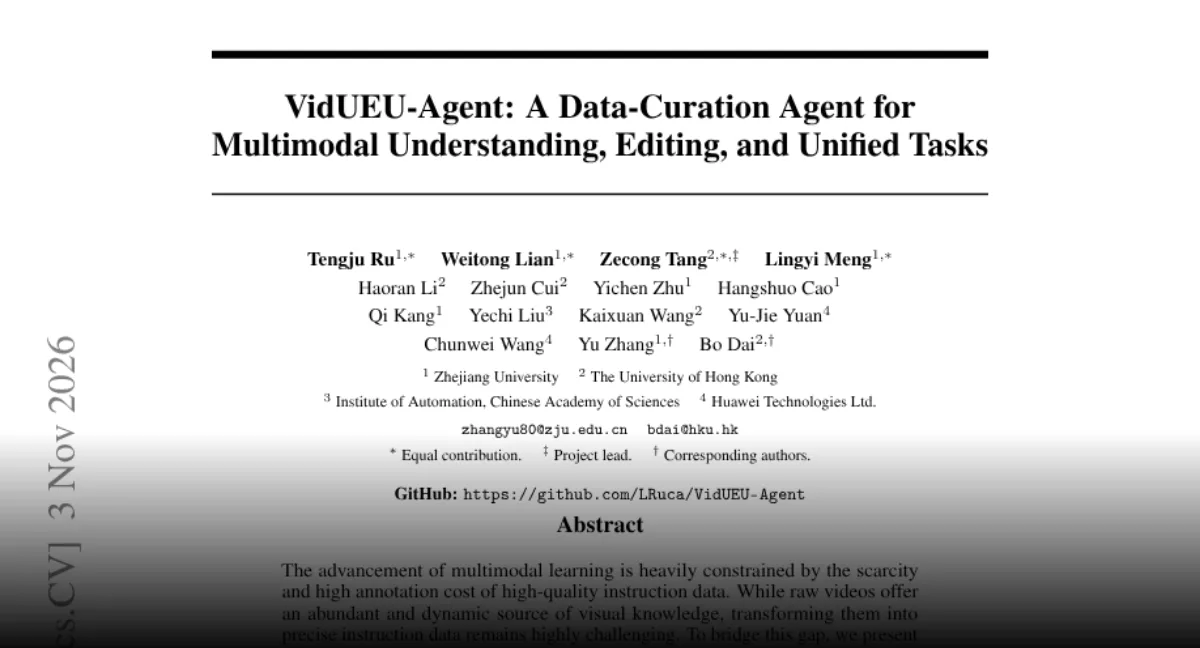
VidUEU-Agent is a data-curation agent for multimodal understanding, editing, and unified tasks.
VidUEU-Agent is an agentic data-curation framework that converts raw videos into structured, evidence-grounded instruction data for multimodal models. It uses global perception, keyframe mining, metadata construction, and task routing to generate understanding, editing, and unified examples. The pipeline produced VidUEU-100K, containing 100,000 samples from 8,268 videos. A feedback loop using downstream training results helps refine data distributions, while the released code, dataset, and paper support reproducible development of unified multimodal systems.
Key Takeaways
- VidUEU-Agent is an agentic data-curation framework that automatically turns raw videos into instruction data for multimodal understanding, image editing, and unified understanding-and-generation tasks.
- It uses a four-stage pipeline: global perception, keyframe and multimodal signal mining, structured metadata construction, and task routing, with evidence-grounded synthesis to improve traceability and factual consistency.
- The framework closes a feedback loop by using downstream training and evaluation results to refine data distribution; in experiments, four iterations improved performance on feedback benchmarks.
- The pipeline produces VidUEU-100K, a dataset built from 8,268 videos with 100,000 instruction samples, including 40,000 understanding, 30,000 editing, and 30,000 unified examples.
- The released paper, code, and dataset provide a reproducible foundation for scalable development of unified multimodal models.
Meta Description
VidUEU-Agent builds instruction data from raw videos, producing VidUEU-100K with 100,000 samples for understanding, editing, and unified tasks.
Tags
VidUEU-Agent, multimodal data, video curation, VidUEU-100K, BAGEL
Featured Image
Abstract split-screen of raw video frames becoming evidence-linked instruction cards, with no real people, no company logos, and no text.
Background: The Bottleneck Behind Video-Based Training Data
VidUEU-Agent is an agentic data-curation framework that constructs instruction data from raw videos for multimodal understanding, image editing, and unified understanding-and-generation tasks. The work matters because the scarcity and high annotation cost of high-quality multimodal instruction data remain major bottlenecks for model development. Raw videos contain rich visual knowledge and temporal information, but converting that material into accurate, verifiable, and task-oriented instruction examples is difficult.
The framework is built to address that gap automatically. Instead of treating video clips as isolated media, it turns them into structured training inputs. The goal is to reduce annotation pressure while preserving task relevance. Its target is to support three task families: understanding, editing, and unified understanding-and-generation.
Development: From Raw Shots To Routed Metadata
The process is organized as a four-stage data construction pipeline. In the first stage, VidUEU-Agent performs global perception to analyze video structure and filter low-quality shots. The second stage mines informative keyframes and multimodal signals from the remaining content. The third stage constructs structured metadata, and the fourth stage routes each metadata entry to suitable task types for instruction synthesis.
This routing step separates understanding-oriented, editing-oriented, and unified-oriented examples, so the same source material can support different model capabilities. Agent planning, tool use, and multi-stage quality control support the entire workflow. For data synthesis, the framework combines vision-language models with visual tools. These tools are used for quality assessment, semantic analysis, and information verification. During instruction synthesis, the model cites the evidence signals it uses. That evidence-grounded design improves data traceability and factual consistency, making the generated examples more auditable than unverified instruction sets.
Latest Progress: Feedback Loops And VidUEU-100K
VidUEU-Agent also closes a loop with downstream training and evaluation results. It uses those results to identify weaknesses and refine data distributions across capabilities, domains, and task types. The feedback loop is meant to adjust the data mix, not simply generate more examples.
In the reported experiment, the framework went through four iterations. Each iteration used 30,000 samples to fine-tune BAGEL from the same initial checkpoint. By starting from the same checkpoint, the setup compares rounds under a common baseline. Across the four rounds, performance improved overall on three feedback benchmarks.
The pipeline produced VidUEU-100K, a dataset constructed from 8,268 diverse videos. VidUEU-100K contains nearly 20,000 dense metadata annotations and 100,000 instruction samples. The samples are divided into 40,000 understanding examples, 30,000 editing examples, and 30,000 unified examples. The dataset spans nine task paradigms and five scenario categories.
The project is documented through the arXiv paper at https://arxiv.org/abs/2611.04418, the code at https://github.com/LRuca/VidUEU-Agent, and the dataset at https://huggingface.co/datasets/Lruca/VidUEU100k.
Current Stage: A Reproducible Starting Point
The work presents VidUEU-Agent and VidUEU-100K as a scalable and reproducible foundation for developing unified multimodal models. The central result is a transformation path: raw videos become diverse, evidence-grounded instruction data through agent planning, tool augmentation, and training-feedback-driven refinement. The available resources make the method inspectable and the dataset reusable.
The project now sits at the point where the pipeline, the dataset, and the code are available for further multimodal model development.
Comments
No comments yet. Be the first to comment.