
Think carefully before accepting the Metis-1.6 technical report.
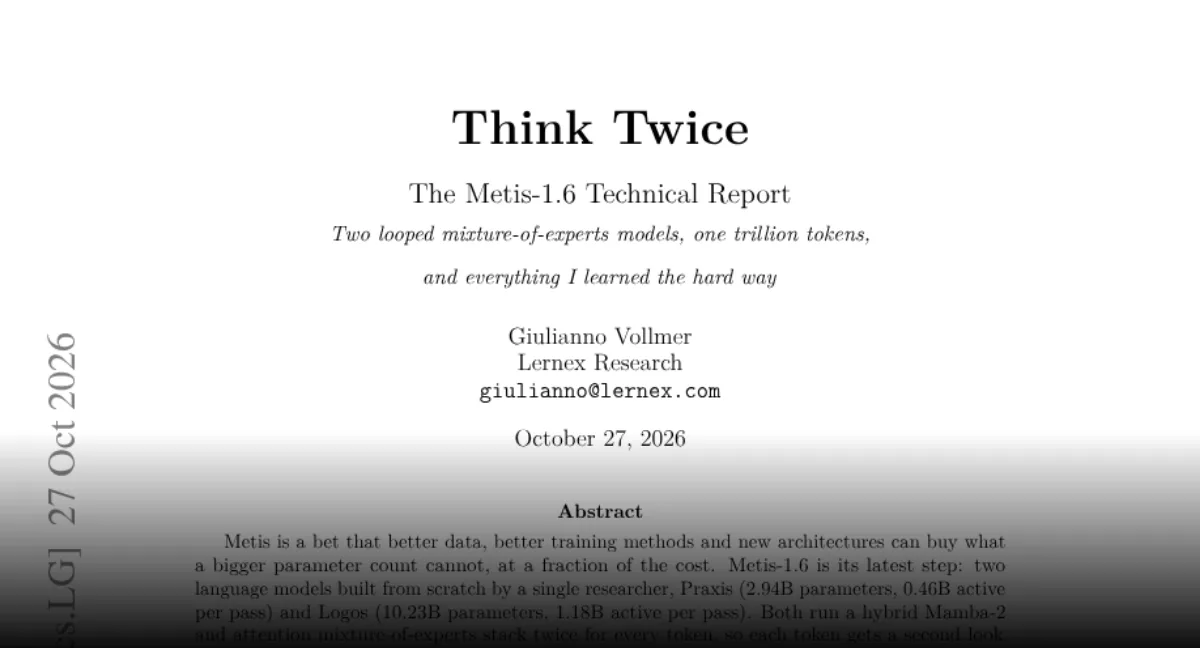
Metis-1.6 offers Logos and Praxis, shared-layer reasoning models trained from scratch, with strong math results, Apache 2.0 weights, and Dromos.
Key Takeaways
- Metis-1.6 includes two reasoning models trained from scratch: Logos with 10.23 billion parameters and Praxis with 2.94 billion parameters.
- Both models reuse the same 20 layers twice per token, relying mostly on Mamba-2 blocks with only 3 attention layers and no positional encoding.
- Trained on 1.02 trillion tokens, Logos performs strongly on math benchmarks but is weaker in code, instruction following, long context, and factual recall.
- The final release removed a learned hashed n-gram memory and stopped at supervised fine-tuning because reinforcement learning reduced breadth.
- Weights are released under Apache 2.0 in MLX, FP8, NVFP4, and GGUF formats, with Dromos as the custom inference engine.
Meta description: Metis-1.6 is two reasoning models trained from scratch. Logos uses 10.23 billion parameters, Praxis uses 2.94 billion, both share 20 layers twice with Apache 2.0.
Tags: Metis-1.6, reasoning models, Mamba-2, Pareto frontier, Apache 2.0
Featured image: Abstract technology style with repeated model layers branching into two paths, no real people, no company logos, no text.
Background: A shared-layer design before training
A post from the model author describes Metis-1.6 as two reasoning models trained from scratch. The central design is weight reuse: every token runs through the same 20 layers twice, with the same weights. That structure means the model does not add new layer weights on the second pass; it reuses the first set, so the same layer stack carries the main computation for each token.
The two models differ in size and deployment target. Logos has 10.23 billion parameters and uses 2.36 billion per token. Praxis has 2.94 billion parameters and fits in 2 GB at 4-bit precision. Both are mostly Mamba-2, with attention in only 3 layers and no positional encoding. In a shared-layer stack, those 3 attention layers are a small part of the 20-layer path, while the rest of the computation is carried by the Mamba-2-style blocks.
Development: Training on 1.02 trillion tokens
The author reports training on 1.02 trillion tokens. In that setting, Logos ranks 2nd of 30 open models in math. The reported scores are 67.5% on AIME 2025 and 63.6% on HMMT February 2026. The post also places Logos on the Pareto frontier for both training data and compute, a description of the trade-off between tokens used and compute spent.
The reported results are not uniformly strong. Logos trails in code, instruction following, long context and factual recall. The paper includes those lower results as well.
Two unexpected findings shaped the final 1.6 release. The models learned to close the gates on a 1.77 billion-parameter hashed n-gram memory, so the author removed that memory component. Separately, reinforcement learning on Logos cost breadth. For that reason, Metis-1.6 stops at supervised fine-tuning instead of continuing through reinforcement learning.
Latest release: Apache 2.0 weights and Dromos
The weights are available under Apache 2.0. The release includes MLX, FP8, NVFP4 and GGUF builds. Dromos is the inference engine the author wrote for these models.
At this stage, Metis-1.6 is a completed model pair rather than an ongoing training log. The author presents the shared-layer architecture, the training scale, the math benchmark positions, the weaker areas, the removed memory, the supervised fine-tuning endpoint, the open license, the build formats and the custom inference engine as the current package around Logos and Praxis.
Comments
No comments yet. Be the first to comment.