
Should Compact Encoders for Closed-Set Decisions Use Joint or Per-Option Designs for 17 Million to 1 Billion Parameters?
Compact joint encoders from 17 million to 1 billion beat DeBERTa-v3, run fast on CPUs, and show per-option scoring adds cost and order limits.
Key Takeaways
- Crivo released six open joint decision encoders (17M–1B) for closed-set choices, with the 68M and 150M models beating a 435M DeBERTa-v3 zero-shot classifier on 209 tasks by 4.9 and 5.9 accuracy points.
- The 17M encoder is built for fast, low-cost serving, answering a median request in 14 ms on 16 CPU threads, while remaining competitive on 145 unseen tasks.
- Per-option scoring can outperform joint scoring, but only when initialized from a reranker and at 5–13× higher encoder-pass cost, so the released models use joint scoring for efficiency.
- A key production caveat is option-order sensitivity: reordering the candidate options changes 12–23% of the joint models’ answers, showing that small closed-set decoders still face design limits.
Crivo Releases 17M to 1B Joint Decision Encoders That Beat 435M DeBERTa-v3
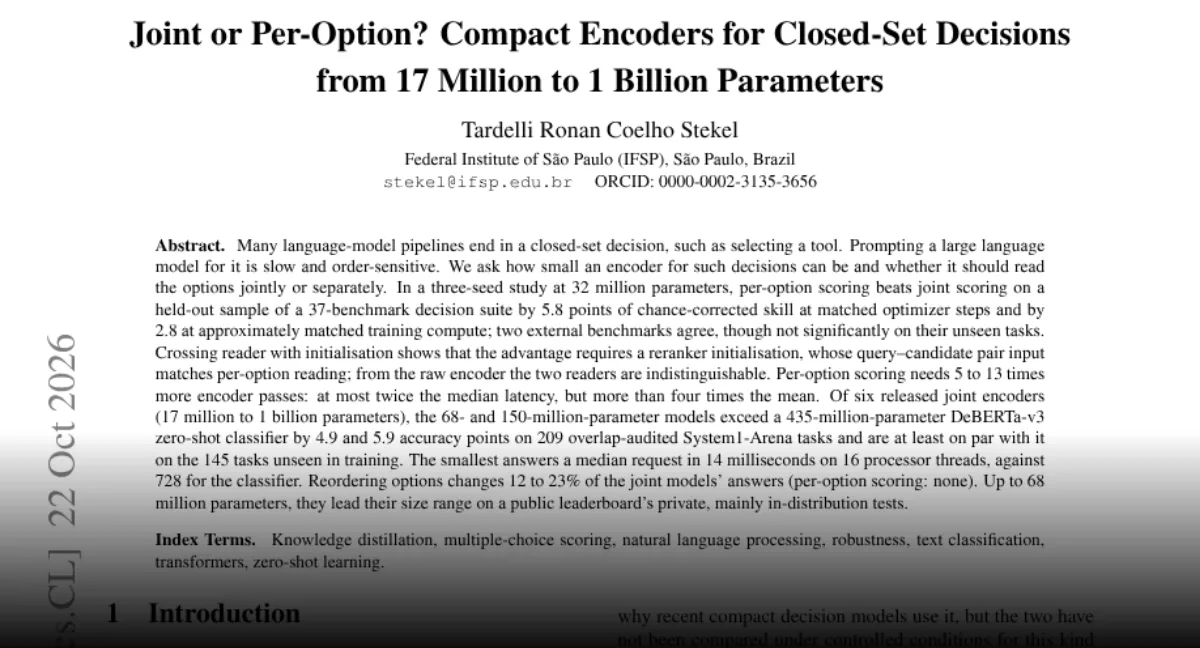
Meta description: Crivo joint encoders range from 17M to 1B, beat 435M DeBERTa-v3 on 209 tasks, answer in 14 ms on 16 CPU threads, and stay competitive on 145 unseen tasks.
Tags: Crivo decision encoders, joint vs per-option scoring, small language model encoders, DeBERTa-v3 comparison, open model latency
Featured image: Abstract technology style with routing nodes and option cards, no real people, no company logos, no text.
Crivo decision encoders include 68M and 150M open joint models that beat a 435M DeBERTa-v3 zero-shot classifier on 209 overlap-audited System1-Arena tasks, while a three-seed study shows per-option scoring can be stronger at higher cost.
Background: Closed-Set Choices Need Small Decoders
Many language model pipelines end in a closed-set decision: pick a tool, assign a label, or choose a route. Crivo decision encoders are built for that final step, where a small model compares a prompt with a short list of allowed options.
The design question has two parts. First, how small can the encoder be while still giving useful accuracy? Second, should the encoder read all options together, or score each option one at a time? A joint reader sees the options as one batch. A per-option reader scores each option separately. The difference changes both model quality and serving cost.
Development: Per-Option Wins Only After Reranker Initialisation
The study tested the two reading patterns in a three-seed experiment with 32M parameters. At matched optimizer steps, per-option scoring won by 5.8 points of chance-corrected skill, a score adjusted for random guessing. At roughly matched compute, the gap narrowed to 2.8 points.
The result was conditional. The per-option advantage appeared when the reader was initialized from a reranker. From the raw encoder, the joint reader and per-option reader were indistinguishable. That means the gain was not a simple property of per-option scoring alone; it depended on what the starting model had already learned.
Cost decided the release. Per-option scoring needed 5–13× more encoder passes, so the published models use joint scoring. This makes the released system cheaper to run, but it leaves the stronger per-option pattern outside the public set.
Latest Progress: Six Open Joint Encoders From 17M to 1B
The release includes six open joint encoders ranging from 17M to 1B parameters. On 209 overlap-audited System1-Arena tasks, the 68M and 150M models beat a 435M DeBERTa-v3 zero-shot classifier by 4.9 and 5.9 accuracy points. On the 145 tasks unseen in training, they are at least on par with that classifier.
The smallest model is aimed at fast serving. The 17M encoder answers a median request in 14 ms on 16 CPU threads.
One measured caveat matters for production use: reordering the options changes 12–23% of the joint models' answers. A joint encoder can be fast, but it is still sensitive to the way the candidate list is presented.
Models: https://huggingface.co/collections/tardellirs/crivo-6acaa1731d71f839970f04a6
Code and results: https://github.com/tardellirs/crivo-decision-encoders
Current Stage: Cheap Joint Scoring, Unreleased Per-Option Advantage
Crivo is currently a set of open joint encoders rather than a complete benchmark winner for every decision pattern. The study shows that per-option scoring can be stronger, but only after a reranker initialisation and with much higher encoder-pass cost. For readers, the practical takeaway is that small closed-set decoders can be competitive, yet option order and reading pattern remain active design limits.
Comments
No comments yet. Be the first to comment.