
FrameForge leverages priors from video foundation models to enable unified image generation.
FrameForge repurposes video models with adaptive temporal relations, using MoTE and CoTR for subject, edge, and editing image generation benchmarks.
Key Takeaways
- FrameForge reuses pretrained video foundation models for unified conditional image generation by treating condition-to-target relations as adaptive temporal transformations rather than fixed temporal slots.
- Its core components are MoTE and CoTR: MoTE dynamically selects temporal RoPE experts to adapt virtual temporal distance, while CoTR uses a latent intermediate state and reasoning-bottleneck attention to model the transformation path.
- The method covers subject-driven generation, canny-to-image generation, and image editing, aiming to preserve subject identity, follow edge guidance, and edit images under textual instructions.
- Reported evaluations on DreamBench, COCO2017, and GEdit-Bench show superior performance among compared methods, though the evidence emphasizes method design and benchmark outcomes over detailed numerical results.
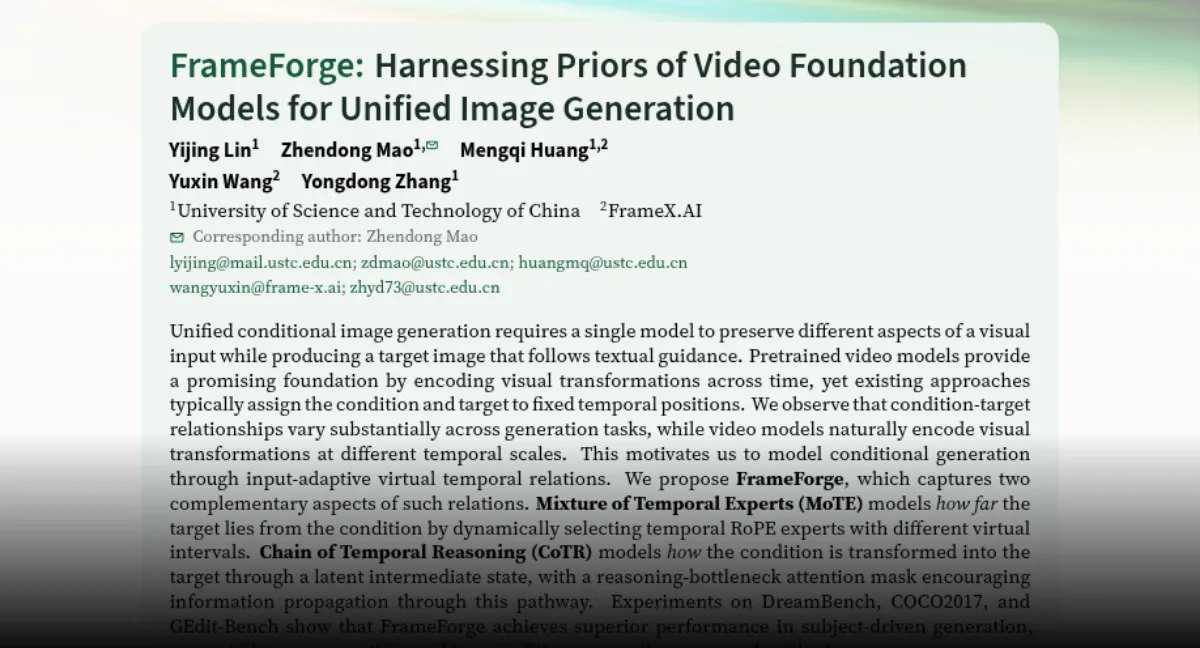
Unified conditional image generation asks a single model to preserve selected aspects of a visual input while producing a target image guided by text. FrameForge addresses this by treating pretrained video models as a foundation for adaptive temporal relations rather than fixed slots for condition and target. Its reported results on DreamBench, COCO2017 and GEdit-Bench cover subject-driven generation, canny-to-image generation and image editing.
Background: Video Models Offer a Temporal Starting Point
Pretrained video models encode visual transformations across time, which makes them useful for tasks that need to understand how one visual state changes into another. However, earlier approaches commonly place the condition and the target at fixed temporal positions. That design can be limiting because the distance and relationship between condition and target vary across generation tasks.
The observation behind FrameForge is that video models already represent transformations at different temporal scales. Instead of forcing every task into the same fixed timeline, the method models conditional generation through input-adaptive virtual temporal relations. This reframes the problem as choosing an appropriate virtual temporal distance and path for each input.
Development: MoTE and CoTR Create Two Complementary Paths
FrameForge captures two complementary aspects of adaptive temporal relations. The first, Mixture of Temporal Experts, or MoTE, models how far the target lies from the condition. It dynamically selects temporal RoPE experts with different virtual intervals, allowing the model to adjust the temporal gap implied by each task.
The second component, Chain of Temporal Reasoning, or CoTR, models how the condition is transformed into the target. It uses a latent intermediate state and a reasoning-bottleneck attention mask that encourages information to propagate through that pathway. Together, MoTE and CoTR separate the question of temporal distance from the question of transformation route.
Latest Progress: Benchmarks Cover Subject, Edge and Editing Tasks
Experiments on DreamBench, COCO2017 and GEdit-Bench show that FrameForge achieves superior performance in subject-driven generation, canny-to-image generation and image editing among the compared methods. The benchmark set matches the three capabilities the model targets: preserving subject identity, converting canny edge guidance into an image, and editing an existing visual input under textual guidance.
At present, FrameForge stands as a method that repurposes video-model temporal structure for conditional image generation, with the current evidence centered on method design and reported benchmark results rather than additional numerical performance details.
Meta description: FrameForge uses video models and adaptive temporal relations for unified conditional image generation, with DreamBench, COCO2017 and GEdit-Bench tests.
Tags: FrameForge, unified conditional image generation, video models, MoTE, CoTR
Featured image: Abstract blue temporal network connecting visual frames and a generated target, with no people, logos or text.
Comments
No comments yet. Be the first to comment.